
Bluntnose Sixgill Shark
Play the Bluntnose Sixgill Shark free
Hexanchus griseus
Bluntnose Sixgill Shark (Hexanchus griseus): Six Gills, Green Eyes, Deep Sea
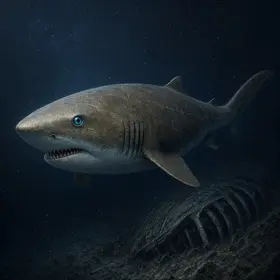
The bluntnose sixgill shark (Hexanchus griseus) is a huge, slow-moving deep-sea shark with six gill slits instead of the usual five. It lives on continental slopes worldwide, rises towards the surface at night to feed, and is listed as Near Threatened by the IUCN.
- Habitat
- Outer continental shelves, upper slopes and seamounts, mostly 200 to 1,100 m (660 to 3,600 ft) deep
- Size
- Up to about 5.5 m (18 ft); heaviest published weight 590 kg (1,300 lb)
- Diet
- Fish, rays, other sharks, squid, crabs, seals and carrion such as whale carcasses
- Range
- Tropical and temperate seas worldwide, from about 65°N to 48°S
- Breeding
- Live young; litters of 22 to 108 pups, each 60 to 75 cm (24 to 30 in) long
- Status
- Near Threatened (IUCN, 2020)
Habitat & range
The bluntnose sixgill shark lives in tropical, temperate and boreal seas around the world, in the Atlantic, Indian and Pacific oceans and the Mediterranean (Florida Museum). It mostly stays between 200 and 1,100 m (660 and 3,600 ft) deep over outer continental shelves and upper slopes, and has been recorded from the surface down to about 2,490 m (8,170 ft) (IUCN Red List). Young sharks sometimes come into shallow inshore water, and the Salish Sea around Puget Sound, Washington, is one of the few known places where pups are born (Wikipedia). Bluntnose Sixgill Shark appears as a Pisces creature card in Wilder, a free browser collectible card game.
Diet & hunting
It is a generalist that eats bony fish, hagfish, rays, chimaeras, other sharks, squid, crabs, seals and dolphins, and it readily scavenges carrion (Wikipedia). BBC Blue Planet II filmed a group of sixgills feeding on a whale carcass on the deep sea floor (Wikipedia). Many sixgills make a daily vertical migration: off Oahu, Hawaii, tagged sharks spent the middle of the day around 600 to 700 m (2,000 to 2,300 ft) deep and rose to about 300 m (980 ft) between midnight and 3 a.m. to forage (Comfort and Weng 2015). It is usually sluggish, but its strong tail can power a fast burst after prey (Wikipedia).
Behavior & adaptations
Its body looks a lot like fossil sharks from the Triassic, about 200 million years ago (Florida Museum). It has six long gill slits on each side of the head, where most sharks have five, a single dorsal fin set far back near the tail, a broad blunt snout and fluorescent green eyes (Florida Museum). The lower jaw carries six broad, comb-like, saw-edged teeth on each side, used to saw and tear food (Florida Museum). It is grey, olive or brown above with a paler belly (Florida Museum). Sixgills are slightly buoyant, so they can glide upwards with little effort and may approach prey from below (Wikipedia).
Conservation
The IUCN lists the bluntnose sixgill shark as Near Threatened, close to qualifying as Vulnerable (IUCN Red List). It is estimated to have declined by 20 to 29 percent over three generations, or about 160 years, mostly through bycatch and some targeted fishing in deep-water fisheries (IUCN Red List). Females take 18 to 35 years to mature, which makes it slow to recover (Wikipedia). It is harmless to people unless provoked (Wikipedia).
Fun facts about Bluntnose Sixgill Shark
- Its name comes from its six pairs of gill slits; most sharks have five (Florida Museum).
- Living sixgills have fluorescent green eyes (Florida Museum).
- A single litter can hold more than 100 pups (Wikipedia).
- In 2019 scientists tagged a sixgill in its deep-sea habitat from a submersible for the first time (Wikipedia).
Bluntnose Sixgill Shark vs Tiger Shark
The tiger shark usually wins in shallow water, but in the deep the sixgill is on home ground.
The two rarely meet. The tiger shark hunts mainly in warm, shallower coastal water, while the sixgill spends its days hundreds of metres down and only rises at night (Florida Museum). Both are big scavengers that will eat almost anything, including dead whales (Wikipedia). In a straight fight the tiger shark is faster and more agile, while the sixgill relies on its heavy body and saw-edged lower teeth. Its best defence is simply to sink back into the dark.
Read more about Tiger Shark.
Common questions about Bluntnose Sixgill Shark
Is the bluntnose sixgill shark dangerous to humans?
No, not unless it is provoked. It is a deep-sea shark that rarely meets people and is considered harmless unless provoked (Wikipedia). Young sixgills sometimes come into water as shallow as 12 m (39 ft), but adults usually stay deeper than 100 m (330 ft) (Wikipedia). The bigger risk runs the other way: it is caught as bycatch in deep-water fisheries and listed as Near Threatened (IUCN Red List).
How big does a bluntnose sixgill shark get?
Up to about 5.5 m (18 ft) long. That is the IUCN's figure, and it makes it the largest of the six- and seven-gill sharks (IUCN Red List; Wikipedia). The heaviest published weight is 590 kg (1,300 lb) (Florida Museum). Females grow larger than males and only mature at about 4.5 m (15 ft) (Wikipedia).
Does the bluntnose sixgill shark really have green eyes?
Yes. Living sixgills have fluorescent green eyes (Florida Museum). They look striking in deep-sea camera lights because the shark spends its days in dim water mostly 200 to 1,100 m (660 to 3,600 ft) down (IUCN Red List), and the eyes are one of the easiest ways to recognise it in submersible footage alongside its six gill slits (Florida Museum).
How deep does the bluntnose sixgill shark live?
Mostly 200 to 1,100 m (660 to 3,600 ft) down, with records from the surface to about 2,490 m (8,170 ft) (IUCN Red List). It often moves up at night: tagged sharks off Hawaii spent midday around 600 to 700 m deep and rose to about 300 m (980 ft) after midnight to feed (Comfort and Weng 2015).
Why is it called a sixgill shark?
Because it has six gill slits on each side of its head. Most sharks have five (Florida Museum). It also has just one dorsal fin, set far back near the tail, and a body plan that looks a lot like fossil sharks from about 200 million years ago (Florida Museum). See more sharks like the tiger shark in Wilder.
More Pisces animals
Pisces · Water · Cost 5