
Common Lancehead
Play the Common Lancehead free
Bothrops atrox
Common Lancehead: The Snake Behind Most Amazon Snakebites
The common lancehead (Bothrops atrox) is a pit viper of the Amazon and other tropical lowlands of northern South America east of the Andes. It is common, well camouflaged and often lives close to people, and it is the snake responsible for most snakebites in the Amazon region. Its venom disrupts blood clotting and damages tissue.
- Habitat
- Lowland rainforest, gallery forest, forest edges and plantations, up to about 1,280 m
- Size
- Usually 75 to 125 cm; largest measured female 162 cm
- Diet
- Mostly small mammals as adults; lizards and frogs as juveniles
- Range
- Northern South America east of the Andes: Colombia, Venezuela, the Guianas, Ecuador, Peru, Bolivia, northern Brazil, and Trinidad
- Breeding
- Gives birth to live young, on average about 60 and up to 80 per litter
- Status
- Least Concern (IUCN)
Habitat & range
The common lancehead lives in the tropical lowlands of South America east of the Andes: southeastern Colombia, southern and eastern Venezuela, the Guianas, eastern Ecuador and Peru, northern Bolivia and the northern half of Brazil, plus the island of Trinidad (Wikipedia; IUCN 2021). It uses rainforest, gallery forest, deciduous forest and lower montane wet forest up to at least 1,280 m, and it copes well with disturbed land such as plantations and forest edges (IUCN 2021). Despite large-scale forest loss it is one of the most numerous pit vipers in its range (Wikipedia). Common Lancehead appears as a Reptilia creature card in Wilder, a free browser collectible card game.
Diet & hunting
The common lancehead is mostly nocturnal. At night adults lie coiled on the ground in an ambush posture and wait for prey to come close (Monteiro et al. 2020). Adults eat mostly small mammals such as rodents and opossums, and also birds, while juveniles eat more lizards and frogs (Monteiro et al. 2020; Wikipedia). Young snakes have a pale tail tip that they can wiggle to lure prey (Monteiro et al. 2020). Large prey is struck and released, then tracked down by its scent trail (Wikipedia).
Behavior & adaptations
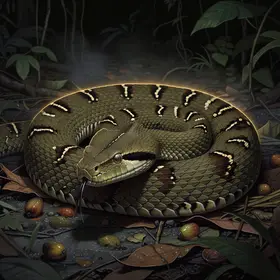
It is a moderately heavy-bodied pit viper with a broad, lance-shaped head, which gives the group its name. The colour is olive, brown, tan or grey, with dark trapezoid blotches edged in pale scales and a dark stripe behind each eye, a pattern that hides it well in leaf litter (Wikipedia). Like other pit vipers it has heat-sensing pits between the eyes and nostrils. It is mainly a ground snake, but it swims well and can climb, and juveniles are often found on low plants up to about 1.5 m (Wikipedia; Monteiro et al. 2020). It gives birth to live young, up to 80 at a time, each about 30 cm long (Wikipedia).
Bite & danger to people
The common lancehead is the South American pit viper responsible for most snakebites in the Amazon region (Monteiro et al. 2020). In Amazonas State, Brazil, snakebites average 52.8 cases per 100,000 people a year, and more than 150 in some municipalities (Feitosa et al. 2015, via Monteiro et al. 2020). Many bites happen to men working outdoors, for example harvesting palm fruit, where rodents attract the snakes, and 85 to 90% of bites are on the legs or feet (Monteiro et al. 2020). The venom stops blood from clotting and damages tissue: in Manaus, 54% of patients arrived with unclottable blood (Monteiro et al. 2020). Antivenom is the effective treatment.
Conservation
The common lancehead is listed as Least Concern by the IUCN because of its wide range, stable population, presence in many protected areas and tolerance of disturbed habitats (IUCN 2021).
Fun facts about Common Lancehead
- The name fer-de-lance is French for spearhead, after the shape of the head (Wikipedia).
- In Peru it is called jergón, and in Ecuador equis, after the X-shaped markings on its back (Wikipedia).
- An enzyme from its venom, batroxobin (reptilase), is used in hospital labs to test blood clotting (Wikipedia).
- It was once thought to include the terciopelo of Central America, which is now treated as a separate species (Wikipedia).
Common Lancehead vs Green Anaconda
The green anaconda usually wins on sheer size and strength, if it avoids the fangs.
Both snakes live in the Amazon basin, the lancehead on the forest floor and the anaconda in swamps, rivers and flooded forest (Wikipedia). The green anaconda is one of the heaviest snakes in the world and kills by constriction, while the lancehead is usually under 1.25 m long (Wikipedia). The lancehead's weapon is its venom, which stops blood from clotting and damages tissue (Monteiro et al. 2020). One well-placed bite could hurt even a big snake, but it would have to land it first.
Read more about Green Anaconda.
Common questions about Common Lancehead
Is the common lancehead the same snake as the fer-de-lance?
Often, but the name is used for more than one snake. Fer-de-lance is a common name for Bothrops atrox east of the Andes, but it is also used for the terciopelo, Bothrops asper, of Central America and the Pacific side of the Andes. The terciopelo was once lumped into B. atrox and is now treated as a separate species (Wikipedia).
How dangerous is a common lancehead bite?
Serious, and it needs antivenom fast. The venom stops blood from clotting and damages tissue, causing pain, swelling, bleeding and sometimes kidney failure or necrosis. In Manaus, 54% of bitten patients arrived with unclottable blood. About 0.6% of snakebites in the Brazilian Amazon are fatal, a higher rate than elsewhere in Brazil (Monteiro et al. 2020).
Why does the common lancehead bite so many people?
It is common, camouflaged and lives where people work. It is the pit viper behind most snakebites in the Amazon. It waits motionless on the ground at night, and palm trees that draw rodents also draw the snakes, so fruit harvesters and farm workers get bitten. Some 85 to 90% of bites are on the legs or feet (Monteiro et al. 2020).
How many babies does a common lancehead have?
Often about 60, and up to 80 at once. It gives birth to live young rather than laying eggs. The babies are about 30 cm long, brighter than the adults, with yellow or beige tail tips (Wikipedia). Young lanceheads can wiggle that pale tail tip to lure frogs and lizards (Monteiro et al. 2020).
Is common lancehead venom used in medicine?
Yes, in blood tests. An enzyme from its venom, batroxobin, sold as reptilase, is used in hospital labs to measure fibrinogen and check how well blood clots. Unlike the usual thrombin test, it still works when the sample contains the blood thinner heparin (Wikipedia; Batroxobin).
More Reptilia animals
Reptilia · Forest · Cost 3