
Terciopelo
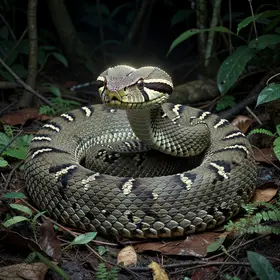
Bothrops asper
Terciopelo: Central America's Most Dangerous Snake
The terciopelo (Bothrops asper) is a large, heavy pit viper of humid lowland forest from Mexico to northern South America. It also lives on farms and near houses, and it causes most snakebites in Central America, including the most serious and most of the fatal ones.
- Habitat
- Humid lowland rainforest and evergreen forest, often near swamps and streams; also farms and plantations
- Size
- Often 1.2 to 1.8 m; large females up to 2.5 m and 6 kg
- Diet
- Frogs and lizards when young; rodents, opossums, birds and other small animals as adults
- Range
- North-eastern Mexico through Central America to Colombia, western Ecuador and Venezuela
- Breeding
- Live young; average litters of about 19 to 41 in Costa Rica
- Status
- Least Concern (IUCN)
Habitat & range
The terciopelo lives from north-eastern Mexico through Guatemala, Belize, Honduras, Nicaragua, Costa Rica and Panama to Colombia, western Ecuador and Venezuela (Reptile Database). It is mainly a lowland snake of tropical rainforest and evergreen forest, and in Costa Rica it strongly prefers areas near swamps (Sasa et al. 2009). It also does well along the agricultural frontier, so it is not rare to find one in or near houses (Sasa et al. 2009). Its name means velvet in Spanish; in Guatemala, Honduras and Nicaragua it is called barba amarilla, yellow beard, after its yellowish chin (Wikipedia). Terciopelo appears as a Reptilia creature card in Wilder, a free browser collectible card game.
Diet & hunting
The terciopelo is a nocturnal sit-and-wait hunter. Radio-tracked snakes in Costa Rica moved only short distances, under 10 m, between a daytime shelter and a night-time ambush spot, with occasional longer trips to new hunting areas (Sasa et al. 2009). Young snakes eat mostly frogs and lizards, while adults add birds, rodents and other small mammals (Sasa et al. 2009). Young terciopelos can wiggle their pale tail tips to lure prey within reach (Wikipedia).
Behavior & adaptations
It has a broad, flat, lance-shaped head, a dark stripe behind each eye, heat-sensing pits between eye and nostril, and 18 to 25 dark, pale-edged triangles along each side that often meet over the back in X shapes (Reptile Database; Wikipedia). Females grow much bigger than males: males reach about 1.6 m and females up to 2.5 m (Reptile Database). It is the most prolific snake in the Americas; in Costa Rica, Pacific litters averaged 18.6 young and Caribbean litters 41.1 (Wikipedia). When cornered it can be fast and defensive, rising into an S-shaped coil (Wikipedia).
Bite & danger to people
Central America has about 5,500 snakebite cases a year, and the terciopelo causes the majority of them, the most severe ones and most of the fatal cases (Gutiérrez 2014). Bites cause pain, swelling, blistering, bleeding and tissue death at the bite site, and in serious cases bleeding, blood-clotting failure, kidney injury and shock (Gutiérrez 2014). Most victims are young farm workers in rural areas (Otero-Patiño 2009; Sasa and Vázquez 2003). Antivenom has cut deaths sharply: Costa Rica recorded 48 snakebite deaths from 1993 to 2006 (Fernández and Gutiérrez 2008), and a 2012 to 2013 review of 475 hospital cases found one death (Sasa and Segura Cano 2020).
Conservation
The terciopelo is listed as Least Concern (IUCN, via GBIF). Despite persecution and habitat change it remains common, and researchers stress learning to live alongside it and improving snakebite prevention and treatment (Sasa et al. 2009).
Fun facts about Terciopelo
- The genus name Bothrops comes from Greek words for pit and face, after the heat-sensing pits (Wikipedia).
- In Mexico it is called nauyaca, from Nahuatl words meaning four noses (Wikipedia).
- It often raises its head high off the ground, so bites can land above the knee (Wikipedia).
- It was once treated as a subspecies of the common lancehead, Bothrops atrox, and the two are still often confused (Wikipedia).
Terciopelo vs Jaguar
The jaguar usually wins, but it is a fight a cat would rather skip.
Jaguars and terciopelos share the lowland forests of Mexico, Central America and northern South America. Jaguars eat more than 85 kinds of prey, snakes among them, and their jaws are strong enough to bite through thick reptile skin (Animal Diversity Web). But a terciopelo is no easy snack. A big female can be 2.5 m long, and its venom causes heavy bleeding and tissue damage (Gutiérrez 2014). A jaguar that gets bitten pays a high price.
Read more about Jaguar.
Common questions about Terciopelo
Is the terciopelo the same as the fer-de-lance?
Often, but not always. Bothrops asper is widely called fer-de-lance, but that name has also been used for other lanceheads, including Bothrops atrox and the Martinique lancehead, Bothrops lanceolatus (Wikipedia). Herpetologists now prefer the name terciopelo for B. asper. Local names include barba amarilla and equis (Gutiérrez 2014).
How dangerous is a terciopelo bite?
Very dangerous without treatment. The terciopelo causes most of the roughly 5,500 snakebites a year in Central America, the most severe ones and most deaths (Gutiérrez 2014). Its venom causes swelling, blistering and tissue death, and can cause bleeding, clotting failure, kidney injury and shock. With fast antivenom most people survive: a Costa Rican review of 475 cases found one death (Sasa and Segura Cano 2020).
Why does the terciopelo bite so many people?
Because it lives where people farm and live. It is large, common and well camouflaged, and it is often found in or near houses along the agricultural frontier (Sasa et al. 2009). Most victims are young farm workers (Otero-Patiño 2009). Boots, a stick to check the ground, a torch at night and clearing around houses all lower the risk (Gutiérrez 2014).
What is the difference between Bothrops asper and Bothrops atrox?
They are separate species that look alike. Bothrops asper was once treated as a subspecies of B. atrox, the common lancehead (Wikipedia). B. atrox usually has more yellow or rust tones and rectangular or trapezoid blotches, while B. asper has pale-edged dark triangles (Wikipedia). The terciopelo lives from Mexico to north-western South America (Reptile Database).
How many babies does a terciopelo have?
Often dozens at once. Terciopelos give birth to live young. In Costa Rica, Pacific litters averaged 18.6 young (5 to 40) and Caribbean litters 41.1 (14 to 86), which makes it the most prolific snake in the Americas (Wikipedia). Bigger females have bigger litters, and the newborns are about 27 to 36 cm long (Wikipedia).
More Reptilia animals
- Thorny Devil
- West African Carpet Viper
- Western Banded Gecko
- Western Diamondback Rattlesnake
- Black Mamba
- Central Bearded Dragon
Reptilia · Forest · Cost 4