West African Carpet Viper
Play the West African Carpet Viper free
Echis ocellatus
West African Carpet Viper: Small Snake, Huge Death Toll
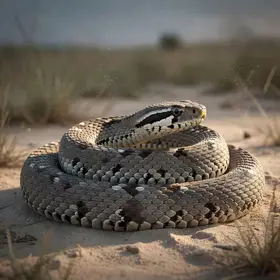
The West African carpet viper (Echis ocellatus) is a small, rough-scaled viper of the West African savanna, usually only 30 to 50 cm long. It warns intruders with a sizzling sound made by rubbing its saw-edged scales together. Its venom stops blood from clotting, and carpet vipers cause most snakebites in parts of northern Nigeria, the country with the highest snakebite death toll in West Africa.
- Habitat
- Savanna and dry open country, occasionally wooded areas
- Size
- Usually 30-50 cm long, up to about 65 cm
- Diet
- Small rodents, lizards, frogs, birds, centipedes and scorpions
- Range
- West Africa, including Mali, Burkina Faso, Ghana, Togo, Benin, Niger and Nigeria
- Young
- Lays eggs; about 6-20 per clutch
- Status
- Least Concern (IUCN 2021)
Habitat & range
The West African carpet viper lives in the savannas of West Africa, from Mali, Burkina Faso and Niger south to Ghana, Togo, Benin and Nigeria (Reptile Database). It is mainly a snake of open savanna and is only occasionally found in wooded areas (Wikipedia, citing Spawls and Branch 1995). In 2018 some populations at the edges of its old range were split off as separate species: Echis jogeri in the far west and Echis romani in the east, including Cameroon and Chad (Reptile Database). West African Carpet Viper appears as a Reptilia creature card in Wilder, a free browser collectible card game.
Diet & hunting
It hunts on the ground at dusk and in the first hours of the night, taking small mammals, birds, lizards and frogs, and also centipedes and scorpions (Wikipedia). Its sandy brown colour, dark blotches and rows of pale, dark-edged eye-spots break up its outline on bare soil and leaf litter; the name ocellatus refers to those eye-spots (Wikipedia). Females lay about 6 to 20 eggs, usually near the end of the dry season, and the hatchlings are only 10 to 12 cm long (Wikipedia; Reptile Database).
The saw-scale warning
Carpet vipers are also called saw-scaled vipers because the scales on their lower sides stick out at an angle and carry saw-edged keels. When disturbed, the snake forms open C-shaped coils and moves them against each other so the keels rasp together, making a sound like a boiling kettle (Gans and Maderson 1973). The display is visible and audible at the same time, and the snake strikes quickly from that position. Rubbing scales instead of hissing may also help a dry-country snake save water (Gans and Maderson 1973).
Bite & danger to people
The genus Echis, and this species in particular, is a major cause of snakebite envenoming (WHO). In a study in northeastern Nigeria, carpet vipers caused at least 66% of snakebites, and untreated bites by Echis vipers kill about 12 to 20% of the people bitten (Habib et al. 2015). The same analysis estimates about 1,927 snakebite deaths a year in Nigeria, the highest of the 16 West African countries studied (Habib et al. 2015). The venom makes the blood unable to clot and causes bleeding, so doctors check a simple bedside clotting test; specific antivenoms restored clotting within six hours in 76 to 83% of patients in a Nigerian trial (Abubakar et al. 2010).
Conservation
The IUCN lists the West African carpet viper as Least Concern because it is widespread and common in suitable savanna (IUCN 2021). The bigger problem is on the human side: there has long been a shortage of effective, affordable antivenom in the region, and ineffective products have been sold (Abubakar et al. 2010).
Fun facts about West African Carpet Viper
- It was first described in 1970 as a subspecies of the saw-scaled viper Echis carinatus before being raised to a full species (Wikipedia).
- The harmless African egg-eating snakes copy the carpet vipers' scale-rubbing warning sound (Gans and Maderson 1973).
- Hatchlings are only 10 to 12 cm long, about the length of a finger (Wikipedia).
- Its type specimen came from Garango in Burkina Faso (Reptile Database).
West African Carpet Viper vs Honey Badger
The honey badger wins; small venomous snakes are on its menu.
Honey badgers live across most of sub-Saharan Africa, so the two really can meet on the savanna. Snakes, including venomous ones, are a regular part of a honey badger's diet, and its thick, loose skin helps protect it from bites (Animal Diversity Web). The carpet viper is small, fast and quick to strike from its coils, and its venom is dangerous. But a viper only about 40 cm long is a snack-sized target for a determined badger that digs, bites and does not back off.
Read more about Honey Badger.
Common questions about West African Carpet Viper
Is the West African carpet viper the deadliest snake in Africa?
It is the leading cause of snakebite in the West African savanna, though no reliable Africa-wide death count exists for any species. In northeastern Nigeria, carpet vipers caused at least 66% of bites, and untreated Echis bites kill about 12-20% of people bitten (Habib et al. 2015). For South Asia's counterpart, see the Russell's viper.
How does a carpet viper make its sizzling sound?
By rubbing its scales together, not by hissing. The scales on its lower sides are tilted and carry saw-edged keels. When threatened, the snake forms C-shaped coils and slides them past each other so the keels rasp, making a sound like a boiling kettle (Gans and Maderson 1973). That is where the name saw-scaled viper comes from.
Is the West African carpet viper the same as the saw-scaled viper?
It is one of several saw-scaled vipers, but not the Indian one. The genus Echis is known as the saw-scaled or carpet vipers (WHO). The West African carpet viper, Echis ocellatus, lives in West Africa, while the saw-scaled viper of India, Echis carinatus, is a different species. In 2018, populations in Cameroon and Chad were split off as Echis romani (Reptile Database).
What happens if a carpet viper bites you?
The venom stops the blood from clotting and causes bleeding, swelling and pain. Without antivenom, Echis bites kill about 12-20% of people bitten (Habib et al. 2015). In a Nigerian trial, one dose of specific antivenom restored blood clotting within six hours in 76-83% of patients (Abubakar et al. 2010). Anyone bitten should get to a hospital with antivenom as fast as possible.
How big is a West African carpet viper?
Small: usually 30 to 50 cm long, with a maximum of about 65 cm (Wikipedia, citing Spawls and Branch 1995). Hatchlings are only 10 to 12 cm long. The Russell's viper of South Asia averages about 1.2 m, more than twice as long. The carpet viper is listed as Least Concern by the IUCN Red List.
More Reptilia animals
- Western Banded Gecko
- Western Diamondback Rattlesnake
- Central Bearded Dragon
- Coastal Taipan
- Common Chameleon
- Common Garter Snake
Reptilia · Grassland · Cost 2