
Russell's Viper
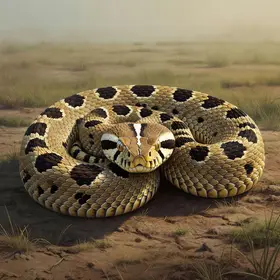
Daboia russelii
Russell's Viper: The Snake Behind India's Snakebite Crisis
The Russell's viper (Daboia russelii) is a stout, chain-patterned viper of South Asia's fields and scrub. In Indian snakebite studies that identified the snake, it made up 43% of cases, more than any other species, in a country with about 58,000 snakebite deaths a year. Its venom stops blood from clotting and can damage the kidneys, yet a diluted form of it is used in hospital labs to test blood.
- Habitat
- Open grassland, scrub, plantations and farmland; avoids dense forest and wetlands
- Size
- Usually about 1.2 m long, up to 1.66 m; stout body
- Diet
- Mainly rats and mice; also lizards, land crabs and scorpions
- Range
- Bangladesh, Bhutan, India, Nepal, Pakistan and Sri Lanka
- Young
- Gives birth to live young; litters of 20-40 are common
- Status
- Least Concern (IUCN 2021)
Habitat & range
Russell's viper lives in Bangladesh, Bhutan, India, Nepal, Pakistan and Sri Lanka (IUCN 2021). It is mostly found in open, grassy or bushy country, scrub, plantations and farmland, and tends to avoid dense forest, marshes and swamps (Mallow et al. 2003). Rats and mice that live alongside people draw it into fields and villages, so people working outdoors are the ones most at risk of a bite (Wikipedia). Russell's vipers in South-East Asia used to be treated as the same species but are now a separate one, the Siamese or eastern Russell's viper, Daboia siamensis (WHO). Russell's Viper appears as a Reptilia creature card in Wilder, a free browser collectible card game.
Diet & hunting
Adults feed mainly on rodents and also take small reptiles, land crabs, scorpions and other invertebrates (Mallow et al. 2003). Young snakes are more active at dusk and hunt lizards, then specialise in rodents as they grow. Russell's viper is mostly a night-time forager on the ground, though it becomes more active by day in cool weather (Mallow et al. 2003). Its strongly keeled scales and blotched pattern help it vanish into dry grass and leaf litter; the genus name Daboia is thought to come from a Hindi word meaning the lurker (Wikipedia).
Behavior & adaptations
Adults are usually slow and do not strike unless provoked. When threatened, a Russell's viper throws its body into S-shaped loops, raises the front third of its body and hisses, a hiss said to be louder than that of any other snake (Mallow et al. 2003). A strike from a large snake can be so forceful that its body lifts off the ground, which is where the myth that Russell's vipers chase people comes from. Females give birth to live young rather than laying eggs, usually 20 to 40 at a time and mostly in June and July; newborns are about 21 to 26 cm long (Mallow et al. 2003).
Bite & danger to people
No snake is named more often in Indian snakebite studies. In a review of studies covering 87,590 bites from 2000 to 2019, Russell's viper made up 43% of the cases where the snake was identified, ahead of kraits (18%) and cobras (12%); the same team estimates India had about 58,000 snakebite deaths a year over that period, most of them in rural homes and fields during the monsoon (Suraweera et al. 2020). The venom causes pain, swelling, bleeding and blood that will not clot, and Russell's viper bites are a major cause of acute kidney injury needing dialysis (WHO). Some survivors later develop pituitary failure (Antonypillai et al. 2011). Antivenom given early saves lives.
Conservation
The IUCN lists Russell's viper as Least Concern because it is widespread and can be common in farmland (IUCN 2021). Many are killed on roads or by people who fear them. Its venom has a medical use too: a diluted form is the basis of the dilute Russell's viper venom time test, used in hospital labs to detect lupus anticoagulant, an antibody linked to blood clots (Thiagarajan et al. 1986).
Fun facts about Russell's Viper
- The species was named after Patrick Russell, a Scottish surgeon who described it from India's Coromandel Coast in 1796 (Wikipedia).
- The scientific name russelii, with one l, is an original misspelling of Russell's name that has stuck (Wikipedia).
- The harmless rough-scaled sand boa has a pattern so similar that it may be mimicking Russell's viper (Mallow et al. 2003).
- Its fangs average about 16.5 mm long (Wikipedia).
Russell's Viper vs King Cobra
The king cobra wins; eating other snakes is what it does best.
The two can meet in parts of India, although the king cobra prefers forest and Russell's viper open country. King cobras feed mainly on other snakes, including venomous ones (Animal Diversity Web), and a long cobra can strike from farther away than a coiled viper can reach. Russell's viper has a thick body, a fast strike and venom that destroys blood clotting, so the cobra would not get a free meal. But the king cobra is built for exactly this job.
Read more about King Cobra.
Common questions about Russell's Viper
Is Russell's viper the most dangerous snake in India?
By the number of bites, yes. In Indian studies from 2000 to 2019 that identified the snake, Russell's viper caused 43% of bites, ahead of kraits (18%) and cobras (12%) (Suraweera et al. 2020). India has about 58,000 snakebite deaths a year, but no study gives a reliable death count for each species. The king cobra is longer, and the inland taipan has stronger venom, but neither bites nearly as many people.
What happens if a Russell's viper bites you?
Pain and swelling, then bleeding and blood that will not clot. Russell's viper bites are also a major cause of acute kidney injury that can need dialysis (WHO). Some survivors develop pituitary failure months or years later (Antonypillai et al. 2011). Antivenom given early in hospital is the main treatment.
Is Russell's viper the same as the Siamese Russell's viper?
No, they are now two species. Daboia russelii lives in South Asia (Bangladesh, Bhutan, India, Nepal, Pakistan and Sri Lanka) (IUCN Red List), while the Siamese or eastern Russell's viper, Daboia siamensis, lives in South-East Asia, including Myanmar and Cambodia (WHO). Both are medically important, and bites from both can cause kidney injury and pituitary damage (Antonypillai et al. 2011).
Why is Russell's viper venom used in hospitals?
Because it makes blood clot so reliably. A diluted form of the venom is the basis of the dilute Russell's viper venom time (dRVVT), a lab test used to detect lupus anticoagulant, an antibody linked to dangerous blood clots (Thiagarajan et al. 1986). The venom triggers clotting directly, which is also why a real bite uses up the body's clotting factors and leaves the blood unable to clot.
Does Russell's viper lay eggs?
No, it gives birth to live young. Litters of 20 to 40 are common, and the young are born mostly in June and July, each about 21 to 26 cm long (Wikipedia, citing Mallow et al. 2003). The species is listed as Least Concern by the IUCN Red List.
Featured in the Field Journal
More Reptilia animals
- Saltwater Crocodile
- Spectacled Cobra
- Thorny Devil
- West African Carpet Viper
- Western Banded Gecko
- Western Diamondback Rattlesnake
Reptilia · Grassland · Cost 4