Spectacled Cobra
Play the Spectacled Cobra free
Naja naja
Spectacled Cobra: India's Cobra With Glasses on Its Hood
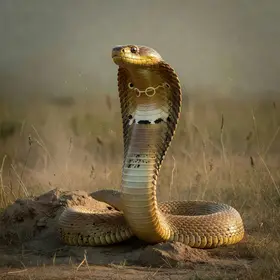
The spectacled cobra or Indian cobra (Naja naja) is a heavy-bodied cobra of the Indian subcontinent, named for the spectacle-shaped mark on the back of its hood. It hunts rats in fields and villages, which brings it close to people. Its bite can cause paralysis and severe tissue damage, and it is one of India's Big Four medically important snakes.
- Habitat
- Forest, grassland, scrub, rice paddies, farmland and village edges, often near water
- Size
- Mostly 1 to 1.5 m long; rarely up to 2.2 m
- Diet
- Rodents, frogs, toads, lizards and birds
- Range
- India, Pakistan, Sri Lanka, Bangladesh, Nepal and Bhutan
- Breeding
- Lays 10 to 30 eggs in rat holes or termite mounds
- Status
- Least Concern (IUCN 2021)
Habitat & range
The spectacled cobra lives across the Indian subcontinent, from Pakistan through India, Nepal and Bangladesh to Sri Lanka, up to about 2,000 m (IUCN 2021). It is highly adaptable: it uses forest, grassland, dry scrub, rice paddies and other farmland, and it also lives around villages and city outskirts (IUCN 2021; Wikipedia). It shelters in holes in embankments, termite mounds, rock piles and rodent burrows, often near water (Wikipedia). Spectacled Cobra appears as a Reptilia creature card in Wilder, a free browser collectible card game.
Diet & hunting
It eats rodents, frogs, toads, lizards and birds (Wikipedia). It bites quickly and then waits while the venom acts, before swallowing the prey whole. Because it follows rats, it sometimes enters houses and farm buildings, and the IUCN notes that it is an important natural pest controller on farmland (IUCN 2021).
Behavior & adaptations
When threatened, the cobra rears up and spreads its large hood. Many individuals have a pale mark on the back of the hood made of two round eye-spots joined by a curved line, like a pair of glasses (Wikipedia). Colour varies a lot across the range, from tan and brown to all black. Females lay 10 to 30 eggs between April and July in rat holes or termite mounds, and the hatchlings are independent with working venom from birth (Wikipedia).
Bite & danger to people
The spectacled cobra is one of India's Big Four, the snakes behind most serious bites on the subcontinent (Wikipedia). In Indian studies from 2000 to 2019 that identified the snake, cobras caused 12% of bites, behind the Russell's viper and kraits (Suraweera et al. 2020). In the first series of proven bites from Sri Lanka, 88% of 25 bites happened in daytime and 52% at the victim's home. A fifth were dry bites, 36% of patients had paralysis signs, 32% had severe tissue death at the bite, 16% needed a ventilator and 2 died (Kularatne et al. 2009).
Conservation
The IUCN lists the spectacled cobra as Least Concern because it is common, widespread and adaptable, with a stable population (IUCN 2021). It is still killed on sight, hunted for its skin and collected illegally for venom and by snake charmers. In India it is protected under the Wildlife (Protection) Act of 1972 (IUCN 2021).
Fun facts about Spectacled Cobra
- The name naja comes from the Sanskrit word naga, meaning cobra (Wikipedia).
- Its relative the monocled cobra has a single O-shaped ring on its hood instead of spectacles (Wikipedia).
- Adults in southern Pakistan are often all black on top, while young ones there may be grey (Wikipedia).
- Carl Linnaeus described the species in 1758 (Wikipedia).
Spectacled Cobra vs King Cobra
The king cobra wins; to it, a spectacled cobra is prey.
Their ranges overlap in parts of India, but only one of them specialises in eating snakes. King cobras feed mainly on other snakes, including venomous ones (Animal Diversity Web), and are the longest venomous snakes, often more than twice the length of a spectacled cobra, which is mostly 1 to 1.5 m long (Wikipedia). The spectacled cobra has a strong neurotoxic bite and a bold hood display, but it mainly hunts rats, frogs and birds. The king cobra is bigger and built for exactly this fight.
Read more about King Cobra.
Common questions about Spectacled Cobra
Is the spectacled cobra the most dangerous snake in India?
It is one of the four most dangerous, but not the top one. In Indian studies from 2000 to 2019 that identified the snake, cobras caused 12% of bites, behind the Russell's viper at 43% and kraits as a group (Bungarus species, not the common krait alone) at 18% (Suraweera et al. 2020). It is still one of India's Big Four medically important snakes (Wikipedia)).
What happens when a spectacled cobra bites a person?
It can cause paralysis, severe tissue damage, or both. In the first series of proven Indian cobra bites from Sri Lanka, 5 of 25 were dry bites with no venom. Of all 25 patients, 36% had signs of paralysis, 32% had severe tissue death around the bite, 16% needed a ventilator and 2 died (Kularatne et al. 2009). Anyone bitten needs hospital care and antivenom quickly.
Where and when do spectacled cobra bites usually happen?
Often by day, close to home. In a Sri Lankan hospital study of proven cobra bites, 88% happened in daytime and 52% in the victim's own home compound (Kularatne et al. 2009). Spectacled cobras hunt rats and sometimes enter houses and farm buildings looking for them (Wikipedia).
What is the spectacle mark on a cobra's hood?
It is a pale pattern on the back of the hood. In the spectacled cobra it is two round eye-spots joined by a curved line, so it looks like a pair of glasses, though some individuals lack it. The related monocled cobra has a single O-shaped ring instead (Wikipedia).
Is the spectacled cobra the same as the king cobra?
No, they are different snakes. The spectacled cobra (Naja naja) is mostly 1 to 1.5 m long and eats rodents, frogs and birds (Wikipedia). The king cobra (Ophiophagus hannah) belongs to a different genus, is the longest venomous snake and feeds mainly on other snakes (Animal Diversity Web).
More Reptilia animals
- Thorny Devil
- West African Carpet Viper
- Western Banded Gecko
- Western Diamondback Rattlesnake
- Central Bearded Dragon
- Coastal Taipan
Reptilia · Grassland · Cost 3