Russell's Viper: Why It Bites More People in India Than Any Other Snake
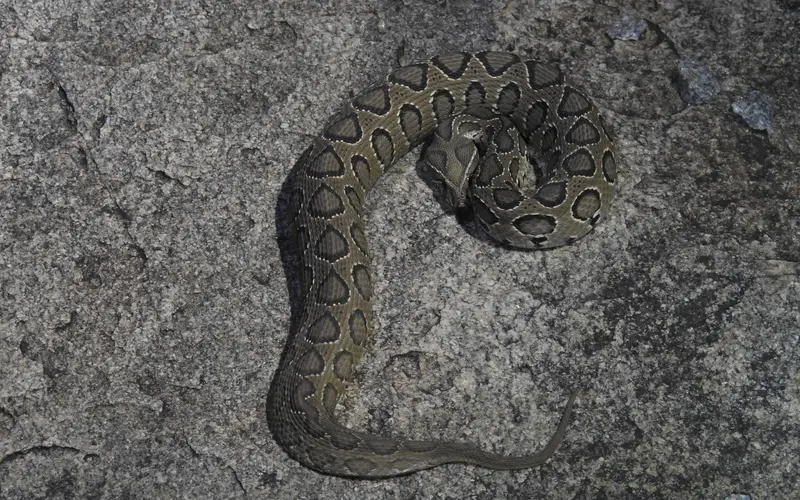
Russell's viper lives where India farms. It hunts rats in crops, stays still when people come close, and bites feet in the dark and hands at harvest.
Play Russells Viper in Wilder, free in your browser
Species deep dive · russells viper Play this card, common krait Play this card
*Because it lives exactly where people farm. Russell's viper (Daboia russelii) hunts the rats and mice that crowd into India's fields, it is active at night, and when someone comes close it usually stays still and trusts its camouflage instead of moving away. Most bites happen when a person steps on one in the dark without a light, or reaches into a crop by hand at harvest time; many victims are farmers working in paddy fields (Suraweera et al. 2020). In Indian snakebite studies that identified the snake, Russell's viper made up 43% of cases, more than any other species (Suraweera et al. 2020).*
That matters because India has more snakebite deaths than anywhere else. A nationally representative study estimated about 1.2 million snakebite deaths in India from 2000 to 2019, an average of about 58,000 a year (Suraweera et al. 2020). WHO puts the global toll at about 81,000 to 138,000 deaths a year (WHO), and the Indian study's authors note that India is home to roughly half of the world's snakebite deaths (Suraweera et al. 2020). No study gives a reliable death count for each species, so the 43% is a share of identified bites, not of deaths. But no other snake is named as often.
A snake of fields, not forests
Russell's viper is a stout viper with long rows of large, dark-rimmed, pale-centred spots down its back (WHO South-East Asia 2016). The IUCN lists it from Bangladesh, Bhutan, India, Nepal, Pakistan and Sri Lanka, from sea level up to about 2,750 m, in forest, shrubland, grassland and human-made land such as farms (IUCN Red List). It is mostly a snake of open, grassy or bushy country and farmland rather than dense forest, and adults feed mainly on rodents, foraging on the ground mostly at night (Mallow, Ludwig & Nilson 2003, True Vipers).
Put those facts together and you have a snake that is drawn to the same places as people. The snakebite researchers behind the Indian study point out that the worst-hit areas are low-lying, densely populated and intensively farmed, and that grain farming attracts large numbers of rodents and frogs, which in turn bring in high densities of snakes (Suraweera et al. 2020). It's also found almost everywhere in India: a 2021 study describes a near pan-India range covering every biogeographic zone except the Trans-Himalaya, most of the Northeast and the islands (Senji Laxme et al. 2021).
How the bites happen
The same study lists the typical situations for each of India's main venomous snakes. Kraits tend to bite people asleep on the floor at night. Saw-scaled vipers are often stepped on in bare or sandalled feet at night, or disturbed while grass is cut with a short sickle. Russell's viper bites happen in two main ways (Suraweera et al. 2020):
- At night, when someone walks without a light and steps on one.
- In the day, during harvest, for example while pulling up clumps of leafy peanut plants by hand, and while working in paddy fields.
India's national treatment guidelines describe the same pattern: most viper and cobra bites happen during the day or early darkness, while people water plantations or walk barefoot through tall grass or crops such as soybean (Ministry of Health and Family Welfare 2017).
Across the published Indian studies, 77% of bites were on the leg, 64% happened outdoors and 48% happened in the four monsoon months from June to September. Half of all snakebite deaths in the national study also fell in those monsoon months (Suraweera et al. 2020).
Why it doesn't just get out of the way
Many snakes slip away when they feel footsteps. An adult Russell's viper is usually slow and does not strike unless provoked, and it relies on its pattern to stay hidden in dry grass and leaf litter. When it is threatened it throws its body into S-shaped loops, raises the front of its body and hisses (Mallow, Ludwig & Nilson 2003, True Vipers). WHO's clinical guidelines describe that loud, blowing hiss as a warning sound you can recognise even in the dark (WHO South-East Asia 2016). But a warning only helps if you hear it in time. A snake that relies on not being seen, lying in a field full of people who can't see it, is a recipe for bites.
What the venom does
Russell's viper venom attacks the blood. It uses up the body's clotting factors, so the blood stops clotting, and doctors in India test for this at the bedside by leaving a little blood in a glass tube for 20 minutes to see whether it clots. The guidelines note that this can show up as early as 30 minutes after the bite (Ministry of Health and Family Welfare 2017). Russell's viper bites are also a major cause of acute kidney injury that can need dialysis (WHO), and some survivors develop pituitary failure later on (Ministry of Health and Family Welfare 2017).
It isn't the same venom everywhere. In Tamil Nadu and some other areas, Russell's viper bites often cause paralysis as well, because the venom varies a lot across India (Ministry of Health and Family Welfare 2017). A 2021 study compared venom from five regions of India, more than 5,800 km apart, and found large differences between populations. India's commercial antivenom, made with venom from southern India, still met its labelled strength against most of them, but not against the population from semi-arid Punjab, where it neutralised only about 0.39 mg of venom per ml against a marketed 0.6 mg (Senji Laxme et al. 2021). Indian polyvalent antivenom covers four species, the "Big Four": the spectacled cobra, common krait, Russell's viper and saw-scaled viper (Suraweera et al. 2020).
What stops bites, and what to do after one
Because so many Russell's viper bites come from stepping on a snake nobody saw, the most useful protections are simple. WHO's snakebite guidelines for South-East Asia advise proper shoes or boots and long trousers instead of bare feet or sandals, especially in the dark or in undergrowth, and a torch, flashlight or lamp when walking at night, above all after heavy rain. They also point out that many bites happen during ploughing, planting and harvesting, and that in Myanmar lightweight boots designed for farmers were accepted for the high-risk rice harvest (WHO South-East Asia 2016).
If someone is bitten, India's treatment guidelines say to keep them still, splint the bitten limb like a fracture, remove rings, watches, shoes and tight clothing, and get them to a health facility with antivenom as quickly as possible, by vehicle rather than walking or driving themselves. They also list what not to do: no cutting, sucking, washing, rubbing or herbs on the wound, no tourniquet, and no attempts to catch or kill the snake (Ministry of Health and Family Welfare 2017). WHO stresses that most deaths and serious harm from snakebite can be prevented with safe, effective antivenom that people can actually reach (WHO).
India launched a National Action Plan for Prevention and Control of Snakebite Envenoming in March 2024, with the aim of halving snakebite deaths by 2030 (Press Information Bureau, 12 March 2024).
Not the most venomous, still the most important
On a lab venom-potency table, Russell's viper is nowhere near the top; that title belongs to Australia's inland taipan, which has bitten very few people (read Inland Taipan: Has Anyone Ever Died From a Bite?). The king cobra is far longer and more famous. Russell's viper matters for a plainer reason: it is common, it lives in fields, and it meets people every day. For another snake whose danger comes from living alongside people, read Eastern Brown Snake: How Dangerous Is It, Really?
On the Wilder card
In Wilder the Russell's Viper is a Rare Reptilia card in the Grassland element. It costs 4 Energy, with Attack 4 and Health 4, and has three keywords that fit the real snake well: Venom, so combat damage it deals to another creature destroys it; Camouflage, so enemy Actions, Signatures and abilities can't target it until it attacks; and Basking, which gives it +1 Attack permanently at the end of your turn if it didn't attack (up to +2), a good match for a sit-and-wait hunter. Its flavour text reads: "Its hiss is said to be the loudest of any snake. It hunts the rats in the fields." Its card page also covers its biology, the dRVVT blood test made from its venom, and a "who would win" matchup against the king cobra. For another field-dwelling viper with a huge human toll, see the West African Carpet Viper.
Wilder is a free browser collectible card game about real animals, and you can play it free in your browser with no signup.
Photo credit
Hero photograph: Ashwin Viswanathan, "Russell's Viper (Daboia russelii)" (photographed 21 November 2020), via iNaturalist on Wikimedia Commons, CC BY 4.0. Cropped for the Field Journal hero.

Play Russells Viper in Wilder, free in your browser
Questions people ask
How long do you have after a Russell's viper bite?
There is no safe waiting time, so go to hospital at once. India's treatment guidelines say the blood can stop clotting as early as 30 minutes after a Russell's viper bite, although it may take longer, and they advise taking every bitten person straight to a facility with antivenom and watching them for 24 hours (Ministry of Health and Family Welfare 2017).
Where do Russell's vipers live in India?
Almost everywhere. A 2021 study describes a near pan-India range covering every biogeographic zone except the Trans-Himalaya, most of the Northeast and the islands, and reaching 2,000 m or more in the Himalayan region (Senji Laxme et al. 2021). The IUCN also lists it from Bangladesh, Bhutan, Nepal, Pakistan and Sri Lanka (IUCN Red List).
Is snakebite a notifiable disease in India?
The central government has asked for it to be. In November 2024 the Union Health Ministry wrote to all states and Union Territories asking them to make snakebite cases and deaths a notifiable disease under their public health laws, so that health facilities must report them (Akashvani News, 30 Nov 2024). Each state decides under its own law.
Is there a snakebite helpline number in India?
Yes, 15400. The Health Ministry announced a Snakebite Helpline on that number in March 2024, to give people immediate help and guidance, starting as a pilot in five states and Union Territories: Puducherry, Madhya Pradesh, Assam, Andhra Pradesh and Delhi (Press Information Bureau, 12 March 2024). In an emergency, India's guidelines also list the ambulance numbers 102 and 108 (Ministry of Health and Family Welfare 2017).
Sources
- Suraweera W, Warrell D, Whitaker R, et al. (2020). Trends in snakebite deaths in India from 2000 to 2019 in a nationally representative mortality study. eLife 9: e54076
- Senji Laxme RR, Khochare S, Attarde S, et al. (2021). Biogeographic venom variation in Russell's viper (Daboia russelii) and the preclinical inefficacy of antivenom therapy in snakebite hotspots. PLoS Negl Trop Dis 15(3): e0009247
- Ministry of Health and Family Welfare, Government of India (2017). Standard Treatment Guidelines: Management of Snake Bite
- World Health Organization, Regional Office for South-East Asia (2016). Guidelines for the Management of Snakebites, 2nd edition
- World Health Organization. Snakebite envenoming fact sheet
- World Health Organization. Snakebite envenoming: snakes gallery
- IUCN Red List: Daboia russelii (assessment 2019, published 2021)
- Press Information Bureau, Government of India (12 March 2024). National Action Plan for Prevention and Control of Snakebite Envenoming launched
- Akashvani News (30 November 2024). Centre asks states and UTs to make snakebite cases a notifiable disease