Common Garter Snake: Where Do Garter Snakes Go in Winter?
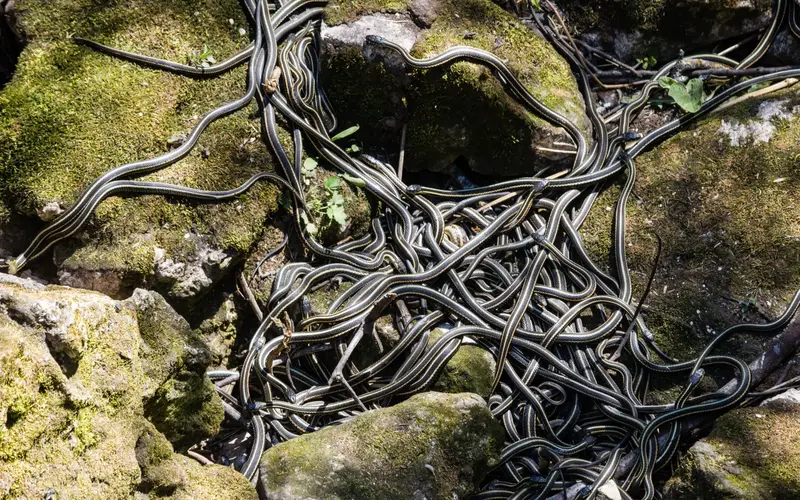
Garter snakes spend winter underground below the frost line, often in shared dens. In Manitoba, tens of thousands crowd into the same limestone pits.
Play Common Garter Snake in Wilder, free in your browser
Species deep dive · common garter snake Play this card
Underground, below the frost line, and often in a crowd. As autumn cools, common garter snakes crawl into winter dens such as rodent and crayfish burrows, ant mounds, root tunnels, rock crevices and the spaces under stumps, and stay there until spring (Vermont Fish & Wildlife; Maine IF&W). In the far north, where good dens are rare, tens of thousands can share the same one. At the Narcisse Snake Dens in Manitoba, Canada, red-sided garter snakes pile into limestone pits each autumn, and on 21 October 2026 the province reported that most had already gone underground for the winter (Province of Manitoba).
The common garter snake (Thamnophis sirtalis) is one of North America's most widespread snakes, and it lives further north than most. That's why its winter is such a challenge. A snake can't make its own body heat, so if it can't get somewhere that stays above freezing, it dies.
Brumation, not quite hibernation
People usually say garter snakes "hibernate", and wildlife agencies use the word too. Connecticut's environment department uses a more precise word: garter snakes brumate. Brumating animals aren't deeply asleep the way hibernating mammals are; they're awake but inactive. As temperatures drop towards the lowest a garter snake can tolerate, the snakes gather to brumate together, and these winter groups are called aggregations (Connecticut DEEP).
In Vermont, garter snakes go into their dens in late October and stay until March or early April (Vermont Fish & Wildlife). In colder places the season is longer.
Why they sleep in piles
Garter snakes are mostly solitary in summer, but they gather in large numbers at good winter sites. Lying together in tight coils cuts heat loss and keeps their bodies a little warmer (Animal Diversity Web).
The most famous example is in Manitoba's Interlake region. The red-sided garter snake (Thamnophis sirtalis parietalis), a northern subspecies of the common garter snake, finds plenty of food and water there. What makes the area special is the limestone bedrock. Underground water has dissolved and collapsed the rock into a network of crevices and caverns that reach down below the frost line, and the province says it's only by massing down there that the snakes can survive Manitoba winters (Province of Manitoba). The Narcisse dens are often called the world's largest concentration of snakes (Province of Manitoba, 2002).
Can a garter snake survive freezing?
Only briefly. In a 1992 study, red-sided garter snakes collected near their dens in autumn could chill to about −5.5 °C without freezing. By midwinter that ability had faded, and they froze at about −0.8 to −1.2 °C. Snakes held frozen at −2.5 °C for 3 hours or less, with up to 40% of their body water turned to ice, recovered fully. After 10 hours only half survived, and none recovered after 24 or 48 hours (Churchill & Storey 1992).
The researchers concluded that freezing isn't part of the snakes' winter plan at all. Instead, surviving a short freeze probably helps on cold autumn and spring nights, when the snakes are still above ground (Churchill & Storey 1992). For the long winter, they need a den that doesn't freeze.
The other winter danger: drying out
Cold isn't the only threat. In a 1989 experiment, eastern garter snakes were kept for up to 165 days in conditions that copied winter dens. Snakes kept in air slowly dried out and died, faster in drier and warmer air. Snakes kept underwater at 5 °C stayed hydrated, survived, and used the least energy. Some garter snakes really do spend the winter submerged in flooded dens, and the study showed why that can pay off (Costanzo 1989).
The autumn commute
Northern garter snakes travel to get to a good den. In Manitoba's Interlake, red-sided garter snakes head south to their summer range in spring and come back north to their dens in late summer and autumn. Researchers have recorded movements of up to 17.7 km (Gregory & Stewart 1975). At Narcisse the snakes return to the dens in early September and stay active on the surface on warm, sunny days, until cool, wet weather drives them underground (Province of Manitoba).
Most adults go back to the same den every year, although marking studies show that some use other dens. Biologists think the snakes find their way home by following scent trails. Young snakes usually spend their first winter close to where they spent the summer, in ant hills, animal burrows or any crevice that gets them below frozen ground, and only join an established den in their second year (Province of Manitoba).
Snake tunnels under the highway
That autumn commute crosses Manitoba's Highway 17. Daily monitoring from spring 1991 to autumn 1993 found that road deaths at times approached 10,000 snakes, mostly in autumn. Wildlife staff responded with low drift fences that steer snakes towards tunnels under the road. Snakes that hit the fence tended to follow it rather than climb over it. In autumn 1999, traps along the fences and at a tunnel exit caught 10,927 snakes, about 15% of the estimated population, showing the system could guide snakes under the road. In 2000, Manitoba Hydro bored four more pipes under the highway to test as extra tunnels (CARCNET).
What happens in spring
When the dens warm up, the males come out first and wait for the females. Each female that emerges can end up at the centre of a "mating ball" of up to a hundred males (Province of Manitoba). For the strange chemistry of those mating balls, and why garter snakes give birth to live young, read Common Garter Snake: Live Young, Mild Venom, and Backyard Ecology.
On the Wilder card
In Wilder the Common Garter Snake is a Common reptile card in the Forest element: cost 1, Attack 1, Health 3, with Basking, a fair fit for a snake whose year depends on finding warmth. Its flavour text reads: "Harmless to you. Not to the frog." For another animal that has to get through the winter without freezing, read American Bullfrog: Where Do Bullfrogs Go in Winter?
Wilder is a free browser collectible card game about real animals, and you can play it free in your browser with no signup.
Photo credit
Hero photograph: Jucá Costa, "Narcisse Snake Dens 10" (red-sided garter snakes, Thamnophis sirtalis parietalis, massed in a den pit at Narcisse Wildlife Management Area, Manitoba, 21 May 2016), Wikimedia Commons, CC BY-SA 4.0. Taken in spring, when the snakes come back up. Cropped for the Field Journal hero.

Play Common Garter Snake in Wilder, free in your browser
Questions people ask
When do garter snakes come out of hibernation?
In spring, from about March to May depending on how far north they live. In Vermont they come out in March or early April (Vermont Fish & Wildlife). At Manitoba's Narcisse dens, emergence and mating peak in late April and the first three weeks of May, often busiest around Mother's Day weekend (Province of Manitoba).
Can you see garter snakes on warm winter days?
Sometimes. Common garter snakes stay active at a wider range of temperatures than most snakes, and although they spend winter in dens, they can be found basking on rocks on mild winter days (Vermont Fish & Wildlife; Animal Diversity Web).
Do garter snakes eat during the winter?
No. Brumating snakes are inactive (Connecticut DEEP), and in a winter-den experiment they lived off the fat and liver reserves they had built up (Costanzo 1989). In Manitoba's Interlake, red-sided garter snakes only feed in their summer range in June, July and August, and wood frogs are their most common prey (Gregory & Stewart 1975).
Can you visit the Narcisse Snake Dens?
Yes. The dens are in Narcisse Wildlife Management Area, 6 km north of Narcisse on Highway 17, about 130 km from Winnipeg. A 3 km trail links four active dens with viewing platforms, but going into the dens is not allowed. Spring, from late April through May, is the best time, and the snakes are also visible in September on warm days (Province of Manitoba).
Sources
- Province of Manitoba: Snakes of Narcisse (fall update 21 Oct 2026, viewing times and FAQ)
- Province of Manitoba news release (22 May 2002): Improvements underway at the Narcisse snake dens
- Churchill & Storey (1992) Freezing survival of the garter snake Thamnophis sirtalis parietalis, Canadian Journal of Zoology 70:99-105
- Costanzo (1989) Effects of humidity, temperature, and submergence behavior on survivorship and energy use in hibernating garter snakes, Thamnophis sirtalis, Canadian Journal of Zoology 67:2486-2492
- Gregory & Stewart (1975) Long-distance dispersal and feeding strategy of the red-sided garter snake (Thamnophis sirtalis parietalis) in the Interlake of Manitoba, Canadian Journal of Zoology 53:238-245
- CARCNET: Red-sided garter snake mortality on PTH #17 at Narcisse WMA
- Vermont Fish & Wildlife Department: Common garter snake
- Connecticut DEEP: Common gartersnake fact sheet
- Maine Department of Inland Fisheries and Wildlife: Common gartersnake
- Animal Diversity Web: Thamnophis sirtalis (common garter snake)