Where Do Bullfrogs Go in Winter?
Species deep dive · american bullfrog
Underwater, on or near the bottom of a pond, and mostly not buried in the mud. American bullfrogs (Lithobates catesbeianus) spend the winter underwater, adults and tadpoles alike, and while they're submerged they close their nostrils and "breathe" through their skin (Minnesota DNR). When researchers radio-tracked six adult bullfrogs through a winter in two small ponds in northeastern Ohio, the frogs were nearly always submerged, kept moving even in the coldest weeks, and the ones seen on the pond bottom were not buried or covered by silt (Stinner et al. 1994).
Don't frogs dig into the mud?
That's the classic picture, and plenty of good references still describe it. The USGS species profile says bullfrogs hibernate "buried in the mud underwater" (USGS), and New York's wildlife agency says they burrow into the pond bottom and absorb oxygen stored in the mud (NYSDEC).
The physiology points the other way. A hibernating turtle can slow its metabolism enough to get by on the little oxygen in mud, but a frog can't, so frogs that winter underwater need to stay near oxygen-rich water. They spend much of the winter lying on top of the mud or only partly buried, and now and then they slowly swim about (Virginia DWR; Scientific American). Lab studies suggest frogs survive only a few days to a week without oxygen, even in cold water, while painted turtles have survived up to six months at 3°C in nearly oxygen-free water (Stinner et al. 1994). A major review of how true frogs overwinter concluded that, because they tolerate so little anoxia, it is "untenable" that they spend much of the winter buried in oxygen-free mud (Tattersall & Ultsch 2008).
Picking a winter spot
The Ohio frogs didn't stay where they spent the summer. In November and December, all six moved 33 to 96 metres to their wintering areas. Five settled in fairly shallow water near small inlet streams, and the sixth stayed 1–2 metres off the west shore. Out of 208 times the frogs were located, they were seen floating at the surface or sitting on the bank only 10 times, and they moved about even from mid-December to mid-February. The authors concluded that adult bullfrogs prefer relatively warm, shallow water for the winter and stay active rather than torpid (Stinner et al. 1994).
Cold water helps. Below about 5°C, a submerged true frog can take in enough oxygen through its skin across a wide range of oxygen levels (Tattersall & Ultsch 2008).
The real winter dangers
The two big killers are freezing and running out of oxygen. In cold northern winters, overwintering deaths in true frogs occasionally reach 100% because of one or both. Frogs also have to last the whole winter on the energy they stored in their liver, muscles and fat before it started. That's usually enough in cold, well-oxygenated water, but when oxygen runs low, frogs can't use their fat stores efficiently and burn through their glycogen fast (Tattersall & Ultsch 2008).
Thaws can be dangerous too. "Winter kill" happens when an early warm spell lures a frog out of its winter spot and the temperature then drops fast below freezing (Virginia DWR).
Tadpoles under the ice
Bullfrog tadpoles stay in the pond through the winter too, and they may be active under the ice all season (NYSDEC). Many northern true frogs overwinter as tadpoles. Tadpoles cope better than adults when oxygen runs low, and spending a winter as a tadpole lets them grow bigger before they turn into frogs (Tattersall & Ultsch 2008). That's one reason bullfrogs need ponds that never dry up (USGS).
A pond survivor that went global
Bullfrogs are native to eastern North America, but they were brought to the U.S. West Coast as food in the 1850s and have since spread to Europe, Asia and South America. They're ranked among the world's 100 worst invasive species. They eat almost anything they can swallow, from insects, leeches and scorpions to fish, other frogs, small alligators, turtles, snakes, rodents, bats, birds and even young mink, and in crowded ponds they eat each other. Where they've been introduced, they prey on native frogs and threaten pupfish, and they're known to spread the deadly amphibian chytrid fungus (USGS).
Removing them is hard but possible. Starting in 2005, Yosemite National Park used environmental DNA and audio recorders to find bullfrogs in Yosemite Valley and remove them, the first successful bullfrog removal at a landscape scale. It made room to bring the endangered California red-legged frog back to the valley in 2016 (USGS).
On the Wilder card
The American Bullfrog is a Common Amphibia (Water) card: Cost 2, Attack 2, Health 3, with Ambush and Toxin. Ambush suits a real ambush predator that sits still and grabs whatever comes close (National Aquarium). The flavour text is "One croak, and the whole pond holds its breath." On its card page it takes on the axolotl in a pond showdown. Read the axolotl's story in the Field Journal, then try both in the free browser collectible card game.
The short version: bullfrogs spend winter underwater, breathing through their skin in cold, oxygen-rich water. Tracked frogs sat on the pond bottom without burying themselves and kept moving all winter, because a frog sealed in oxygen-poor mud would suffocate.
Photo credit
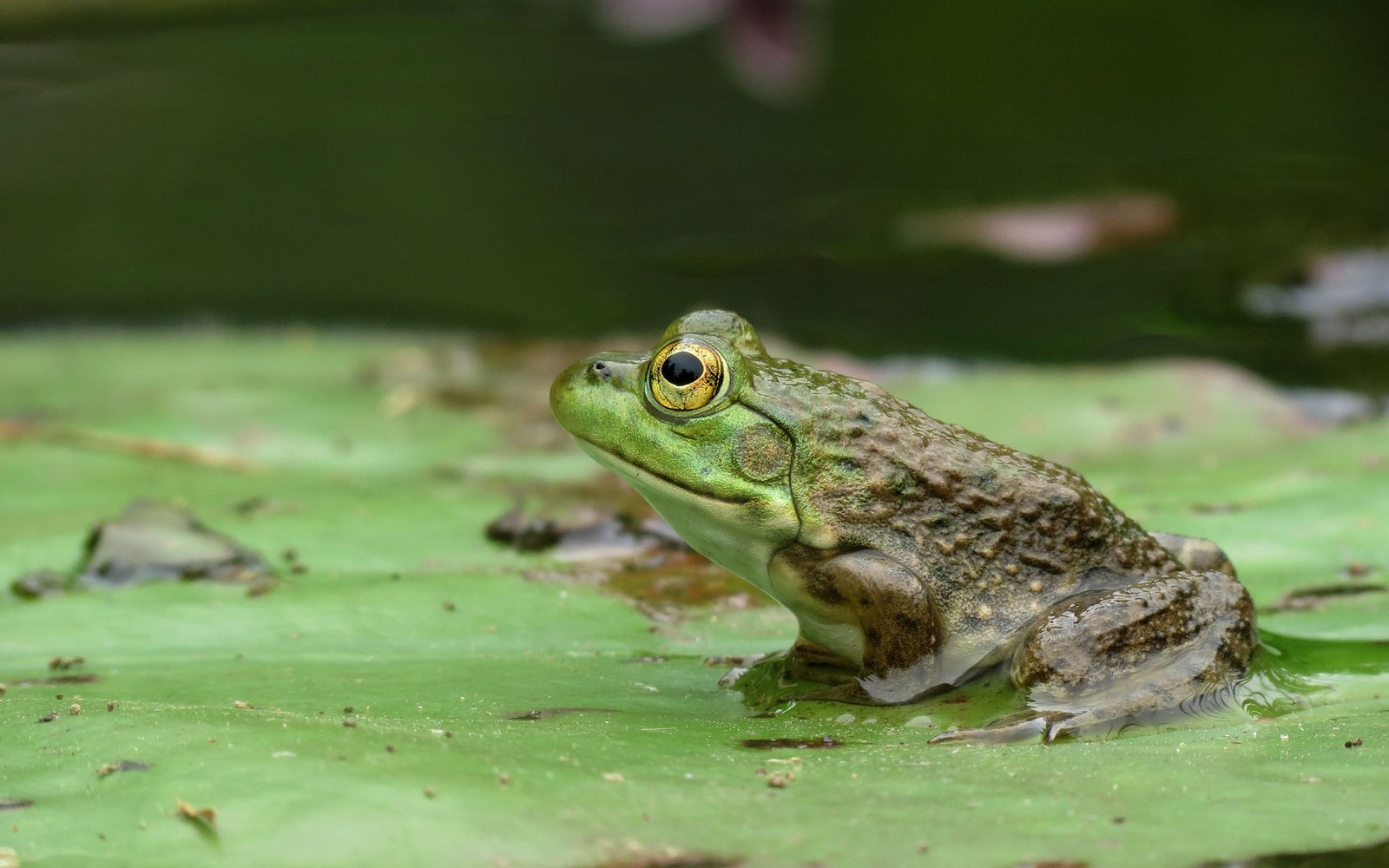
Hero photograph: Katja Schulz, American Bullfrog on a Lily Pad, Wikimedia Commons (via Flickr), CC BY 2.0. Cropped for the Field Journal hero.

Questions people ask
Can a bullfrog freeze solid like a wood frog?
No. Frogs that normally spend the winter in water cannot survive freezing, so bullfrogs have to avoid ice rather than tolerate it (Stinner et al. 1994). Wood frogs winter on land instead, where they can freeze almost completely, with no brain activity or heartbeat, and revive when they thaw. Glucose made by their liver works as an antifreeze (Virginia DWR).
How long do bullfrogs stay tadpoles?
Anywhere from a few months to several years. New York's wildlife agency says bullfrogs can stay tadpoles for one to three or more years depending on conditions (NYSDEC). In the warm south, metamorphosis can take as few as 79 days, while in the colder north it can take two to three years (National Aquarium).
How far away can you hear a bullfrog?
Up to about half a mile (National Aquarium). Males make the deep "jug-o-rum" call by inflating a balloon-like sac in the throat, and calling peaks between early May and mid-July (NYSDEC).
Why is it called a bullfrog?
For its voice. The American bullfrog is named for its deep call, which sounds like a bull roaring (Minnesota DNR).
Are American bullfrogs endangered?
No. Lithobates catesbeianus is listed as Least Concern on the IUCN Red List (IUCN), and bullfrogs are abundant in their native range (National Aquarium). See the Wilder card.
Sources
- Stinner, Zarlinga & Orcutt 1994, Ohio Journal of Science 94(1):8-13 — Overwintering behavior of adult bullfrogs, Rana catesbeiana, in northeastern Ohio
- Tattersall & Ultsch 2008, Biological Reviews 83 — Physiological ecology of aquatic overwintering in ranid frogs
- Virginia Department of Wildlife Resources (2020) — Where Do Frogs Go in the Winter?
- Scientific American — How do frogs survive winter? Why don't they freeze to death?
- Minnesota DNR — American Bullfrog
- USGS Nonindigenous Aquatic Species — American Bullfrog (Lithobates catesbeianus) species profile
- NYSDEC — Bullfrog (Watchable Wildlife)
- National Aquarium — American Bullfrog
- IUCN Red List — Lithobates catesbeianus (IUCN SSC Amphibian Specialist Group)