Caecilians: The Legless Amphibians Whose Babies Eat Their Mother's Skin
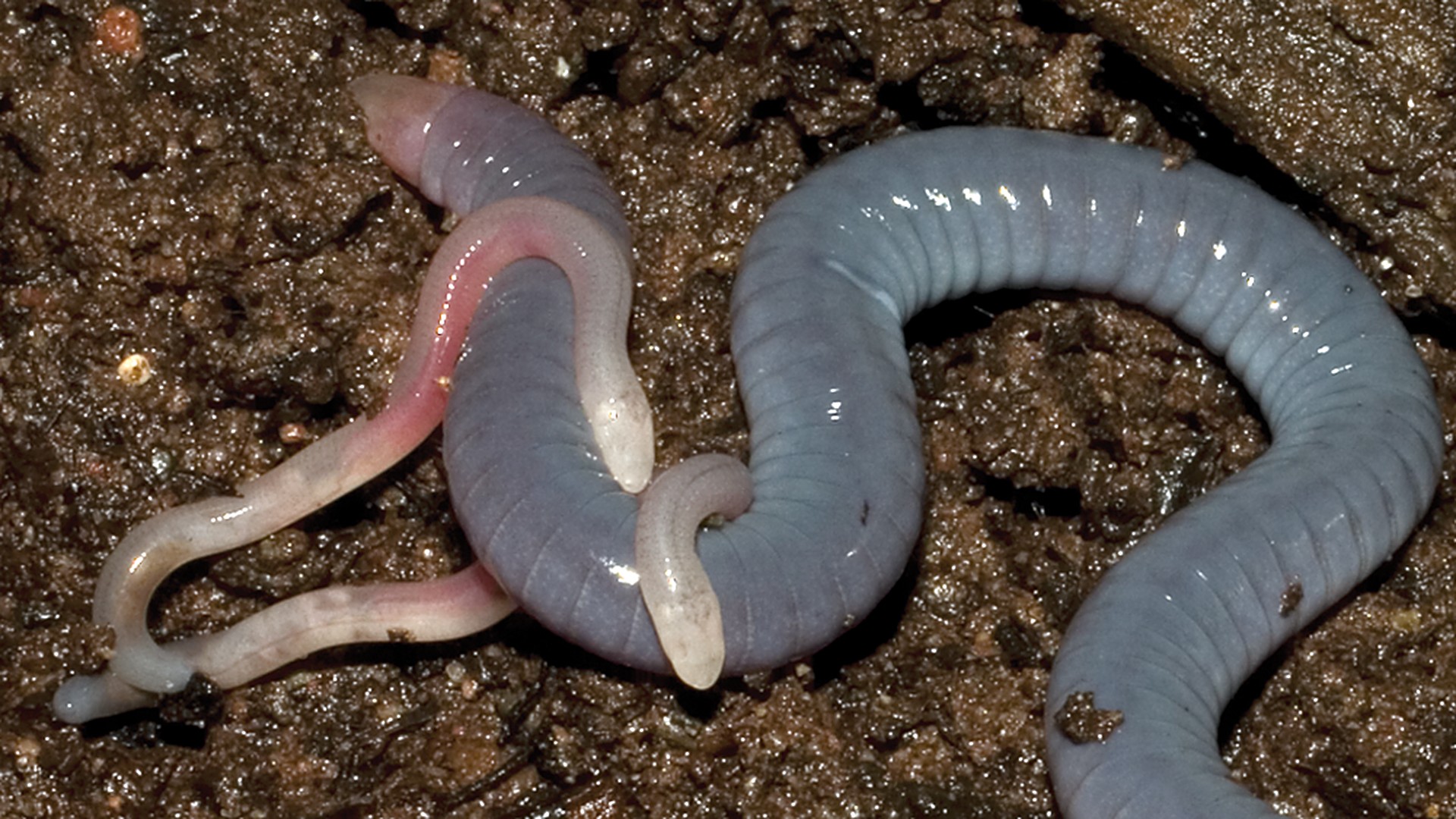
Species deep dive · chandgadi caecilian
This month, news broke of a new animal from a village backyard in India's northern Western Ghats. It lives in damp soil, has no legs, and is easy to mistake for a large earthworm. It is actually an amphibian: the Chandgadi caecilian, Gegeneophis chandgadi, which joins Wilder today as a new card. Meet the Chandgadi Caecilian in the Wilder field guide →
Caecilians (say it "seh-SILL-yens") get far less attention than frogs or salamanders. They deserve more, if only for how some of them raise their young. In several species, a mother's outer skin thickens with fat while she guards her brood. Her hatchlings then peel that layer off and eat it, using a set of baby teeth that seem built for the job. In at least one species, the young also drink a milk-like fluid from their mother. Here is what we know, and where the evidence comes from.
What is a caecilian?
Caecilians make up Gymnophiona, one of the three living groups of amphibians. The other two are frogs and salamanders. They are the smallest of the three by far. As of September 26, 2026, AmphibiaWeb lists 233 caecilian species, compared with 8,018 frogs and 845 salamanders.
They have long, ringed bodies with no legs. Most burrow through soil, and some live in water. National Geographic gives their size range as roughly 3.5 inches to nearly 5 feet. Two features stand out on the head:
- A small sensory tentacle. Caecilians have a pair of tiny, chemically sensitive tentacles on the face, between each eye and nostril. They help the animal pick up chemical cues, including food, in the dark. The tentacle is unique to caecilians.
- Tiny eyes. Their eyes are very small and are thought to sense little more than light and dark. In some species, skin covers the eyes. In Microcaecilia, one of the skin-feeding genera below, bone covers them.
Are caecilians snakes or worms?
Neither. The Smithsonian's National Zoo notes that caecilians don't look much like amphibians, but their bones, teeth, fat bodies and other structures show they are related to frogs and salamanders. Unlike worms, they are vertebrates, with a skull, jaws, teeth and a backbone. Unlike snakes, they have smooth, slimy amphibian skin and depend heavily on it for breathing. The rings around the body look like an earthworm's segments, which is why reporters covering the Chandgadi find kept noting that people mistake caecilians for earthworms or blind snakes.
Do caecilians really eat their mother's skin?
Yes. Biologists call it maternal dermatophagy, from Greek words meaning "skin eating." It has been directly observed in caecilians on two continents.
Boulengerula taitana, Kenya (Nature, 2006)
The key study came from Alexander Kupfer and colleagues, published in Nature in April 2006. They studied Boulengerula taitanus, a small egg-laying caecilian from Kenya's Taita Hills. Its name has since been corrected to B. taitana. The team collected 21 brooding females, with broods of two to nine young, from underground nests. In captivity they watched eight bouts of skin feeding by young from five broods and filmed five of them.
The young crawled over and around their mother, pressing their heads against her and repeatedly opening and closing their mouths. They used their lower jaws to lift and peel off the outer layer of her skin, the stratum corneum. The paper's figures show what that feeding achieved:
- Over one week, the young grew about 11% longer, or about 1 mm a day on average.
- Over the same week, the mothers lost about 14% of their body mass.
- Young preserved right after collection in the field had only thin layers of skin in their stomachs. That suggests skin alone was enough to fuel their growth.
How a mother's skin becomes food
In non-brooding females, the outer skin is made of flat, hardened cells. In brooding females, Kupfer's team found those cells were much larger and packed with small sacs. The epidermis was up to twice as thick. That came from each cell getting longer, not from there being more cells. Stains showed the cells were full of fat, and the outer layer was rich in protein. Tests for carbohydrates came back negative. The authors compared it to mammal milk because both are rich in fat. Brooding mothers were also noticeably paler than other adults, and that pale color has turned out to be a useful field sign in later studies.
Special baby teeth
Hatchlings don't have their parents' simple pointed teeth. Young B. taitana have odd, variable crowns: many teeth combine a blade-like cusp with extra small cusps, and some have longer, pointed hooks that the paper compares to a grappling hook. These teeth are temporary. By the time the young leave their mother, at about 86 mm long (hatchlings are about 28 mm), they look like small adults.
The ringed caecilian in Brazil has similar gear. Wilkinson and colleagues (2008) counted 44 spoon-shaped teeth on the lower jaw of one 120 mm nestling. The teeth sat in three rows, and each one ended in several small claw-like points. The feeding they saw was "quite frenetic." The young tore off pieces of skin by spinning along their bodies, sometimes two fighting over the same strip.
Microcaecilia dermatophaga: named for skin eating
In 2013, Mark Wilkinson, Emma Sherratt, Fausto Starace and David Gower described a new species from forest near the Mana River in French Guiana. They named it Microcaecilia dermatophaga, meaning "skin eater." It was the first new caecilian described from French Guiana in more than 150 years. It was also only the third species, from a third genus, in which young had been seen feeding directly on their attending mother's skin.
The captive observations fit the Kenyan pattern closely. The mother turned paler after her eggs hatched. The team watched the last seconds of one feeding bout, with the normally still hatchlings moving fast over her body and pulling off pieces of skin. Over a 20-day stretch in sterile soil with no other food, the young's combined mass rose by 86%. The hero photo above comes from this paper: a presumed M. dermatophaga mother, blue-grey and ringed, with her two pale hatchlings.
Siphonops annulatus: skin, and then milk
The ringed caecilian, Siphonops annulatus, from South America is where researchers first suspected skin feeding. In the 1990s, researchers noticed its hatchlings had teeth unlike the adults' and that mothers looked paler. In 2008, working partly from footage filmed with the BBC, Wilkinson, Kupfer and Brazilian colleagues confirmed that its young peel and eat their mother's skin too. They also noticed something else. The young sometimes gathered around their mother's vent and drank fluid that came out of it.
In March 2024, a paper in Science by Pedro Mailho-Fontana and colleagues explained that fluid. Females of this egg-laying species feed their hatchlings a lipid-rich "milk" for about two months. It is released through the mother's vent and made by enlarged glands in the lining of her oviduct. The authors report that it is mostly fats and carbohydrates. Scientific American's coverage adds that it contains palmitic and stearic acids, fatty acids also found in cow's and human milk. The young appear to trigger it themselves, by touching and nibbling the area around the vent and by making high-pitched calls that grow stronger in the last minute before the milk appears. According to Scientific American, the researchers concluded that an occasional meal of skin could not explain how fast the young grew. They more than double in weight in their first week.
This is not true mammal milk. It is a separate way of doing a similar job, and it makes the ringed caecilian the first amphibian known to feed its young this way.
Why it matters: 100+ million years of parenting underground
Skin feeding has been confirmed in African and South American caecilians that are only distantly related. Researchers argue it is an ancient behavior, not a coincidence. The 2008 paper estimated it has probably lasted in several lineages for more than 100 million years. The 2006 paper proposed a broader link. Some caecilians give birth to live young, and their fetuses use specialized teeth to feed on the lining of the mother's oviduct. Skin feeding with similar baby teeth may be the stepping stone between laying eggs and live birth.
Quick answers
Are caecilians dangerous?
Not to people in any meaningful way. They have teeth, and a 2020 study in iScience by Mailho-Fontana and colleagues found glands at the base of the teeth in ringed caecilians, containing enzymes (phospholipase A2) often found in venoms. Science News pointed out that the study stopped short of proving they are venomous. A tropical field biologist told National Geographic he had been bitten several times with no lasting effects beyond the pain of the teeth. Like many amphibians, some species also have toxic skin secretions. Handle them gently, or better, don't handle them at all.
Do caecilians lay eggs?
Some do and some don't. Species such as B. taitana, M. dermatophaga and the ringed caecilian lay eggs in underground nests and guard them. Others give birth to live young.
Do caecilians have eyes?
Yes, but they are tiny. In many species they probably sense only light and dark, and in some they sit under skin or bone. The tentacle does much of the sensing.
Where do caecilians live?
In the wet tropics: Central and South America, Africa, and South and Southeast Asia. India alone has 41 caecilian species, according to the Zoological Survey of India team behind the Chandgadi description. Most live in soil and leaf litter, so they are rarely seen.
The newest caecilian: Chandgadi, from a backyard
Gegeneophis chandgadi was described in 2026 in the Records of the Zoological Survey of India by Sahil Shikalgar and colleagues from ZSI's Western Regional Centre in Pune and partner institutions. It was found during the August 2025 monsoon in lead author Shikalgar's own backyard in Buzawade village, Chandgad taluka, Kolhapur district, Maharashtra. It turned up under rotting logs, organic waste and bamboo leaf litter. The name honors Chandgadi, the local dialect of Marathi. The team told it apart from close relatives using body features, ring patterns and mitochondrial DNA. They recommend listing it as Data Deficient because it is known only from the area around the village. The find brings India's Gegeneophis species to 12, and 11 of them are found only in the Western Ghats.
Nobody has published how G. chandgadi raises its young, so we won't guess whether it feeds its young on skin. What we do know is that a new amphibian was found in a village backyard, not a protected forest, which is a good reason to look closely at the soil around you.
On the Wilder card
In Wilder TCG, the Chandgadi Caecilian is a Cost 2 Amphibia Forest card, 1 attack and 3 health, with Camouflage and Ambush. That fits an animal that spends its life hidden in soil and leaf litter. It pairs well thematically with Wilder's other unusual amphibians: the blind, cave-dwelling Olm, the Axolotl (our axolotl Journal piece), the Chinese Giant Salamander, and the Hairy Frog (why it's called the horror frog).
Guest play is free in the browser. Open packs, build a deck, and put a caecilian in it:
Quick facts
- Group: Caecilians, order Gymnophiona, legless amphibians (not snakes or worms)
- Species: 233 recognized on AmphibiaWeb (Sep 26, 2026)
- Signature features: ringed body, small sensory tentacle between eye and nostril, tiny eyes (some under skin or bone)
- Skin feeding (maternal dermatophagy): mother's outer skin thickens up to twice over and fills with fat; young peel it off with temporary multicusped teeth
- Confirmed in: Boulengerula taitana (Kenya, 2006), Siphonops annulatus (South America, 2008), Microcaecilia dermatophaga (French Guiana, 2013), among others
- Milk: S. annulatus mothers release a fat- and carbohydrate-rich fluid from the oviduct for about two months (Science, 2024)
- Danger to people: very low; possible oral venom glands are unconfirmed, and bites cause only mechanical pain
- Range: wet tropics of the Americas, Africa, and South and Southeast Asia
- Newest Wilder card: Chandgadi Caecilian (Gegeneophis chandgadi), Western Ghats, India, described 2026; Cost 2 · 1/3 · Camouflage · Ambush
Questions people ask
What do caecilians eat?
Mostly earthworms, which they catch with rows of needle-like teeth and swallow whole. They also eat insects and other invertebrates (National Geographic).
What is the largest caecilian?
The largest is Caecilia thompsoni of Colombia, at nearly 5 feet (about 1.5 m) long. At the other end, Idiocranium russeli of Cameroon is only about 3.5 inches (9 cm) (National Geographic).
Is there a caecilian without lungs?
Yes. The aquatic Atretochoana eiselti of the Brazilian Amazon has no lungs and is the largest known lungless tetrapod. Long known from just two museum specimens, it was found in its natural habitat in 2011, in warm (24–30 °C), turbid, fast-flowing lowland rivers (Hoogmoed et al. 2011).
Sources
- Kupfer et al. 2006, Nature 440:926–929 — Parental investment by skin feeding in a caecilian amphibian
- Wilkinson et al. 2008, Biology Letters 4:358–361 — One hundred million years of skin feeding?
- Wilkinson, Sherratt, Starace & Gower 2013, PLOS ONE 8(3):e57756 — A new species of skin-feeding caecilian (Microcaecilia dermatophaga)
- Mailho-Fontana et al. 2024, Science 383:1092–1095 — Milk provisioning in oviparous caecilian amphibians
- Scientific American (2024) — The first amphibian known to beg its mother for milk
- Science News (2020) — Bizarre caecilians may be the only amphibians with venomous bites
- Mailho-Fontana et al. 2020, iScience — Morphological evidence for an oral venom system in caecilian amphibians
- National Geographic — Caecilians facts
- National Geographic (2020) — These worm-like amphibians may have venomous saliva
- Smithsonian's National Zoo — Aquatic caecilian
- AmphibiaWeb — Amphibian species by the numbers
- Amphibian Species of the World — Boulengerula taitana
- Amphibian Species of the World — Gegeneophis chandgadi
- Down To Earth (Sep 2026) — New legless amphibian species found in village backyard in Maharashtra's Western Ghats
- The Hindu (Sep 12, 2026) — New species of legless amphibian discovered from Maharashtra
- Wilder TCG — Chandgadi Caecilian field guide