Pig-nosed Turtle: Flippers, Snorkel Snout, and the Last Carettochelyid
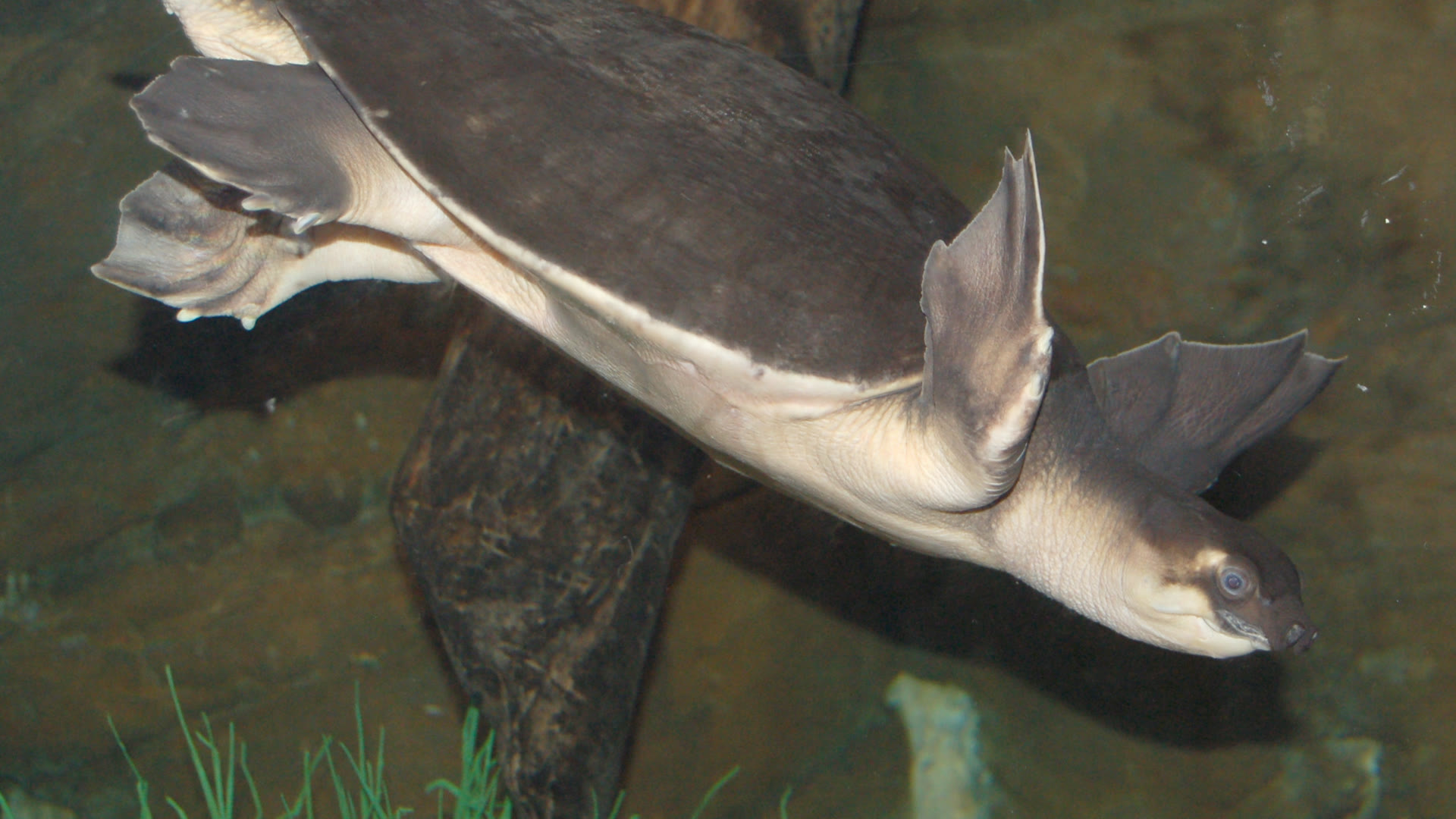
Species deep dive · pig nosed turtle
In late September 2026, two olive ridley sea turtles nested on Southern California beaches — the first documented natural sea-turtle nesting on the U.S. West Coast — and overnight everyone was asking how turtles haul out, how nests work, and which species still look half-marine even far inland. Wilder’s roster does not carry olive ridleys (yet). It does carry something stranger: the pig-nosed turtle, Carettochelys insculpta, a freshwater animal with sea-turtle flippers, a leathery shell, and a fleshy snorkel of a snout.
It is the only living member of Carettochelyidae — a turtle family that otherwise belongs to deep time. Australian Geographic frames the lineage as stretching back on the order of ~140 million years. In Wilder TCG the Pig-nosed Turtle is a Cost 4 Reptilia Water Guardian: a quirky mid-curve card whose real-world brief is “living fossil with flippers and a pig nose.”
Flippers on a river turtle
Most freshwater turtles row with clawed, paddle-ish feet. Pig-nosed turtles look like they borrowed the marine toolkit: oar-like foreflippers (each with two claws), webbed hind limbs, and a streamlined body under a shell covered in soft, pitted, scute-free leathery skin rather than the hard keratin plates most people picture. Smithsonian’s National Zoo notes they can reach roughly 70+ cm shell length and weights in the 20–30 kg range (Wilder’s guide cites up to ~75 cm and 20–30 kg). On land they are awkward; in water they are fast, agile swimmers that spend nearly their entire lives submerged.
Range is tight and tropical: the Daly and Alligator river systems of Australia’s Northern Territory, plus southern lowland rivers, lagoons, swamps, and sometimes brackish estuaries of New Guinea. Soft silty bottoms, aquatic plants, and water up to about seven meters deep are classic habitat. Females leave the water almost only to nest on sandy banks — which is why sandbank integrity (and trampling by livestock such as water buffalo in parts of Australia) matters so much to hatchling success.
The snorkel snout — and a throat that breathes a little
The common name is honest. A large, fleshy, pig-like proboscis puts the nostrils at the tip of a short tube so the turtle can breathe at the surface while the rest of the body stays hidden — a snorkel for murky rivers. The snout is also a sensory tool for finding food in low visibility.
They still need air, like every turtle. But Smithsonian and Australian Geographic both highlight an extra trick: papillae in the throat that absorb additional oxygen from water, extending how long the animal can linger submerged between breaths. Think of it as a physiological assist, not a true fish gill — careful wording for a Field Journal, not a claim that they abandon air breathing.
Diet is omnivorous and opportunistic: fallen fruit and flowers (figs, bush apple, eucalypt blooms that hit the water), aquatic plants, crustaceans, molluscs, insects, and small fish. Strong jaws and clawed flippers help tear tougher items.
Nesting, temperature, and an Endangered ledger
Gravid females dig nests on exposed sandy banks in the dry season, then return to water. Like many turtles, hatchling sex can be influenced by nest temperature — a detail that makes climate and shading on nest beaches more than academic. Globally the species is listed Endangered on the IUCN Red List (Eisemberg et al. 2018 reassessment from Vulnerable), with New Guinea populations — the bulk of the world total — under heavy pressure from harvest and habitat change. Australia separately lists it as Vulnerable under the EPBC Act; Australian numbers have been described as more stable than New Guinea’s, but the global story is still a declining living fossil.
Pet-trade and live-import debates simmer in the background; this piece stays with wild ecology. The Field Journal takeaway is the same one the California nesting spike made vivid for sea turtles: nesting beaches are a bottleneck, and a species that barely leaves the water still depends on a strip of sand.
On the Wilder card
In the Pig-nosed Turtle field guide entry you will find Water habitat tagging, Endangered conservation status, and Guardian flavor for a Cost 4 Reptilia presence — the game echo of a river relic that swims with flippers, breathes through a pig snout, and is the last of its family.
If you have never tried Wilder, guest play is free in the browser — open packs, build a deck, and put this snorkel-nosed river turtle on the table:
Quick facts
- Scientific name: Carettochelys insculpta
- Family: Carettochelyidae (sole living species)
- Hook: freshwater turtle with sea-turtle flippers; fleshy snorkel snout; throat papillae assist aquatic O₂ uptake; last of an ancient family
- Size: carapace to ~70–75 cm; ~20–30 kg
- Diet: omnivore — fruit, plants, crustaceans, molluscs, small fish
- Range: Northern Territory (Australia) + southern New Guinea; rivers, lagoons, swamps, some brackish water
- Nesting: females haul out onto sandy banks in the dry season
- Status: IUCN Endangered (global); EPBC Vulnerable (Australia)
- Wilder family: Reptilia · Water · Cost 4 · Guardian
Photo credit
Hero photograph: captkodak, "Pig-Nosed Turtle Carettochelys insculpta Diving 2260px" (Wikimedia Commons), CC BY-SA 2.5. Cropped for the Field Journal hero.

Sources
- Animal Diversity Web — Carettochelys insculpta
- Smithsonian's National Zoo — Fly River turtle
- Australian Geographic — Pig-nosed turtle fact file
- IUCN Red List — Carettochelys insculpta (Eisemberg et al. 2018)
- Australian Government SPRAT — Carettochelys insculpta
- Georges & Wombey (CRM account) — Carettochelys insculpta
- Wilder TCG — Pig-nosed Turtle field guide