Green Iguana: Arboreal Herbivore, Third Eye, and Invasive Colonizer
Species deep dive · green iguana
Search "green iguana" and you get two animals at once: a chill canopy leaf-eater draped over a riverside branch, and a canal-bank digger that Florida wildlife managers treat as an invasive pest. Both are Iguana iguana — one of the Neotropics' few large arboreal herbivores, and a species whose success story includes hurricane rafts, pet-trade escapes, and a literal third eye on the skull.
In Wilder TCG the Green Iguana is a Reptilia creature tied to Forest habitats (Cost 2). The card is shorthand for a real rainforest-edge specialist whose biology is leaf fermentation, salt sneezes, and a parietal eye — not a cartoon dinosaur costume.
Iguanid of the forest edge
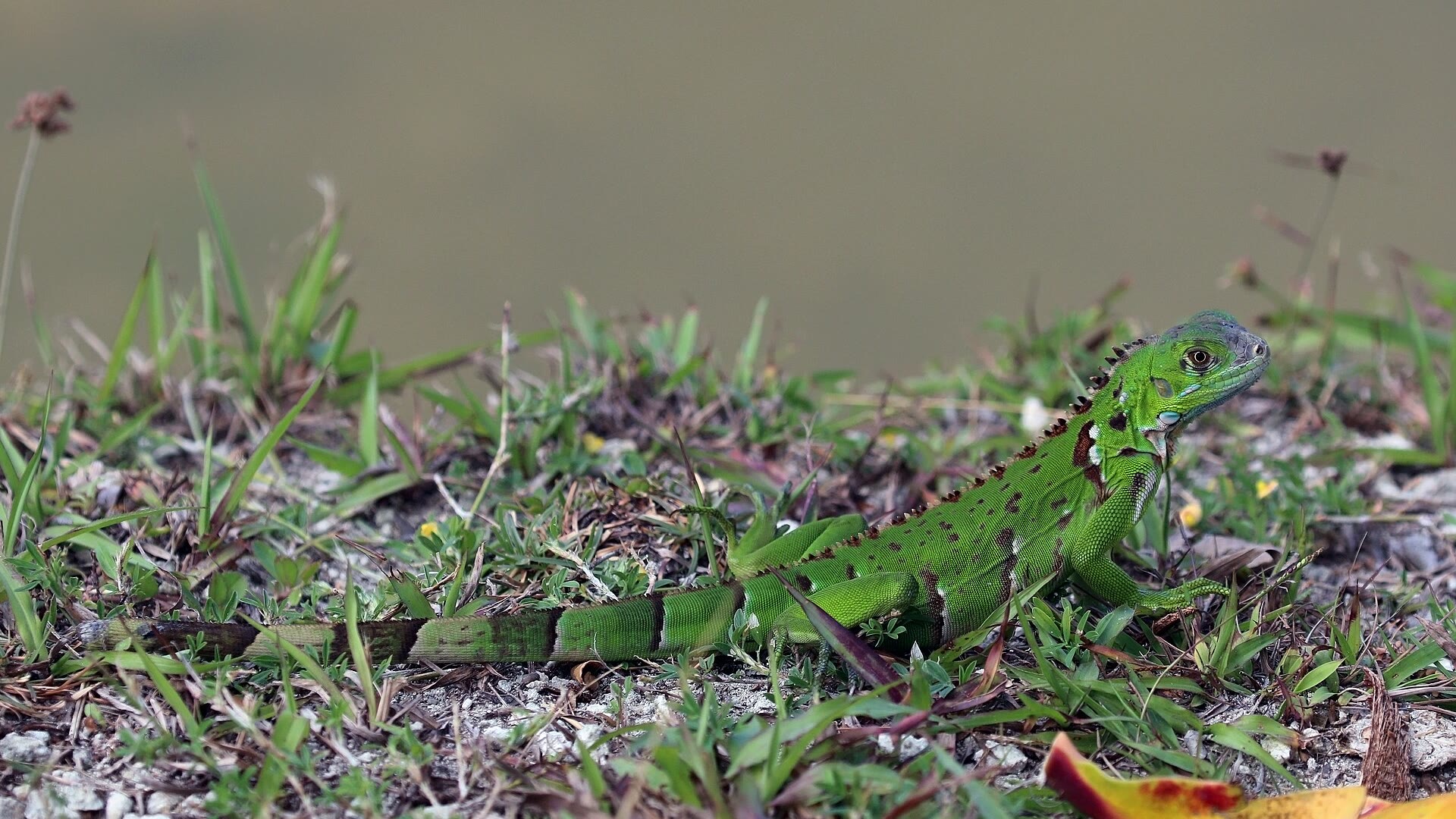
I. iguana belongs to Iguanidae (sometimes treated within Iguaninae), the clade of large-bodied, primarily herbivorous lizards that includes rock iguanas, chuckwallas, and the famous Galápagos and Fiji relatives. Adults can approach ~2 m total length with the long, banded tail dominating the measure; big males commonly weigh several kilograms (field guides and captive records often cite roughly 4–8+ kg). Neonates start brilliant green; adults darken, and breeding males may flash orange or gold.
Despite the "rainforest lizard" reputation, green iguanas are edge animals more than deep-interior ghosts. They occupy river margins, gallery forest, mangroves, dry forest, and even xeric shrub islands — usually close to water they can dive into when threatened. Native range runs from Mexico (Sinaloa and Veracruz) through Central America into tropical South America as far as Paraguay and southeastern Brazil, plus many Caribbean and coastal islands. Elevation is mostly lowland; successful wild reproduction above about 1,000 m is rarely documented.
Third eye, salt sneezes, and a fermentation gut
On the dorsal midline of the skull sits a parietal eye — a light-sensing organ with a rudimentary lens and retina, not a camera for detailed vision. Animal Diversity Web summarizes it as a solar-energy meter that also helps detect predatory shadows from above. Photoreceptor work on iguanas has documented UV-sensitive parapinopsin in the parietal eye and antagonistic UV-versus-visible chromatic responses — wavelength discrimination for a "third eye," not X-ray vision.
A plant-heavy diet dumps excess potassium (and sodium) into the body. Like other herbivorous iguanines, green iguanas use lateral nasal salt glands to dump salts as a white spray or crust around the nostrils — the famous "salty sneeze." Most cellulose breakdown happens in a sacculated hindgut packed with symbiotic microbes; hatchlings often eat adult feces, which may seed that fermentation community. Adults are primarily folivores and frugivores (leaves, flowers, fruit); insects, snails, or carrion show up more as incidental or opportunistic bites than as a hunting lifestyle.
When threatened they freeze, dive from overhanging branches, whip the long tail, or autotomize part of it and regenerate a shorter replacement. Head-bobs, dewlap flares, and femoral-pore scent marks handle territory and courtship. Females dig deep nesting burrows — sometimes shared, sometimes turned into complex multi-female tunnel systems — and typically lay on the order of tens of eggs (clutch size scales with female size; published ranges often span roughly 970+). Timing tracks dry-season nesting so hatchlings meet rainy-season flush of soft leaves.
Hurricane rafts and Florida canals
In 1995, Hurricanes Luis and Marilyn tore trees into the Caribbean. Censky, Hodge, and Dudley documented green iguanas that apparently rafted roughly 200 miles from Guadeloupe to Anguilla on a tangle of vegetation — enough animals to found a new population, and one of the clearest observed cases of over-water vertebrate colonization.
Human introductions tell a parallel story. Pet-trade releases and escapes established I. iguana in southern Florida from the 1960s onward; Florida Fish and Wildlife Conservation Commission now treats the species as invasive nonnative, noting landscape browsing, burrowing damage to seawalls and canal banks, and localized pressure on native plants and invertebrates. Similar introductions appear across Caribbean islands, Hawaii, and beyond. Native-range populations, meanwhile, still face local overharvest for meat, eggs, leather, and the pet trade even while the species as a whole is not globally threatened.
IUCN lists I. iguana as Least Concern; international trade is regulated under CITES Appendix II. "Least Concern" is a global status, not a free pass for every local population — and it sits beside the invasive reality outside the native map.
Paleontologists once named the dinosaur Iguanodon for tooth resemblance to living iguanas — a naming echo, not a claim that green iguanas are living dinosaurs.
From canopy edge to Wilder card
In the Green Iguana field guide entry you will find taxonomy, habitat, and in-game stats. On the board it plays as a Forest Reptilia presence — the game echo of a canopy leaf specialist that wins by height, armor spines, and a whip of regenerating tail rather than venom.
If you have never tried Wilder, guest play is free in the browser open packs, build a deck, and put a salt-sneezing canopy lizard on the table:
Quick facts
- Scientific name: Iguana iguana (Linnaeus, 1758)
- Family: Iguanidae (iguanine herbivores)
- Hook: parietal "third eye"; nasal salt glands; hindgut fermentation herbivore
- Size: up to ~2 m total length; adults often several kg (big males heavier)
- Native range: Mexico to tropical South America + Caribbean islands; edge and canopy habitats near water
- Invasive note: established in southern Florida (and elsewhere) via pet trade; documented 1995 hurricane raft to Anguilla
- Status: IUCN Least Concern; CITES Appendix II
- Wilder family: Reptilia · Forest · Cost 2
Photo credit
Hero photograph: Charles J. Sharp, "Green iguana (Iguana iguana) juvenile" (Wikimedia Commons_juvenile.jpg)), CC BY-SA 4.0. Cropped for the Field Journal hero.
Sources
- Animal Diversity Web — Iguana iguana
- IUCN SSC Iguana Specialist Group — Iguana iguana
- IUCN Red List — Iguana iguana
- Florida Fish and Wildlife Conservation Commission — Green Iguana
- Censky, Hodge & Dudley (1998) Nature — Over-water dispersal of lizards due to hurricanes
- Wada et al. (2012) PLOS ONE — UV-sensitive parapinopsin in iguana parietal eyes
- Wilder TCG — Green Iguana field guide