Green Anaconda: World's Heaviest Snake in the Flooded Basin
Species deep dive · green anaconda
Green Anaconda: World's Heaviest Snake in the Flooded Basin
Search "biggest snake" and you will usually meet two names: reticulated python for length, green anaconda for bulk. Eunectes murinus is the heaviest living snake — a semiaquatic boa that turns murky water into camouflage and uses constriction, not venom, to end a meal.
In Wilder TCG the Green Anaconda is a Rare Reptilia creature with Ambush. The card is shorthand for a living log that waits until the river runs red.
Taxonomy and size (with the hype dialed down)
Kingdom Animalia → Chordata → Reptilia → Squamata → Boidae → Eunectes → E. murinus (Linnaeus, 1758). Recent genetic work has also discussed a northern lineage sometimes treated as E. akayima; field notes here stick to the classic green anaconda complex unless a source splits them.
Mature females dwarf males — extreme sexual size dimorphism. Typical large females often fall around ~4–6 m; males commonly nearer ~3 m. Verified museum-grade monster lengths of 9–12 m lack solid deposits; treat viral school-bus claims as folklore until measured. Weights swing with recent meals. Field work that examined large samples (notably Jesús Rivas) places carefully measured heavy females near ~100 kg class, while popular summaries still cite much heavier extremes. The safe ecological claim: for a given length, anacondas are far bulkier than reticulated pythons — mass, not tape-measure drama, is the title.
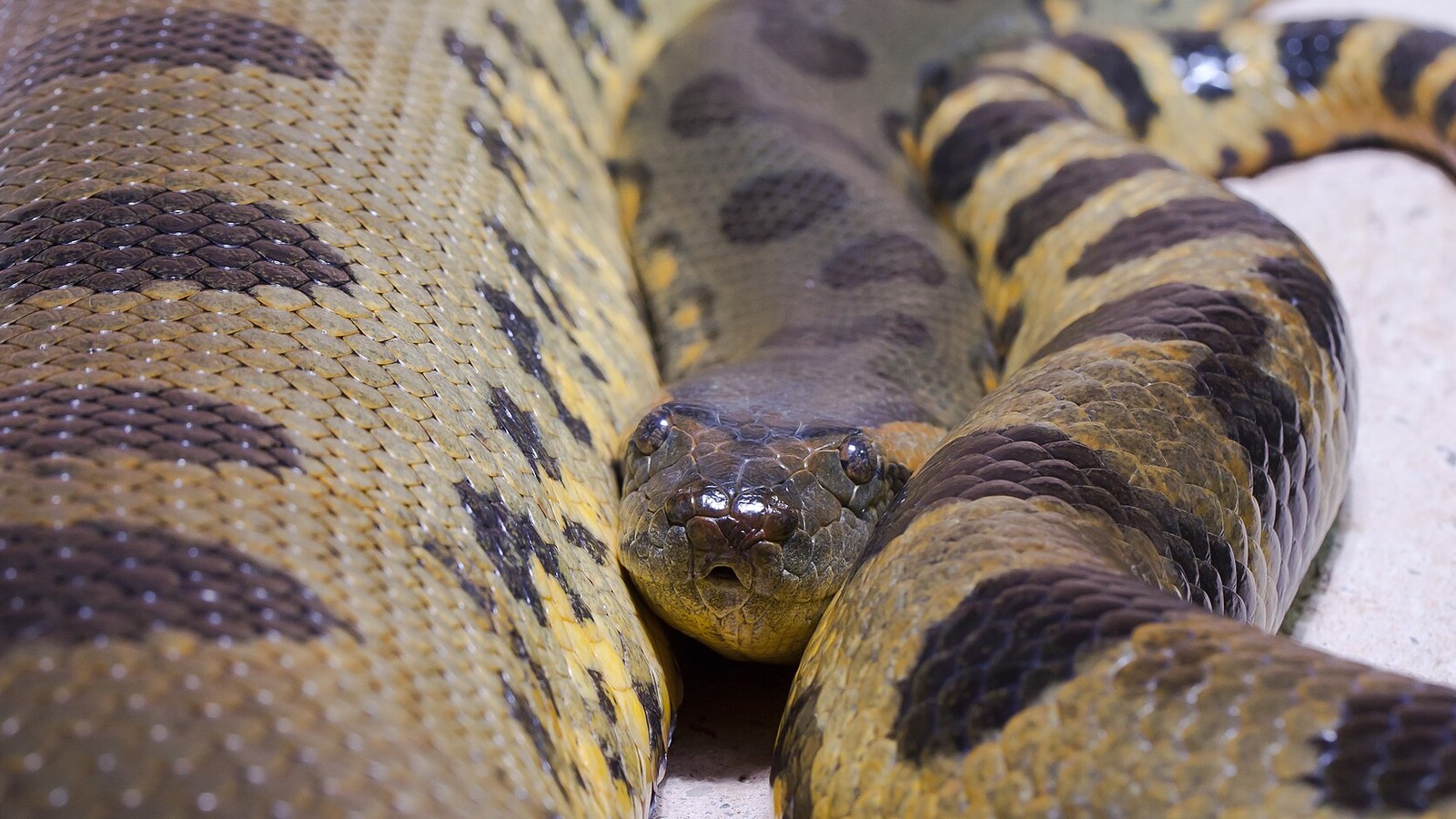
Olive to brown bodies carry oval black blotches; smooth scales and dorsal eyes/nostrils suit a life half-submerged.
Wetland ambush ecology
Range centers on the Amazon and Orinoco basins east of the Andes — Brazil, Colombia, Venezuela, the Guianas, Ecuador, Peru, Bolivia, northern Paraguay, and Trinidad among others — in swamps, marshes, oxbows, slow rivers, and seasonally flooded savanna. Buoyancy turns their girth from a land liability into a stealth asset: they float with little more than eyes and nostrils showing, then strike.
Diet is broad and size-scaled: fish, turtles, birds, capybaras, caimans, deer, peccaries, and other vertebrates that drink or swim too close. Constriction stops circulation and breathing; jaws and stretchy ligaments then walk the prey down. Digestion can idle for weeks after a large meal. They are not venomous — medical panic copy that treats them like cobras is wrong biology.
Occasional jaguar-or-anaconda conflict stories circulate; treat individual anecdotes as rare events, not a species personality. Florida has a small number of verified wild green anaconda observations as a prohibited nonnative risk — native story remains South American wetlands.
Breeding balls and live young
Mostly solitary outside mating season. When a receptive female advertises, multiple males may coil into a slow breeding ball lasting days to weeks. Females are ovoviviparous: after roughly 6–7+ months of gestation they give birth to live young in water — often on the order of ~20–40 neonates (litters can run lower or higher), already able to swim and hunt. Neonates are roughly two feet class at birth; parental care ends at delivery.
Daytime basking and crepuscular or nocturnal hunting fit a dim, watery niche. On land they are powerful but clumsy; in water they are the ambush specialists the myths exaggerate.
Conservation without the cryptid
IUCN lists green anaconda as Least Concern on the strength of a wide range, while habitat conversion, roads, fishing bycatch, and local killing still matter. They help regulate large wetland prey. Stable global status is not a license to invent abundance numbers we do not have.
From flooded basin to Wilder card
In the Green Anaconda field guide entry you will find taxonomy, habitat, and in-game stats. On the board, Ambush mirrors the half-submerged wait — one clean strike after patience, not a chase across dry ground.
If you have never tried Wilder, guest play is free in the browser — open packs, build a deck, and put a Green Anaconda on the table:
Quick facts
- Scientific name: Eunectes murinus (Linnaeus, 1758)
- Claim to fame: heaviest living snake (bulkier than longer reticulated pythons)
- Size (careful): large females often ~4–6 m; males smaller (~3 m); extreme length claims need hard evidence
- Reproduction: live-bearing; breeding balls; neonates independent in water
- IUCN: Least Concern (wide Neotropical wetland range)
- Wilder family: Reptilia · Rare · Ambush
Photo credit
Hero photograph: Diego Delso, "Anaconda común (Eunectes murinus), Tierpark Hellabrunn" (Wikimedia Commons), CC BY-SA 3.0. Cropped for the Field Journal hero.
