Emperor Penguin: Winter Breeding on Fast Ice
Species deep dive · emperor penguin
Emperor Penguin: Winter Breeding on Fast Ice
Search "emperor penguin" and you get the same images: tuxedo birds marching across Antarctica, fathers cradling eggs through the polar night. That postcard is real biology. Aptenodytes forsteri is the only penguin that breeds through the Antarctic winter — and it depends on fast ice (sea ice fastened to the coast, seafloor, or grounded icebergs) staying stable long enough for chicks to fledge.
In Wilder TCG the Emperor Penguin is an Uncommon Aves creature with Herd and Resilient. The card is shorthand for a social ice specialist whose survival trick is cooperation under extremes.
The largest living penguin
Adults typically measure about 110–120 cm in length and weigh roughly 22–45 kg, with males often heavier early in the breeding season. Plumage is sharply two-toned: black dorsal feathers against a white belly, pale-yellow breast, and bright yellow ear patches. Like all penguins it is flightless, with wings stiffened into flippers for underwater pursuit.
At sea, emperors are pursuit divers. Routine foraging dives often fall in the tens to a few hundred metres; exceptional recorded dives have exceeded 500 m, with breath-holds sometimes approaching or exceeding 20 minutes. Solid (non-pneumatic) bones reduce barotrauma risk, and specialised haemoglobin and myoglobin help the bird function at very low oxygen levels while heart rate and non-essential organ activity drop.
Diet is opportunistic within Antarctic waters: mainly fish (often Antarctic silverfish), plus krill and squid depending on colony and season.
Winter fathers and rotating huddles
Breeding begins in autumn as adults trek inland across sea ice — often on the order of tens of kilometres — to colonies that can hold hundreds to many thousands of pairs. As of recent satellite surveys, researchers recognise on the order of sixty-plus breeding locations around Antarctica.
The female lays a single egg (May–June), transfers it to the male, and returns to sea to feed. The male alone incubates for roughly two months, balancing the egg on his feet under a brood patch while air temperatures can plunge far below freezing and katabatic winds roar. He may fast for around four months from arrival through incubation, losing a large fraction of body mass. If the egg is dropped onto bare ice for more than about a minute or two in deep cold, the embryo is usually lost.
Males survive by forming dense huddles that slowly rotate: birds on the windward edge shuffle toward shelter so everyone shares time in the warmer core. Insulation comes from dense plumage (contour feathers plus downy underlayers), subcutaneous fat, and countercurrent heat exchange in the limbs.
After hatching, the father can briefly feed the chick a protein- and lipid-rich oesophageal secretion ("crop milk") until the mother returns with regurgitated seafood. Parents then take turns foraging while chicks later form crèches. Emperors are serially monogamous within a season; fidelity between years is low (on the order of ~15% in studied colonies), because the breeding window is short.
Fast ice or failure
Chicks need stable ice from egg-lay through fledging (roughly April into December/January depending on site). Early spring break-up can dump unfledged chicks into the sea — catastrophic breeding failure. Satellite monitoring documented widespread failure linked to record-low sea ice in 2022, and earlier colony losses (including the disappearance of the long-studied Dion Islands colony) already showed how fragile ice-obligate breeding can be.
In April 2026, IUCN moved the emperor penguin from Near Threatened to Endangered, citing projections that the global population could roughly halve by the 2080s without sharp cuts in greenhouse gas emissions. Satellite work indicated about a 10% adult population loss between 2009 and 2018 (tens of thousands of birds). Emperors are sentinels: their ice platform is a climate instrument.
Predators include leopard seals and orcas at sea, and giant petrels (plus skuas) that take chicks on ice. None of those rivals matches the long-term pressure of disappearing fast ice.
From Antarctica to Wilder card
In the Emperor Penguin field guide entry you will find taxonomy, habitat, and in-game stats. On the board, Herd echoes colony living — strength in numbers — while Resilient nods to surviving one lethal hit the way incubating fathers and rotating huddles buy another day on the ice.
If you have never tried Wilder, guest play is free in the browser — open packs, build a deck, and put an Emperor Penguin on the table:
Quick facts
- Scientific name: Aptenodytes forsteri (Gray, 1844)
- Size: ~110–120 cm length; ~22–45 kg (seasonal)
- Diet: fish, krill, squid
- Breeding: winter on Antarctic fast ice; male-only incubation ~2 months
- Dive extremes: recorded >500 m; breath-holds up to ~20+ minutes
- IUCN: Endangered (2026 assessment; climate / sea-ice driven)
- Wilder family: Aves · Uncommon · Herd, Resilient
Photo credit
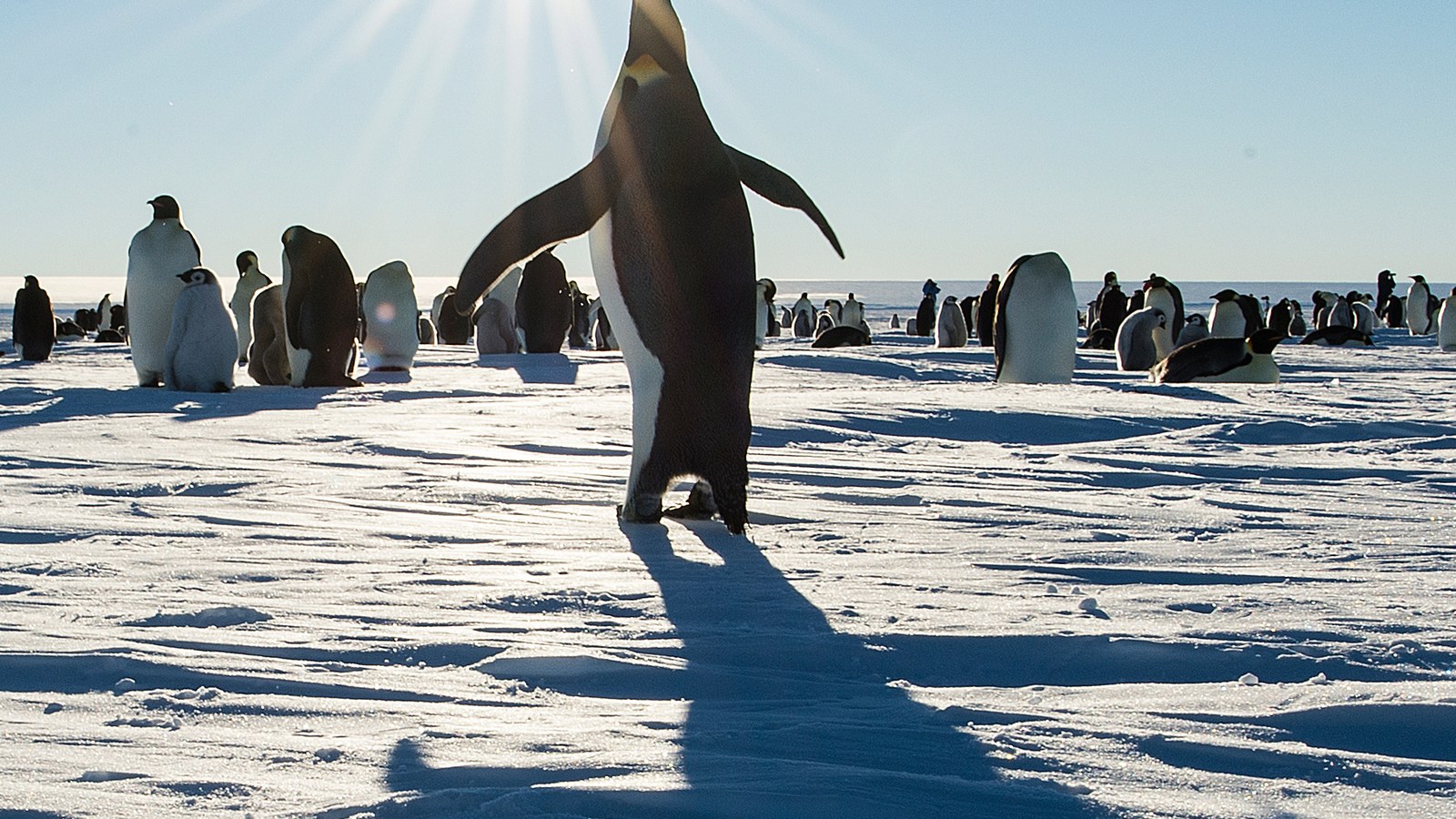
Hero photograph: Christopher Michel, "Emperor Penguin (Aptenodytes Forsteri)" (Wikimedia Commons.jpg)), CC BY 2.0. Cropped for the Field Journal hero.