Andean Condor: 3-Meter Wings, Thermals, and Andes Scavenging
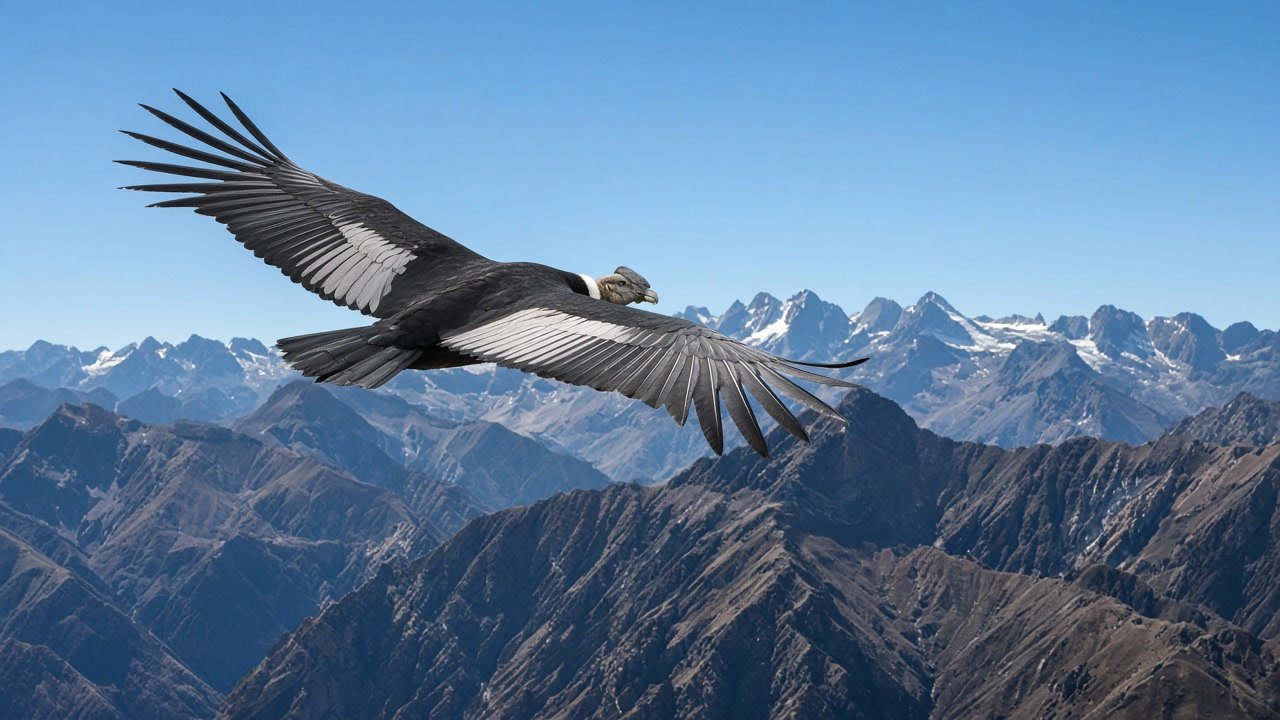
This is a generated illustration, not a photograph.
Species deep dive · andean condor
Three meters of wing and almost no flap: Vultur gryphus turns rising Andean air into a living elevator. The Andean Condor is among the world's largest flying birds — an obligate scavenger of the high cordillera and some Pacific coasts, built for thermals, cliff ledges, and patience.
In Wilder TCG the Andean Condor is an Aves creature of the Air at Cost 5. The card is shorthand for soaring economics: find the thermal, ride it, and let gravity and carcasses do the rest.
Wingspan, comb, and Cathartidae
Adult wingspans commonly fall around ~3.0–3.3 m. Males are the larger sex and carry a fleshy comb (caruncle) over the bill plus conspicuous neck wattles; females are smaller, without the comb, and often show redder irises in field guides. The species belongs to Cathartidae — New World vultures — not the Old World Accipitridae vultures of Africa and Eurasia, though the ecological niche (large scavenger on open terrain) rhymes.
Range runs the Andes from Venezuela and Colombia south to Tierra del Fuego, with birds using páramo grassland, sheer cliffs, and in places foggy Pacific coastal desert where marine mammal carrion supplements terrestrial kills. Nest sites are remote cliff ledges; there is little nest architecture — often a bare scrape on rock.
Thermals first, flap almost never
Andean Condors are obligate scavengers of large mammal and marine carrion — guanaco, livestock, deer, seals, stranded whales — not active hunters of healthy prey. Foraging is a soar: broad wings and light wing-loading let birds hitch thermals and ridge lift for long distances with minimal flapping. Sharp eyes from altitude find carcasses; smaller scavengers may arrive first, but mass and hierarchy matter once a condor lands.
Reproduction is slow. Pairs are long-lived and typically produce one egg on a multi-year cycle often summarized as roughly every other year, with long parental care after hatch. That low reproductive rate is why persecution and poisoning bite hard: adults are expensive to replace.
Cooling quirks fit the scavenger toolkit. Urohidrosis — wetting the legs with urine for evaporative cooling — is documented in New World vultures including this species. A bare head and neck are widely framed as a hygiene adaptation for burying into carcasses (and for UV exposure helping keep skin cleaner) — useful popular science if you keep the wording cautious and skip invented biochemistry.
Icon, Vulnerable, and reintroduction
The condor is a cultural emblem on Andean coats of arms — a brief national-symbol note, not a folklore essay. IUCN lists it Vulnerable. Threats stack: intentional and secondary poisoning, lead from ammunition in carcasses, shooting and persecution, and declines in wild food or open foraging habitat. Captive-breeding and reintroduction programs across parts of the Andes aim to restock local skies where wild recruitment alone cannot keep pace.
Longevity is extreme for a bird: decades in the wild are plausible; captive birds have approached on the order of ~80 years. Longevity plus slow breeding is the conservation math in one sentence.
From thermal to Wilder card
In the Andean Condor field guide entry you will find taxonomy, habitat, and in-game stats. On the board, an Air bird at Cost 5 echoes the real soarer: high energy to play, then the board starts feeling like open sky.
If you have never tried Wilder, guest play is free in the browser — open packs, build a deck, and put an Andean Condor on the table:
Quick facts
- Scientific name: Vultur gryphus
- Family: Cathartidae (New World vultures)
- Size: wingspan ~3.0–3.3 m; males larger with comb/caruncle
- Diet: obligate scavenger — large mammal and marine carrion
- Key traits: thermal soaring; cliff-ledge nests; ~1 egg on a slow multi-year cycle
- IUCN: Vulnerable (poisoning, lead, persecution, food/habitat pressure; reintroductions ongoing)
- Wilder family: Aves · Air · Cost 5