Hoatzin: Stinkbird, Cow-Like Gut, and Clawed Chicks
Species deep dive · hoatzin
The hoatzin (Opisthocomus hoazin) is a chicken-sized Amazon bird that digests leaves the way a cow digests grass — in a giant, microbe-packed crop — and raises chicks that can swim, dive, and climb with temporary wing claws. Locals have long called it the stinkbird for the manure-like smell of that fermenting foregut.
If you came here asking why hoatzins smell, or why their babies have claws on their wings: both traits are real, well studied, and unique among living birds.
A flying cow's gut
Hoatzins are among the world's few obligate folivorous birds. They browse young leaves, buds, flowers, and some fruit along Amazon and Orinoco river edges, often favoring legumes. Digestion happens mainly in an enormous crop and lower esophagus packed with symbiotic microbes — the only documented case of active foregut fermentation in a bird (Grajal, Strahl and colleagues, Science 1989). The crop can outweigh the tiny stomach by a huge margin; meals ferment for many hours before the bird can fly far or feed chicks with regurgitated mash.
That microbial engine also produces methane and the famous odor. It is not a disease and not rotting meat — it is leaf fermentation. The trade-off is a shallow sternum and weak flight: adults clamber through riverside scrub more than they soar.
Clawed chicks over water
Nests sit on branches over water. Chicks hatch alert and mobile. When a monkey, snake, or researcher approaches, they may drop into the water, swim or dive away, then haul themselves back up using two claws on the wing digits (on the first and second fingers). Those claws are lost as the bird matures — they are a juvenile climbing tool, not a permanent "living dinosaur" costume, even if the comparison to Archaeopteryx is irresistible.
Adults nest colonially in the wet season, communicate with rasps and hisses, and rarely leave the flooded gallery forest that feeds them.
Range, look, and status
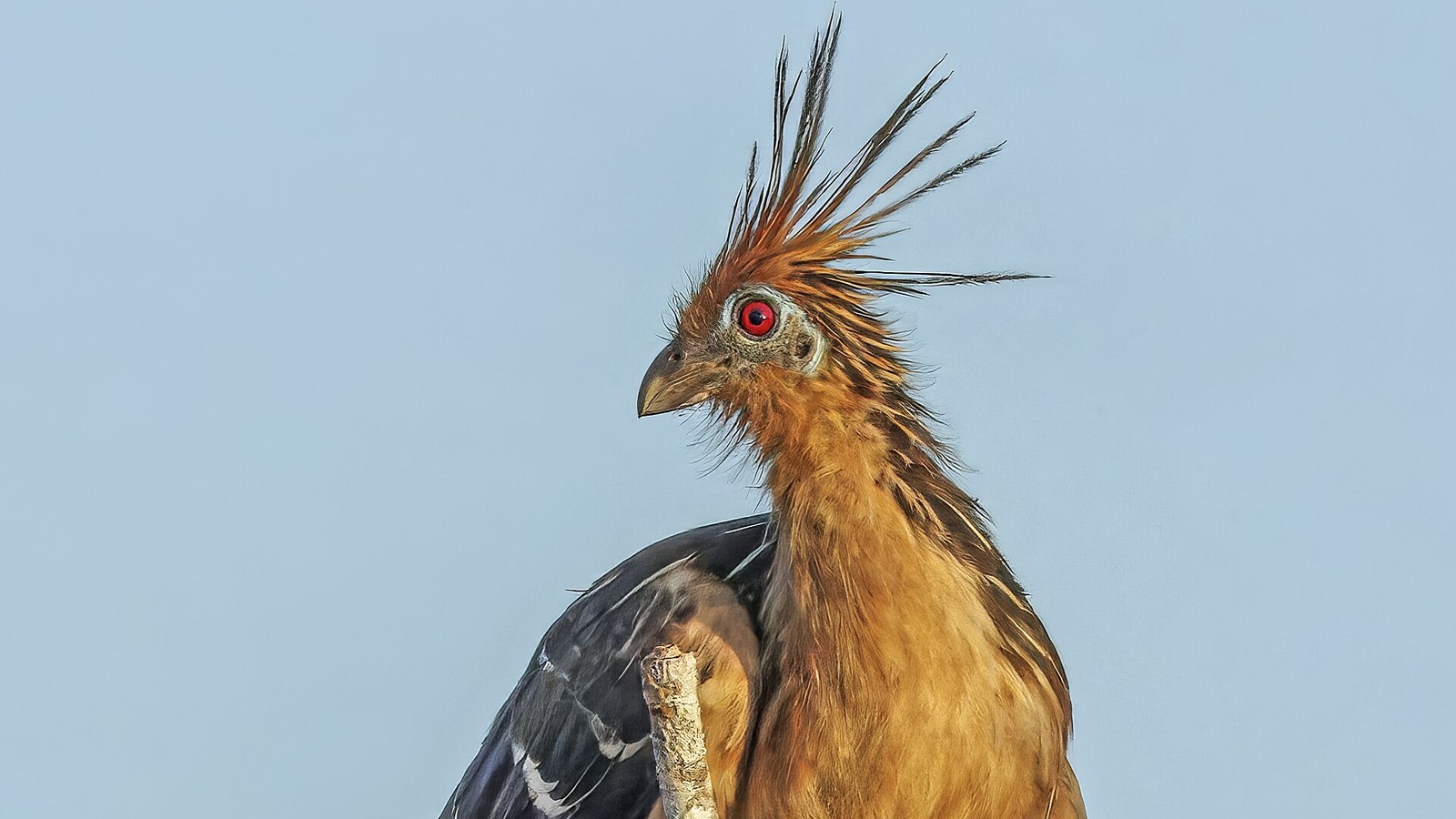
Look for the spiky rufous crest, bare blue facial skin, and red iris along lowland swamps, mangroves, and oxbow lakes east of the Andes — from the Guianas through Amazonia into Bolivia, Brazil, Colombia, Ecuador, Peru, and neighbors, usually below a few hundred meters. Guyana features the bird (as the Canje pheasant) on its coat of arms.
The IUCN lists the species as Least Concern: it remains widespread and locally common where riverside forest survives, though local declines follow deforestation, agriculture, and disturbance. Protecting seasonally flooded forest protects the leaf buffet the gut evolved for.
On the Wilder card
Wilder ships *Hoatzin (Opisthocomus hoazin)* in Aves — a Forest-cost swamp specialist that celebrates the stinkbird niche. Pair this piece with that page when you want the physiology story behind the crest: foregut fermentation, clawed nestlings, and why "weird" can still be Least Concern if the rivers stay wooded.
For another Amazon parental extreme, see our caecilian dermatophagy Journal — different class, same reminder that Neotropical wetlands rewrite the textbook.
Photo credit
Hero photograph: Charles J. Sharp — Hoatzin (Opisthocomus hoazin), Rio Napo — Wikimedia Commons, CC BY-SA 4.0.

Questions people ask
Why does the hoatzin smell like manure?
Because of foregut fermentation. Microbes in its enlarged crop break down leaves the way rumen microbes break down grass, producing a manure-like odor. It is digestion chemistry, not rotting flesh (Grajal et al. 1989; Current Biology primer).
Do hoatzin chicks really have claws on their wings?
Yes. Nestlings have two functional claws on the wing digits that help them climb back to the nest after dropping into water to escape predators. Adults lose those claws (Birds of the World; ADW).
Is the hoatzin the only bird that ferments food like a cow?
It is the only bird with documented active foregut fermentation in an enlarged crop and esophagus. Many birds ferment in the hindgut; hoatzins ferment leaves up front before the stomach (Science 1989).
Where do hoatzins live?
In lowland swamps, mangroves, and river-edge forest of the Amazon and Orinoco basins across northern and central South America. See Wilder's Hoatzin card for the playable swamp-forest summary.
Is the hoatzin endangered?
The IUCN lists it as Least Concern. It remains widespread where riverside forest persists, but local declines follow habitat clearing and disturbance (BirdLife DataZone; Birds of the World).
Sources
- Grajal et al. 1989 — Foregut Fermentation in the Hoatzin
- Wright, Yacoub & Hespell 2009 — Rumen-like methanogens in the hoatzin crop
- Current Biology — The Hoatzin (primer)
- Birds of the World — Hoatzin Opisthocomus hoazin
- Animal Diversity Web — Opisthocomus hoazin
- BirdLife DataZone — Hoatzin Opisthocomus hoazin
- Wilder — Hoatzin card