Peregrine Falcon: 200 mph Stoop and a DDT Comeback
Species deep dive · peregrine falcon
Peregrine Falcon: 200 mph Stoop and a DDT Comeback
Falco peregrinus — "wandering falcon" — breeds on every continent except Antarctica. Ask what makes it famous and you get two answers that both hold: a hunting dive that can exceed 200 mph, and a mid-century crash-and-rebuild that became a textbook Endangered Species Act success.
In Wilder TCG the Peregrine Falcon is a Rare Aves creature with Ambush. The card is shorthand for a sky missile — speed and surprise, not a myth that every stoop is a guaranteed kill.
Taxonomy and the pointed-wing silhouette
Kingdom Animalia → Chordata → Aves → Falconiformes → Falconidae → Falco → F. peregrinus.
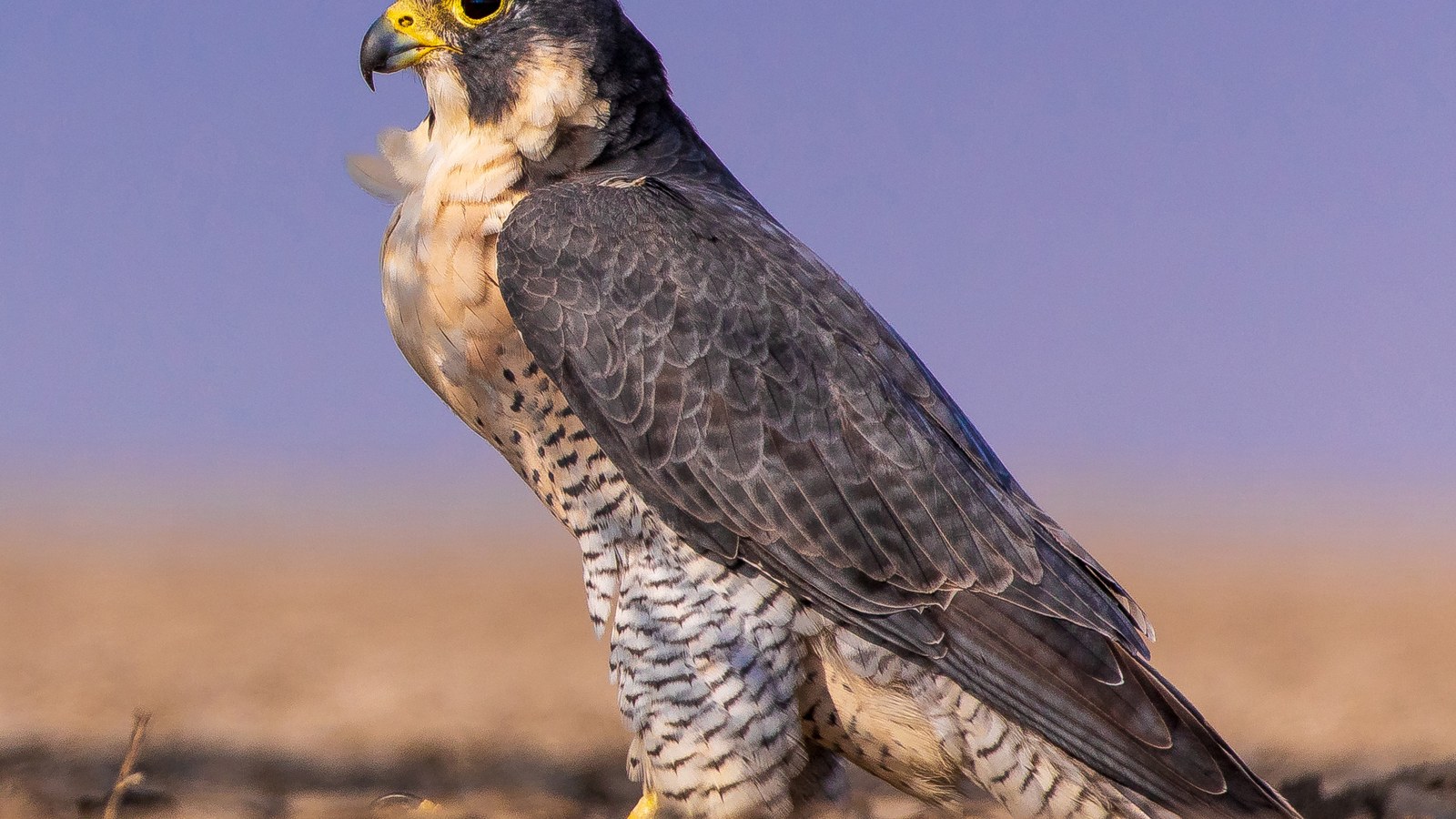
Adults are compact power: dark hooded head, blue-gray upperparts, barred underparts; juveniles browner and streaked. Females run larger than males (typical for many raptors). Field summaries put length roughly 33–50+ cm, wingspan about 74–120 cm, and mass from under half a kilogram up toward ~1.5 kg depending on sex and subspecies.
They do not build stick nests. Eggs go in a simple scrape on a cliff ledge, building cornice, bridge, or sometimes an old nest of another large bird. Sites can be reused for decades.
The stoop — fast, with receipts
Cruising flight is already quick (often cited around 25–35 mph, with faster level pursuits). The signature move is the stoop: fold, drop from hundreds of feet (sometimes much higher), and strike prey in the air with closed feet, then finish with a neck bite if needed. Reliable popular science and field-guide language lands around ~200 mph in a dive; a frequently cited high measured figure is about 242 mph. Older folklore claimed far higher — treat those as unverified. Not every hunt is a stoop; level chases, perch-launched attacks, and even ground takes happen.
Diet is overwhelmingly birds — pigeons in cities, shorebirds and ducks along coasts, songbirds and more inland — with occasional bats or small mammals. Success rates are imperfect; the spectacle is real, the outcome is not automatic.
Anatomical notes that survive careful wording: a tomial tooth on the beak helps dispatch prey; a nictitating membrane protects the eye in a dive; bony structures in the nostrils help manage high-speed airflow (often compared, carefully, to engineering baffles).
Cliffs, tundra, and downtown ledges
Habitat is "open sky plus a high nest and flying prey." That means Arctic cliffs, desert canyons, coasts, wetlands, and — famously — skyscrapers and bridges where feral pigeons are the buffet. Northern breeders may migrate enormous distances (Arctic nearly to southern wintering grounds); equatorial and some coastal birds stay put. Global breeding population estimates land on the order of ~340,000 (Partners in Flight / Cornell summaries).
Pairs are territorial around the nest. Clutch size is commonly 2–5 eggs; incubation is mostly female for roughly a month; young fledge in about 5–7 weeks and may linger while they learn to hunt.
DDT, eggshells, and delisting
Mid-20th-century organochlorine pesticides — especially DDT and its metabolite DDE — accumulated up the food chain. Contaminated prey led to eggshell thinning; eggs broke under incubating parents. Eastern North American breeding populations collapsed; the species vanished from large parts of its former U.S. range.
The U.S. banned DDT in 1972. Captive breeding and "hacking" releases (The Peregrine Fund and partners among leaders) put thousands of young birds back onto cliffs and cities — Peregrine Fund materials cite 4,000+ released in their accounting of the North American effort; broader cooperative tallies often run higher. The American peregrine was removed from the U.S. Endangered Species List in 1999. IUCN now rates the species Least Concern. It remains protected under laws such as the Migratory Bird Treaty Act; CITES Appendix I covers commercial-trade restrictions for many populations.
Local pressures (contamination, collisions, disturbance) still exist. The arc is still one of the clearest "ban the toxin + breed + release" wins in modern conservation.
Falconry and careful cultural notes
Peregrines have been prized in falconry for centuries — royalty's bird in many traditions — and trained birds are sometimes used at airports to haze flocking species away from runways. That human partnership helped recovery logistics (handling and captive-breeding know-how), but it does not make every wild bird a pet. Keep cultural notes light and sourced; skip invented folklore.
From stoop to Wilder card
In the Peregrine Falcon field guide entry you will find taxonomy, habitat, and in-game stats. On the board, Ambush echoes the high-to-low strike that ends a hunt.
If you have never tried Wilder, guest play is free in the browser — open packs, build a deck, and put a Peregrine Falcon on the table:
Quick facts
- Scientific name: Falco peregrinus
- Also called: duck hawk (older North American name)
- Size: ~33–50+ cm long; ~74–120 cm wingspan; ~0.4–1.5 kg
- Diet: primarily birds (pigeons, shorebirds, ducks, songbirds); occasional bats/mammals
- Key traits: dive speeds ~200+ mph; scrape nests on cliffs/buildings; near-global range
- IUCN: Least Concern (U.S. ESA delisted 1999 after DDT-era crash)
- Wilder family: Aves · Rare · Ambush
Sources
- Cornell Lab — All About Birds: Peregrine Falcon
- Cornell Lab — Peregrine Falcon Life History
- Audubon Field Guide — Peregrine Falcon
- The Peregrine Fund — Peregrine Falcon
- Wilder TCG — Peregrine Falcon field guide
Photo credit
Hero photograph: Sumeet Moghe, "Peregrine Falcon (male) cropped" (Wikimedia Commons_cropped.jpg)), CC BY-SA 4.0. Cropped for the Field Journal hero.