Do Oystercatchers Actually Eat Oysters?
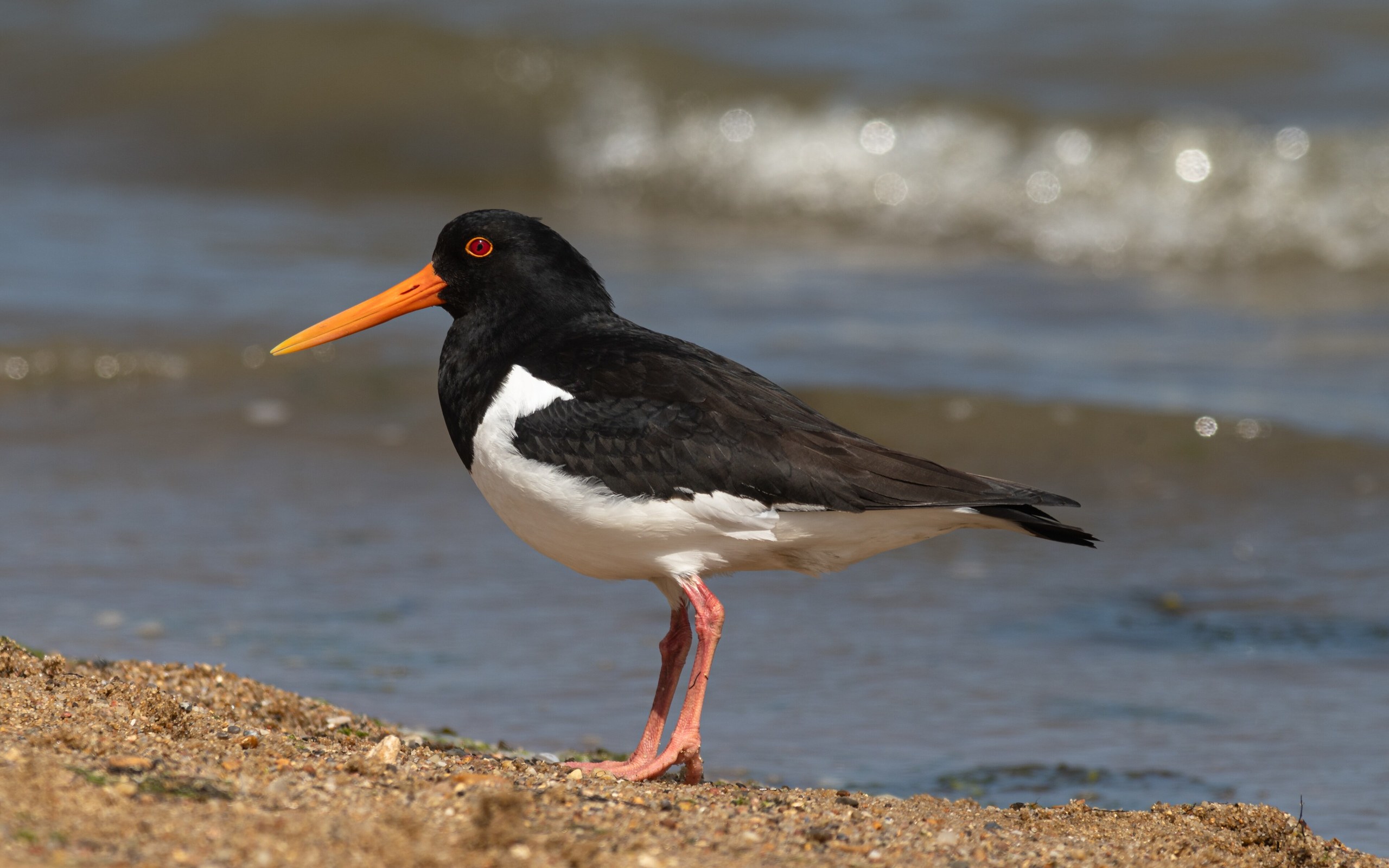
Species deep dive · eurasian oystercatcher
Rarely, at least in Europe. Despite its name, the Eurasian oystercatcher (Haematopus ostralegus) lives mainly on cockles, mussels and worms. In winter, oystercatchers on English estuaries "rely heavily on Cockles and Blue Mussels" (BTO), which they prise or hammer open with their strong bills (RSPB). Oysters hardly feature. The invasive Pacific oysters that have spread over mussel beds in the Dutch Wadden Sea are, "with a few recorded exceptions", not eaten by oystercatchers at all (van de Pol et al. 2014).
So where did the name come from?
From America. The bird's older English name was "sea pie", and the BTO still lists Sea Pie as its folk name (BTO). The English naturalist Mark Catesby coined "oyster catcher" in 1731 after watching the American species eat oysters, and William Yarrell made it the standard name in his 1843 bird guide (Audubon California). The European bird inherited a name earned by its cousin.
A bill that reshapes itself
The really surprising thing about an oystercatcher is its bill. Its horny outer layer grows about 0.4 mm a day, and the tip wears down at the same pace, so the bill's shape follows what the bird eats (Hulscher, Netherlands Journal of Zoology). Experiments with captive birds showed that diet shapes the bill, not the other way round (Swennen et al. 1983):
| Feeding style | What the bird does | Bill tip it ends up with |
|---|---|---|
| Prober | Pulls worms out of mud | Pointed |
| Stabber | Jabs between the two halves of a shell | Chisel-shaped |
| Hammerer | Pounds through the shell itself | Blunt |
Changing technique takes about two to three weeks while the bill regrows, and it costs the bird, so most oystercatchers stick to one style. Only about 30% change their bill shape from one year to the next (van de Pol et al. 2009, Ardea). The shift is easy to see when birds move inland to breed. Within three or four weeks of arriving from the Wadden Sea, blunt and intermediate bill tips turn pointed, and every inland breeder studied had a pointed bill, the shape that goes with probing for soft-bodied prey rather than opening shells. Females also have longer bills than males (Hulscher).
Chicks that get fed
Oystercatcher parents carry food to their young and present it to them, and keep doing so until the chick has learned to feed itself. The ornithologist Michael Norton-Griffiths suggested this parental feeding evolved because very small chicks can't manage the specialised techniques adults use to open shellfish (Norton-Griffiths 1969, Behaviour).
October is estuary season
From autumn, oystercatchers gather in big flocks along the shore (RSPB). Britain holds about 305,000 in winter (2012–17 estimate), against about 96,000 breeding pairs, and Britain and Ireland support a significant share of the world population (BTO). Morecambe Bay holds more wintering oystercatchers than anywhere else in the UK, with about 40,000 counted at high-tide roosts in one recent winter (RSPB).
Why a common bird is Near Threatened
Globally, the Eurasian oystercatcher is listed as Near Threatened (IUCN Red List). The main European population grew to more than a million birds between the 1960s and 1990s, then fell by about 200,000, mostly in the Dutch, German and Danish Wadden Sea. The Dutch decline is put down largely to mechanical shellfish dredging, which removed the mussels and cockles the birds need to get through winter (van de Pol et al. 2014). In the UK, breeding numbers fell 23% between 1995 and 2024 and winter numbers 19% between 1998 and 2023 (BTO).
A very long life
Oystercatchers that survive to breeding age (usually about 4) live around 12 years on average. The oldest ringed bird in Britain reached 41 years and 1 month (BTO), and the European record is a Dutch bird whose ring was read in the field at 47 years and 1 month (EURING).
On the Wilder card
The Eurasian Oystercatcher is a Rare Aves (Water) card: Cost 2, Attack 2, Health 2, with Ambush. Ambush suits a stabber that drives its bill in the moment a mussel opens its shell. The flavour text says "This beak was made for cracking shells and stealing the spotlight." It's a cheap card you can get down early, and you can play it in the free browser collectible card game. For another shellfish specialist, see the sea otter, which uses rocks instead of a bill.
The short version: oystercatchers rarely eat oysters. They live on cockles, mussels and worms, their fast-growing bills wear into a probe, chisel or hammer to suit each bird's diet, and they can live for more than 40 years.
Photo credit
Hero photograph: Hobbyfotowiki, Eurasian oystercatcher (Haematopus ostralegus) at Amrum, Wikimedia Commons, CC0 1.0 (public domain dedication). Cropped for the Field Journal hero.

Questions people ask
What does an oystercatcher sound like?
Loud. Its call is a sharp, piercing "peep" or short whistle, a familiar and easily recognised sound of the seashore (IUCN UK Peatland Programme; RSPB).
Do oystercatchers migrate?
Some do. Most UK oystercatchers winter on the coast, where birds from Norway and Iceland join them (IUCN UK Peatland Programme). Birds from Scandinavia and the Low Countries form a separate continental population with little mixing (BTO), and the main subspecies winters as far south as Ghana (van de Pol et al. 2014).
Do oystercatchers nest inland?
Yes, more and more. Over the last 50 years oystercatchers have moved inland to breed beside rivers and lakes (IUCN UK Peatland Programme). Britain's breeding range grew about 28% since the 1970s, almost all of it inland (BTO), and they even turn up in car parks and on urban rooftops (RSPB).
How many eggs does an oystercatcher lay?
Usually 2 or 3. Both parents incubate for 24–27 days, and the downy chicks fledge after 34–37 days. In Britain the first clutch is laid on average around 19 May, and pairs raise one brood a year (BTO). See the Wilder card.
Sources
- BTO BirdFacts — Oystercatcher (Haematopus ostralegus)
- RSPB — Oystercatcher
- van de Pol et al. 2014, International Wader Studies 20 — A global assessment of the conservation status of the nominate subspecies of Eurasian Oystercatcher
- Audubon California (2012) — How did the Oystercatcher get its name?
- Hulscher, Netherlands Journal of Zoology 35 — Growth and abrasion of the oystercatcher bill in relation to dietary switches
- Swennen, De Bruijn, Duiven & Leopold 1983, Netherlands Journal of Sea Research 17 — Differences in bill form of the oystercatcher; a dynamic adaptation to specific foraging techniques
- van de Pol, Ens, Oosterbeek, Brouwer et al. 2009, Ardea 97 — Oystercatchers' bill shapes as a proxy for diet specialization
- Norton-Griffiths 1969, Behaviour 34 — The organisation, control and development of parental feeding in the oystercatcher
- IUCN Red List — Haematopus ostralegus (BirdLife International)
- EURING European Longevity Records (2023-09-01)
- IUCN UK Peatland Programme — Oystercatcher