Which Big Cats Can Actually Roar (and Why Cheetahs Purr Instead)
Species deep dive · african lion, tiger, snow leopard, cheetah, mountain lion
Only four cats alive today can truly roar: the lion, the tiger, the jaguar and the leopard. The snow leopard belongs to the same big-cat genus, Panthera, but cannot roar. The cheetah, the puma (our mountain lion) and the other smaller cats don't roar either. They purr instead. The difference sits in the larynx: roaring cats have huge vocal folds with a thick pad of fibro-elastic tissue, and the snow leopard and the small cats don't (Hast 1989, Journal of Anatomy; Smithsonian's National Zoo; IUCN Cat Specialist Group).
Who roars, who purrs: the quick list
- Roar: African lion, tiger, jaguar and leopard. A jaguar's usual call is a "saw", which WWF says sounds like sawing wood with the saw only moving one way (WWF). A leopard's call is a "sawing roar" of repeated low strokes, often audible from at least a kilometre away (University of Exeter).
- *In Panthera, but no roar:* the snow leopard. It chuffs, mews, hisses, growls, moans and yowls instead (Snow Leopard Trust).
- Purr, never roar: the cheetah, puma, bobcat, Eurasian lynx, wildcat and the house cat on your sofa (Library of Congress, citing Peters 2002; Peters 2002, Mammal Review).
What it takes to roar
A team at the University of Veterinary Medicine Vienna dissected lions, tigers, jaguars, a cheetah and house cats, and proposed that a real roar has two separate ingredients (Weissengruber et al. 2002, Journal of Anatomy):
- A low pitch, which comes from long, heavy vocal folds.
- A deep, booming timbre, which comes from a long vocal tract. In adult lions, tigers and jaguars the larynx sits far down the neck, near the chest. The distance from lips to vocal folds was about 38 cm in their lion, 29 cm in a tiger and 31–33 cm in jaguars, against 21 cm in the cheetah and 8 cm in a house cat.
The first ingredient is the one the snow leopard is missing. When Michael Hast dissected the larynges of 14 cat species, he found that lions, tigers, leopards and jaguars have proportionately very large vocal folds whose front part is a big pad of fibro-elastic tissue. Other cats have smaller, sharp-edged folds (Hast 1989).
A 2011 study of lion and tiger vocal folds from Omaha's Henry Doorly Zoo looked inside that pad (Klemuk et al. 2011, PLOS ONE). The folds have a deep layer packed with fat cells under a dense, fat-free surface layer, which gives them a large, flat, almost square face. The authors think the fat mostly shapes the fold and cushions it, rather than simply adding weight. That shape makes the folds unusually easy to set vibrating: earlier tests on tiger larynges needed only about 0.2–0.4 kPa of air pressure, lower than people use for normal conversation. The result, as the same paper sums up from earlier recordings, is a roar at about 114 dB measured 1 m away, and lion roaring bouts can last up to 90 seconds with up to 50 calls.
The hyoid myth
You will often read that big cats roar because their hyoid, the chain of small bones that holds up the tongue and larynx, is partly made of stretchy ligament, while small cats purr because theirs is solid bone. The idea goes back to anatomist Richard Owen in the 1830s (Weissengruber et al. 2002).
It doesn't hold up. The snow leopard has that same elastic ligament in its hyoid, yet it has never been heard to roar (Hast 1989). Back in 1994, a review of felid hyoids and larynges by Gustav Peters and Hast already concluded that the data showed no specific link between a bony or bendy hyoid and the ability to purr or roar. The Vienna team argues that the flexible hyoid does a different job: it lets the larynx sit low, which lengthens the vocal tract and deepens the roar's timbre, and it has no direct effect on purring (Weissengruber et al. 2002).
Why the snow leopard can't roar
The snow leopard has the roaring cats' bendy hyoid but not their voice box. Hast found its vocal folds are proportionately shorter and lack the big fibro-elastic pad, which is why it can't produce a roar (Hast 1989). Later work describes its vocal folds as intermediate between the roaring cats and the rest of the family (Weissengruber et al. 2002). Its friendly greeting is the chuff, a soft puff of air through the nose (Snow Leopard Trust). Our snow leopard deep dive covers the rest of its sound repertoire and its giant tail, and has our short video on why it can't roar.
Why cheetahs purr instead
The cheetah has none of the roaring equipment. Its hyoid is fully bony, and its larynx sits high in the throat in about the same place as a house cat's (Weissengruber et al. 2002). The Smithsonian's National Zoo says cheetahs don't roar but purr, bark, growl, hiss and above all chirp, a bird-like call that can be heard about a mile (1.6 km) away. Their purr sounds just like a house cat's. It can go on for minutes, is often heard between mothers and cubs, and keeps going while the cat breathes both in and out (Smithsonian's National Zoo). That in-and-out rhythm is what makes a "true" purr (Library of Congress).
How a purr is made is still being worked out. The classic explanation is very rapid twitching of the muscles inside the vocal folds, driven by a rhythm generator in the brain (Weissengruber et al. 2002; Library of Congress). But in 2023, researchers blew air through larynges from eight house cats, with no nerves or muscles working, and all eight produced vibrations at purring rates of 25–30 Hz. House cats turn out to have their own vocal-fold pads, connective-tissue masses up to 4 mm across, which seem to let the folds vibrate that slowly (Herbst et al. 2023, Current Biology). So roaring cats and house cats both have pads in their vocal folds, just very different ones.
Can roaring cats purr?
Not in the true sense. In Gustav Peters' review of purring, the lion, tiger, jaguar, leopard, snow leopard and clouded leopard were not found to purr properly (Library of Congress, citing Peters 2002). Lions can make a purr-like sound, but the University of Minnesota's Lion Research Center notes that they only make it while breathing out, not continuously like a house cat (Lion Research Center). The snow leopard is the grey area: the Snow Leopard Trust lists a purr among its sounds, while Peters' review doesn't count it as true purring (Snow Leopard Trust). So the old rule of thumb, "a cat can roar or purr but not both", mostly holds, with the snow leopard as the open question. The reason just lies in the vocal folds, not the hyoid.
On the Wilder cards
In Wilder, the free browser collectible card game, the roarers are the heavy hitters. The African Lion is a Mythic (Cost 5, Attack 6, Health 5, Ambush and Herd) whose flavour text is all about the roar: "One roar, and the whole savanna knows who owns the night." The Tiger is a Mythic too (Cost 6, Attack 7, Health 6, Ambush, Camouflage and Relentless). The non-roarers rely on stealth and speed: the Snow Leopard is a Rare with Ambush and Camouflage, the Cheetah is a Rare that hits for 5 but has only 3 Health, and the Mountain Lion is an Uncommon with Ambush and Feast.
The short version: lions, tigers, jaguars and leopards roar because their big, fat-padded vocal folds make a low, loud sound and their low-set larynx gives it a deep boom. The snow leopard has the flexible hyoid but not the padded folds, so it chuffs. Cheetahs, pumas and other small cats purr on the in-breath and the out-breath, something no roaring cat can truly do.
Photo credit
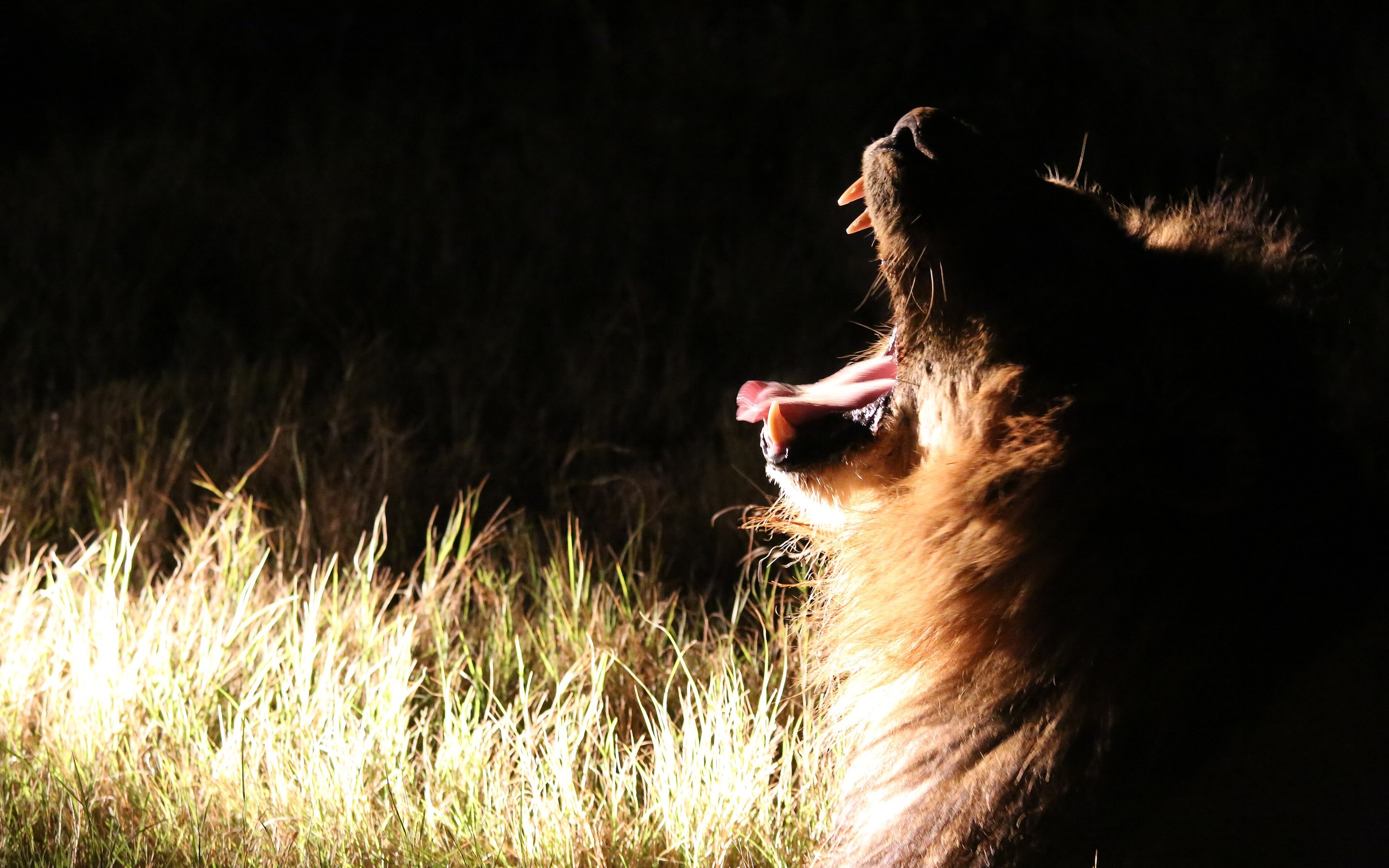
Hero photograph: flowcomm, Roaring lion, MalaMala Game Reserve, South Africa, Wikimedia Commons.jpg), CC BY 2.0. Cropped for the Field Journal hero.
Questions people ask
How far away can you hear a lion roar?
Over 8 km (5 miles) on the open savanna. The Smithsonian's National Zoo notes that one male lion was measured roaring at 114 decibels, nearly as loud as a thunderclap (Smithsonian's National Zoo). Meet the roarer on the African Lion card.
Do female big cats roar too?
Yes. WWF notes that both male and female jaguars roar, and the calls help them find each other to mate (WWF). Female leopards roar as well: a 2024 leopard study notes that both males and females are known to roar (Growcott et al. 2024, Remote Sensing in Ecology and Conservation).
Can mountain lions roar?
No. The IUCN Cat Specialist Group says the puma lacks the elastic hyoid and enlarged vocal folds of the roaring cats, so it can't roar. It chirps, hisses, growls and whistles instead (IUCN Cat Specialist Group), and it is one of the cats that truly purrs (Library of Congress). See the Mountain Lion card.
What sound does a cheetah make instead of a roar?
Mostly a chirp. It sounds like a bird's chirp or a dog's yelp and can carry about a mile (1.6 km). Females in heat chirp to attract males, and coalition males chirp when they get separated. Cheetahs also make a stuttering call, a meow-like "eeaow", growls, hisses and purrs (Smithsonian's National Zoo). See the Cheetah card.
Can scientists tell individual leopards apart by their roars?
Yes, with high accuracy. In Tanzania's Nyerere National Park, researchers paired 50 camera-trap stations with microphones and found that the timing pattern of each leopard's sawing roar identified individuals with 93.1% accuracy (University of Exeter).
Sources
- Hast 1989, Journal of Anatomy — The larynx of roaring and non-roaring cats
- Weissengruber et al. 2002, Journal of Anatomy — Hyoid apparatus and pharynx in the lion, jaguar, tiger, cheetah and domestic cat
- Klemuk et al. 2011, PLOS ONE — Adapted to Roar: Functional Morphology of Tiger and Lion Vocal Folds
- Herbst et al. 2023, Current Biology — Domestic cat larynges can produce purring frequencies without neural input
- Peters 2002, Mammal Review — Purring and similar vocalizations in mammals
- Library of Congress — Why and how do cats purr?
- Smithsonian's National Zoo — Cheetah
- Smithsonian's National Zoo — Do lions actually purr?
- University of Minnesota Lion Research Center — FAQ
- IUCN SSC Cat Specialist Group — Puma
- Snow Leopard Trust — Behavior
- WWF — Top 10 facts about jaguars
- University of Exeter — Leopards can be identified by their roar
- Growcott et al. 2024, Remote Sensing in Ecology and Conservation — The secret acoustic world of leopards