Snow Leopard: The Big Cat That Can't Roar (and Its Giant Tail)
Species deep dive · snow leopard
Can snow leopards roar? No. The Snow Leopard (Panthera uncia) is the one member of the big-cat genus Panthera that cannot roar. Its vocal folds lack the thick fibro-elastic pad that lets lions, tigers, leopards and jaguars push out a deep roar, so it chuffs, mews, growls, hisses, moans and yowls instead (IUCN Cat Specialist Group; Hast 1989, Journal of Anatomy; Snow Leopard Trust).
What a snow leopard sounds like instead
The friendly call is the chuff, also called prusten: a short, breathy puff made by blowing air through the nose with the mouth closed. Snow leopards use it as a non-aggressive greeting, and WWF lists mews, growls and yowls as the rest of the repertoire (WWF; Snow Leopard Trust). Yowls are heard especially in the breeding season, which runs from early January to mid-March (IUCN Cat Specialist Group).
A tail almost as long as the cat
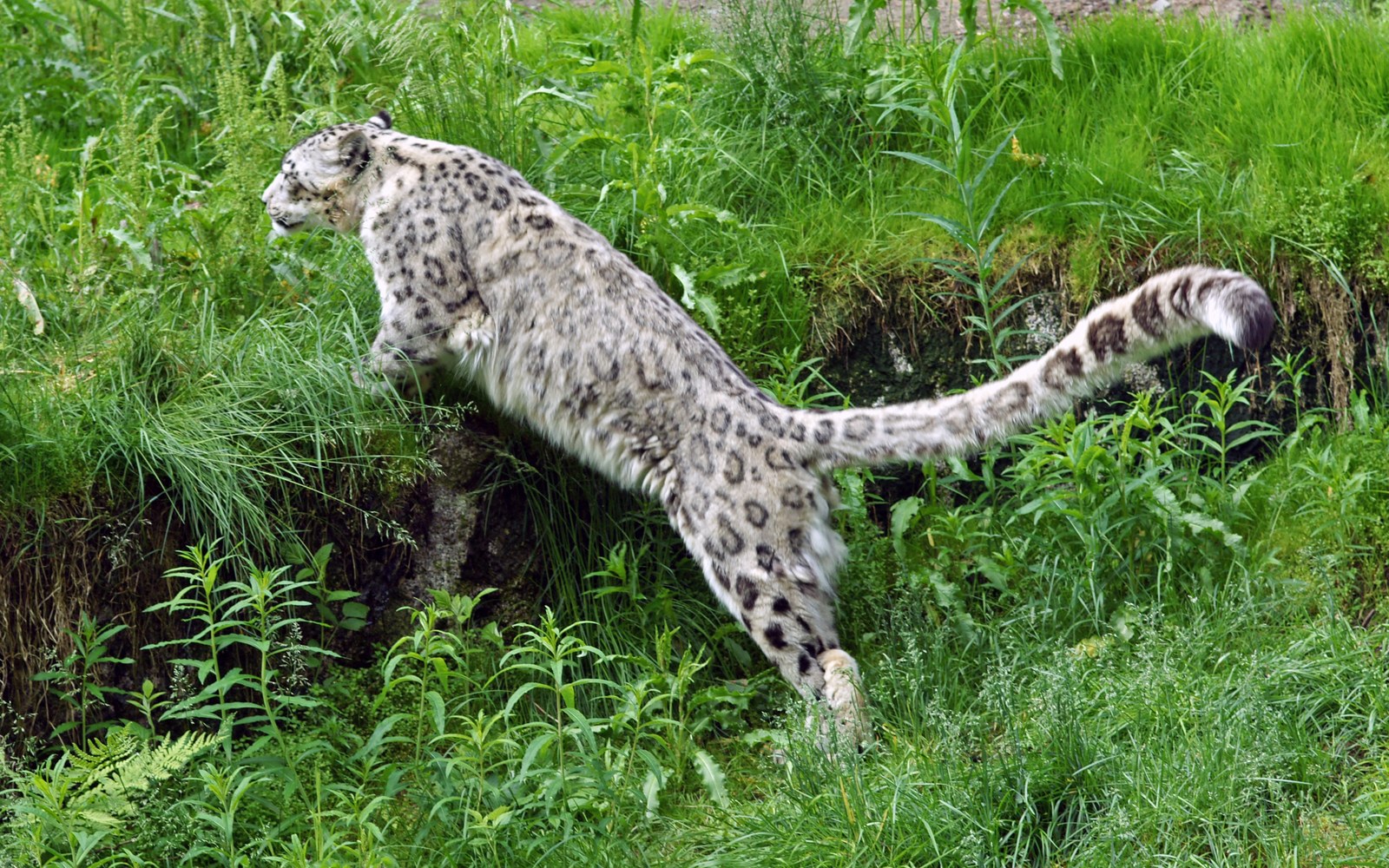
The bushy tail is the snow leopard's signature: up to about 1 m long, or 75–90% of the head-and-body length (80–100 cm on a body of 90–120 cm). On steep, broken slopes it works as a counterweight for balance, and at rest the cat wraps it around its body and face for warmth (IUCN Cat Specialist Group; Panthera).
Built for thin, cold air
Snow leopards usually live at 3,000–5,000 m, occasionally above 5,500 m in the Himalaya, though at the northern edge of their range they come down to 600–2,500 m. Their kit includes an enlarged nasal cavity, short forelimbs with strong chest muscles, big furry paws that work like snowshoes, and a winter coat up to 12 cm long on the belly (IUCN Cat Specialist Group; WWF). Panthera calls it the densest and longest fur of any big cat (Panthera). The adaptation goes down to DNA as well: the first big-cat genome comparison found snow-leopard-specific changes in EGLN1 and EPAS1, two genes tied to high-altitude adaptation in people (Cho et al. 2013, Nature Communications).
Hunting from above, and falling
These solitary cats are most active at dawn and dusk. They stalk wild sheep and goats such as blue sheep, ibex and argali from higher ground, then chase them down steep slopes. They can kill animals up to three times their own weight and may stay with a carcass for up to a week; in Mongolia, snow leopards stayed on an ibex kill for 2.59 days on average (IUCN Cat Specialist Group). The terrain bites back: Panthera notes that falling off cliffs while hunting may be one of the leading natural causes of death in wild snow leopards (Panthera).
The "ghost of the mountains" and people
The nickname comes from how rarely anyone sees one. Camouflaged grey fur, huge home ranges (GPS-collared cats in Mongolia's South Gobi used 100 to over 1,000 km²) and rugged ground make them very hard to study (WWF; IUCN Cat Specialist Group). They are also remarkably shy around people: the Snow Leopard Trust states there has never been a verified snow leopard attack on a human (Snow Leopard Trust).
How many are left?
Nobody knows precisely. The IUCN Red List moved the snow leopard from Endangered to Vulnerable in 2017, and its assessment counts 2,710–3,386 mature individuals. Older whole-population guesses range from about 4,000 to 6,500 cats, and Panthera stresses that the move to Vulnerable does not mean the species is safe (IUCN Cat Specialist Group; Panthera). Better counts are coming country by country: India's first national survey (2019–2023) estimated 718 snow leopards, 477 of them in Ladakh (Press Information Bureau, Government of India). The main threats are retaliatory killing over livestock losses, poaching, fewer wild prey animals and climate change.
How the snow leopard plays in Wilder
In Wilder the Snow Leopard is a Cost 5 Mammalia Tundra Rare (ATK 5 / HP 4) with Ambush and Camouflage. Its flavor text reads "Tail coiled like a scarf, it melts into the high ridges." Ambush lets it strike the turn it is played, which suits a cat that waits on a ridge before it pounces.
Play Wilder free in your browser. It's a free browser collectible card game, and no signup is needed.
Photo credit
Hero photograph: kallerna, "Snow leopard (Uncia uncia) in Ähtäri Zoo" (Wikimedia Commons), CC BY-SA 3.0. Cropped for the Field Journal hero.

Questions people ask
Do snow leopards actually live in snow?
Only part of the year. Most snow leopard range is cold, arid or semi-arid mountain shrubland, grassland and steppe, usually at 3,000–5,000 m, where snow comes and goes with the seasons. In Russia and parts of the Tian Shan they also use open conifer forest (IUCN Cat Specialist Group). See the Snow Leopard card.
Is a snow leopard a type of leopard?
No. It is its own species, Panthera uncia, in the big-cat genus. Despite the name, the IUCN Cat Specialist Group and Panthera describe it as most closely related to the tiger, although some genetic studies place it nearer lions and leopards (IUCN Cat Specialist Group; Panthera).
How many cubs does a snow leopard have?
One to five, most often two or three. Cubs are born blind but already furry, open their eyes after about a week and depend on their mother for at least a year (WWF). Gestation is 98–104 days, most births come in May–June, and young disperse at 18–22 months (IUCN Cat Specialist Group).
How long do snow leopards live?
About 10–20 years, according to the IUCN Cat Specialist Group. They reach sexual maturity at 2–3 years, and the oldest recorded successful breeding in captivity was by a 15-year-old female (IUCN Cat Specialist Group).
Which countries do snow leopards live in?
Twelve countries in Central and South Asia, including China, Mongolia, India, Nepal, Bhutan, Pakistan, Afghanistan and Russia. About half of the habitat is in China (WWF; Panthera). The range follows the Himalaya, Karakoram, Hindu Kush, Pamir, Tian Shan, Kun Lun and Altai (IUCN Cat Specialist Group).
Sources
- Snow leopard species account (IUCN SSC Cat Specialist Group)
- The larynx of roaring and non-roaring cats (Hast 1989, Journal of Anatomy)
- Snow leopard behavior (Snow Leopard Trust)
- Where do snow leopards live? And 9 other facts (WWF)
- Snow leopard (Panthera)
- The snow leopard's shift from Endangered to Vulnerable, explained (Panthera)
- The tiger genome and comparative analysis with lion and snow leopard genomes (Cho et al. 2013, Nature Communications)
- Snow Leopard Population Assessment in India (Press Information Bureau)
- Uncia uncia Ähtäri 2 (Wikimedia Commons)