African Bush Elephant: Largest Land Animal, Size, and the 2021 Endangered Split
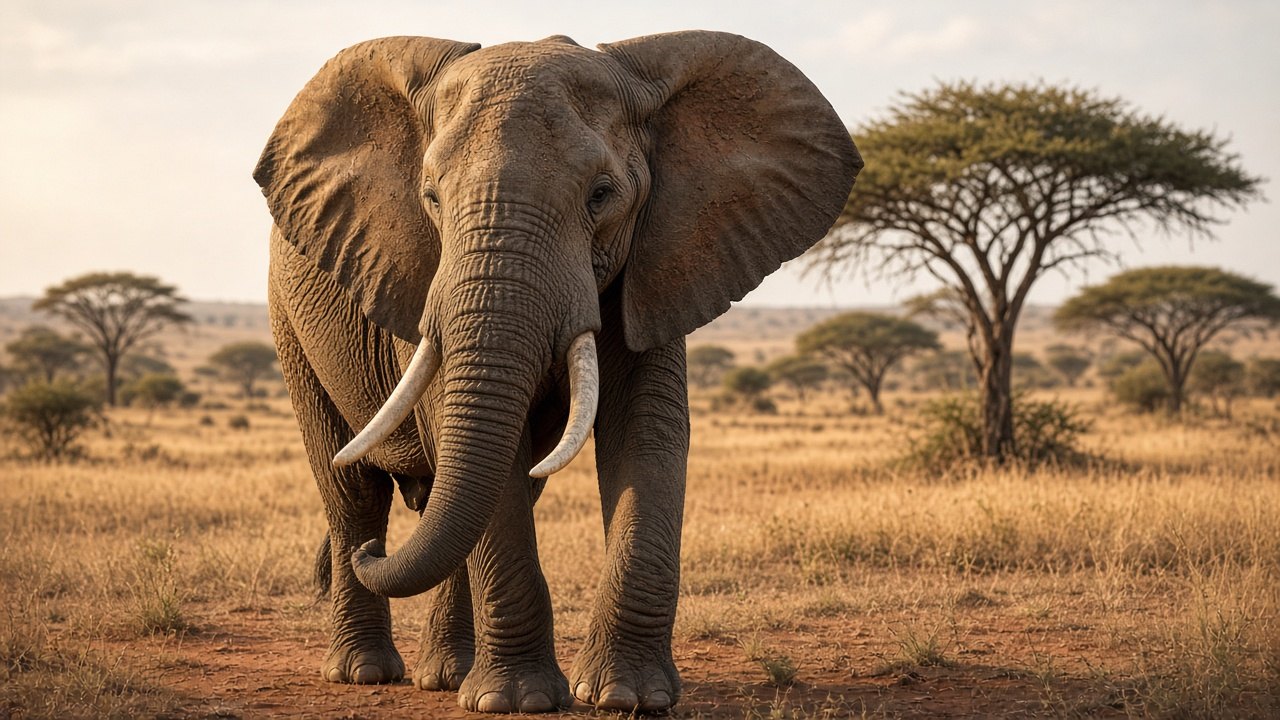
This is a generated illustration, not a photograph.
Species deep dive · african bush elephant
African Bush Elephant: Largest Land Animal, Size, and the 2021 Endangered Split
The African bush elephant (Loxodonta africana), also called the African savanna elephant, is the largest land animal on Earth. Fully grown bulls average about 3.2 m (10.5 ft) at the shoulder and 6 tonnes; cows average about 2.6 m and 3 tonnes (Larramendi 2016).
It is not the same animal as the African forest elephant (Loxodonta cyclotis). Forest elephants are much smaller, with rounder ears and straighter, downward-pointing tusks, and they live in the tropical forests of Central Africa and parts of West Africa rather than open savanna. In 2021 the IUCN assessed the two as separate species for the first time: the bush elephant is Endangered, the forest elephant Critically Endangered. Beyond the numbers, the bush elephant is a keystone herbivore that reshapes grasslands by eating, toppling, digging, and walking.
In Wilder TCG it is a Mythic Mammalia creature on the African Bush Elephant card, with Guardian, Herd, Trumpet Blast, and Stampede: a board presence that matches the real animal's weight class.
How big and how heavy?
Fully grown bulls commonly stand about 3.0–3.4 m (about 10–11 ft) at the shoulder and weigh on the order of 5–7 tonnes (~11,000–15,000 lb). Exceptional historical specimens have been recorded near 4 m and over 10 tonnes. Cows are smaller but still massive.
The silhouette is unmistakable: a concave back, huge heat-shedding ears (often compared to the shape of Africa), curved ivory tusks in both sexes (bulls' tusks grow faster and heavier on average), and a trunk with two finger-like tips (Asian elephants have one). That trunk is a precision tool and a crowbar—often cited as packing on the order of 40,000 muscle units—used to browse, drink, dust-bathe, snorkel while swimming, and greet herd mates.
Ecosystem engineer
Bush elephants are herbivores that can put away on the order of 150 kg of forage a day and drink roughly 150–230 liters of water when available. Grasses, bark, leaves, roots, and fruit all go on the menu. By pushing over trees, opening thickets, and carving paths to water, they keep some landscapes more open and create habitat opportunities for other species. Seed dispersal in dung is part of the same engineering job.
They use low-frequency infrasound and can detect seismic cues through their feet—long-distance communication that fits animals whose home ranges are measured in many kilometers.
Herds, musth, and memory
Family groups are typically led by an older matriarch. Adult bulls often roam alone or in loose bachelor groups, and during musth (a periodic rise in reproductive hormones and aggression) bull behavior gets louder and riskier. Pregnancy lasts about 22 months. Lifespan in the wild can reach 60–70 years for individuals that avoid the main human threats.
Two African elephants, not one
Until 2021, African elephants were often treated as a single species on the IUCN Red List. Genetic and morphological consensus now separates:
- African bush / savanna elephant (L. africana) — Endangered
- African forest elephant (L. cyclotis) — Critically Endangered
Bush elephants prefer more open country across sub-Saharan Africa (savanna, woodland, wetland edges, and some desert/semi-desert populations). Forest elephants are the denser-forest specialists of Central and West Africa—generally smaller, with rounder ears and straighter tusks. Poaching for ivory and habitat conversion drove the multi-decade declines behind those listings.
From savanna to Wilder card
The African Bush Elephant field guide covers taxonomy, stats, and the White Rhinoceros showdown. On the board, Guardian forces enemies to deal with the wall first—the way a living bulldozer occupies space. Herd rewards Mammalia swarming. Trumpet Blast and Stampede are the flashy plays; the body of the card is the tonnage.
Guest play is free in the browser:
Quick facts
- Scientific name: Loxodonta africana
- Also called: African savanna elephant
- Not to be confused with: African forest elephant (L. cyclotis): smaller, rounder ears, straighter downward-pointing tusks
- IUCN: Endangered (assessed separately from forest elephants since 2021)
- Size: bulls commonly ~3–3.4 m (10–11 ft) at the shoulder, ~5–7 t (~11–15k lb); average about 3.2 m and 6 t
- Trunk tip: two finger-like tips (vs one in Asian elephants)
- Diet: herbivore (grasses, bark, leaves, fruit)
- Wilder family: Mammalia · Mythic · Guardian, Herd
Questions people ask
How tall and heavy is an adult African bush elephant?
Fully grown bulls average about 3.2 m (10.5 ft) at the shoulder and 6 tonnes, with most between 3.0–3.4 m and 5.2–6.9 t. Cows are smaller, averaging about 2.6 m and 3 t, and bulls only reach full height at around 40 years old (Larramendi 2016). Game stats are on our African bush elephant card.
What is the difference between a bush elephant and a forest elephant?
They are two separate species. The bush (savanna) elephant, Loxodonta africana, is far bigger: bulls average about 3.2 m and 6 t, against roughly 2.2 m and 2 t for forest elephant bulls (Larramendi 2016). The forest elephant, L. cyclotis, has rounder ears and straighter, downward-pointing tusks, and lives in the tropical forests of Central and West Africa (WWF). The IUCN first assessed them separately in 2021.
Is Loxodonta africana the same as the African bush elephant?
Yes. Loxodonta africana (Blumenbach, 1797) is the scientific name of the African bush elephant, also called the African savanna elephant. Older sources often used it for all African elephants, because they were treated as one species; since 2021 the IUCN has assessed the forest elephant separately as Loxodonta cyclotis (IUCN).
Why is the African bush elephant endangered?
Mainly ivory poaching and loss of habitat to farming and other land uses. In its 2021 assessment the IUCN found savanna elephant numbers fell by at least 60% over 50 years and listed the species as Endangered; poaching rose sharply after 2008 and peaked in 2011. Some populations are stable or growing, especially in the Kavango-Zambezi Transfrontier Conservation Area (IUCN).
What is the biggest African bush elephant ever recorded?
A bull nicknamed Henry, shot in Angola in 1955 and on show in the rotunda of the Smithsonian's National Museum of Natural History since 1959. He stood about 4 m (13 ft 2 in) at the shoulder and is described as an 11-ton elephant, well above typical bulls of 3–3.4 m (Smithsonian NMNH).
How much do African elephants sleep?
Only about 2 hours a day, the least of any mammal recorded. Activity loggers on two wild matriarchs in Botswana's Chobe National Park showed sleep mostly between 2 and 6 a.m.; they lay down only every third or fourth night and sometimes went 46 hours without sleep (Gravett et al. 2017, PLOS ONE).
How big is a baby African elephant at birth?
Around 100 kg (220 lb), within a range of about 90–120 kg (Animal Diversity Web). San Diego Zoo Wildlife Alliance gives a birth height of 66–107 cm and says calves gain 1–1.3 kg a day in their first year (San Diego Zoo). Adults are on our African bush elephant card.