Desert Locust: Phase Change, Serotonin, and the Swarm That Eats a Continent
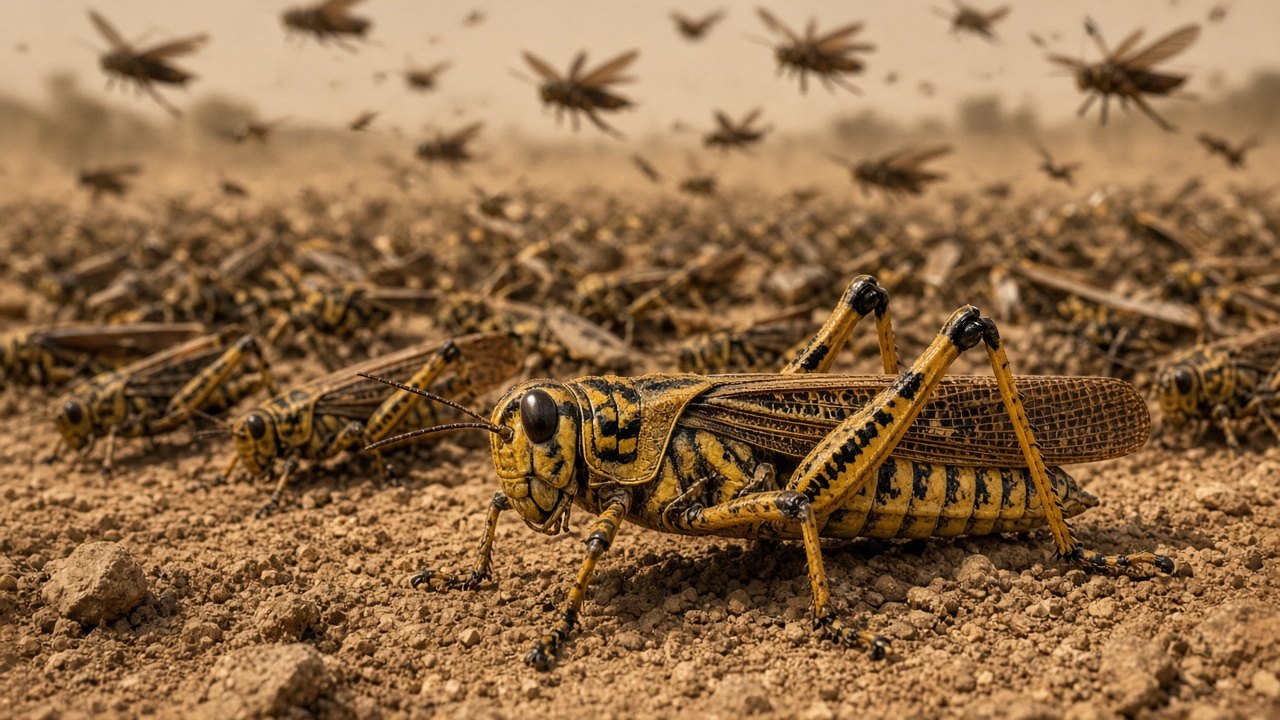
This is a generated illustration, not a photograph.
Species deep dive · desert locust
Search "desert locust" and you will meet a grasshopper that refuses to stay a grasshopper. Schistocerca gregaria is the classic density-dependent phase polyphenist: at low numbers it lives like any wary solitary acridid; when crowding spikes, behavior, color, and eventually shape flip toward the gregarious phase that builds hopper bands and flying swarms.
In Wilder TCG the Desert Locust is a Common Insecta creature with Swarm and the ability Swarm Call. The card is shorthand for a pest whose real power is multiplication — one becomes many when the landscape packs them together.
Solitary green, gregarious black-and-orange
FAO and locust biologists reserve the word locust for short-horned grasshoppers that can change phase with density. In the solitarious phase, individuals avoid one another and blend into sparse vegetation — often with greener hopper coloration. In the gregarious phase they seek conspecifics, march as cohesive hopper bands, and fly as adult swarms; hopper color shifts toward bold black patterning with orange or yellow accents.
Behavior flips first. Lab and field work show that forced contact — especially tactile cues on the hind legs — can reconfigure activity and attraction within hours. Color and body proportions lag behind: full gregarious patterning may take a crowded generation, and shape changes can take longer still. That mismatch is why you can sometimes see swarming insects that still look partly "solitary" in color.
Serotonin: the chemical tip into a band
A landmark Science study (Anstey, Rogers, Ott, Burrows & Simpson, 2009) showed that serotonin in the thoracic ganglia is both necessary and sufficient for the initial behavioral gregarization of desert locusts. Block serotonin signaling and crowding fails to flip the switch; raise it and solitary animals begin acting gregarious even without a full social crowd.
That finding matters for more than neurobiology. The enabling step of a plague is not magic weather alone — it is solitarious locusts learning, chemically, to stop avoiding neighbors so bands can cohere.
Recession belt versus plague map
In quiet recession years, Desert Locust populations are largely confined to arid and semi-arid belts across northern Africa through the Middle East into southwest Asia — on the order of about 16 million km² and roughly thirty countries. When breeding succeeds across seasons and bands merge into swarms, the invasion area can swell toward about 29–32 million km² and touch on the order of sixty countries.
Swarms ride winds for long daily displacements; hoppers march as units; adults synchronize mating, egg-laying, and fledging so the next generation hatches into dense egg-beds already primed to band. Adults can consume plant matter on the order of their own body weight in a day — which is why a dense square kilometer of swarm is compared to the daily cereal needs of tens of thousands of people. Treat those FAO-scale comparisons as order-of-magnitude ecology, not a kitchen scale.
From phase change to Wilder card
In the Desert Locust field guide entry you will find taxonomy, habitat, and in-game stats. On the board, Swarm and Swarm Call echo the real tipping point: pay the energy and the table starts filling with drones the way a green solitarious pocket turns into a marching band.
If you have never tried Wilder, guest play is free in the browser — open packs, build a deck, and put a Desert Locust on the table:
Quick facts
- Scientific name: Schistocerca gregaria (Forskål, 1775)
- Order / family: Orthoptera · Acrididae
- Hook: density-dependent phase polyphenism (solitarious ↔ gregarious)
- Behavioral switch: serotonin-mediated; can begin within hours of crowding
- Range note: ~16M km² recession belt; roughly double in major plague years
- Wilder family: Insecta · Common · Swarm · Swarm Call · Grassland · Cost 2
Questions people ask
What is the difference between a locust and a grasshopper?
Every locust is a grasshopper, but most grasshoppers aren't locusts. The FAO describes locusts as grasshoppers (family Acrididae) that can change their behavior and habits when crowded and migrate over large distances. A solitary desert locust looks and acts much like an ordinary grasshopper until crowding flips it into its swarming phase.
How far can a desert locust swarm travel in a day?
Swarms usually fly with the wind at about 16–19 km/h and can cover about 130–150 km or more in a day, according to the FAO. They regularly cross the Red Sea, about 300 km. In 1988, swarms flew from West Africa to the Caribbean, roughly 5,000 km, in about ten days.
How long does a desert locust live?
About three to five months in total, though the FAO says this varies a lot with weather. Eggs usually hatch in about two weeks, hoppers take roughly 30–40 days to reach adulthood, and adults most often take two to four months to mature.
Can you eat desert locusts?
People in several countries do. Locusts are high in protein and are usually stir-fried, roasted, or boiled. The FAO warns that locusts killed by pesticides should never be eaten, and during control campaigns it advises not eating any locusts, alive or dead, because pesticides don't always kill them right away.
How are desert locust swarms controlled?
Mostly by spraying small, concentrated doses of pesticide (called ultra-low-volume spraying) from vehicles and aircraft, and less often from knapsack sprayers. The chemicals are mainly organophosphates. An independent FAO expert group has recommended ten chemical pesticides and one biopesticide for use against desert locusts. The FAO says catching outbreaks early, before bands merge into swarms, is what matters most.