Bombardier Beetle: How It Fires Boiling Spray, Even From Inside a Toad
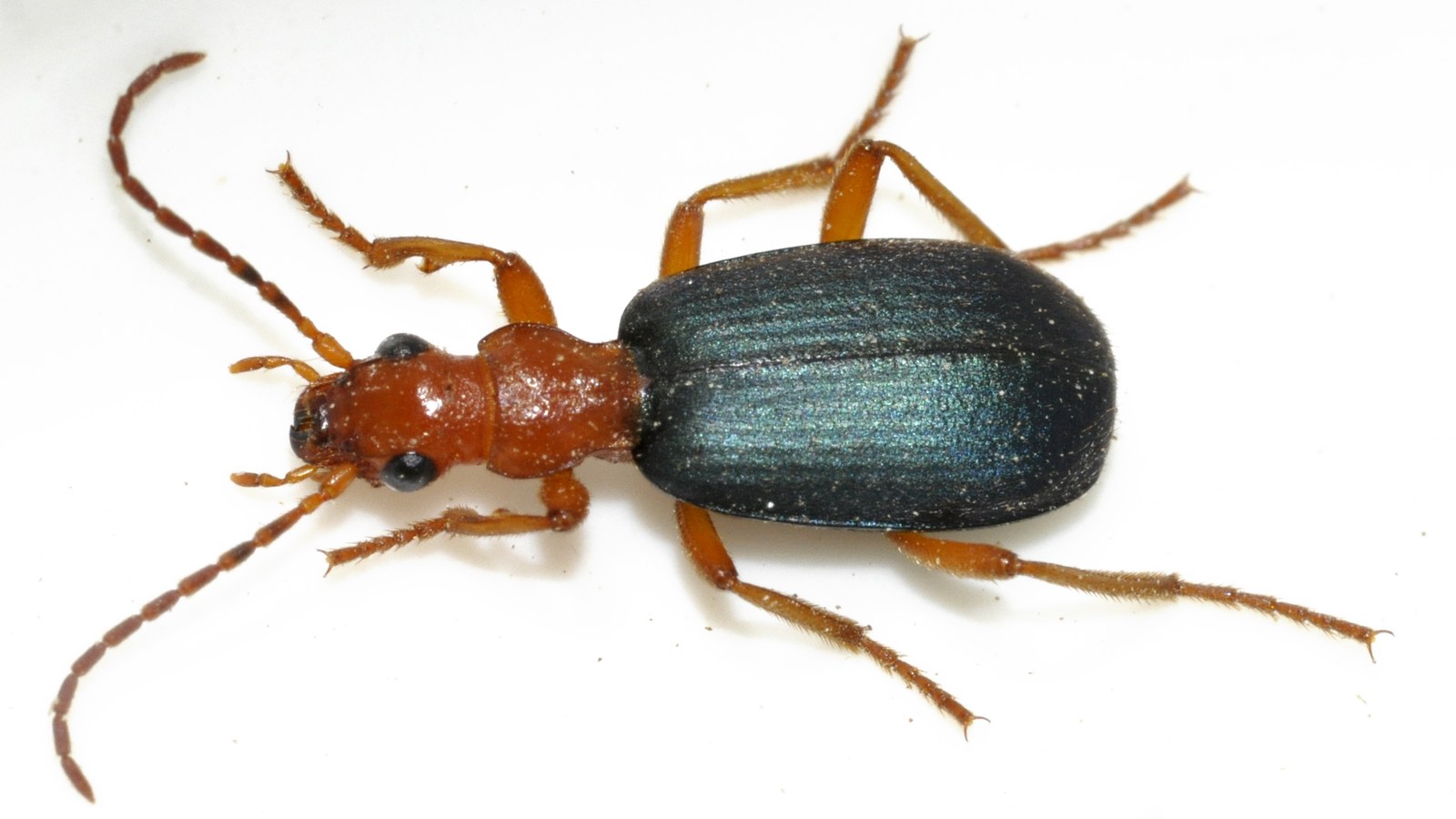
Species deep dive · common bombardier beetle
How does a bombardier beetle make its boiling spray? It mixes it at the moment it fires. Each of the beetle's two defensive glands, at the tip of the abdomen, has a storage chamber and a separate, hard-walled reaction chamber. The storage chamber holds a water solution of about 25% hydrogen peroxide and about 10% hydroquinones. When something grabs the beetle, muscles squeeze that fuel through a one-way valve into the reaction chamber, where enzymes called catalases and peroxidases are waiting. The mix reacts explosively, turning into irritating p-benzoquinones, oxygen and water and giving off a lot of heat. The spray leaves the beetle at 100 °C, the boiling point of water, at up to 10 m/s, and it can reach targets up to 30 cm away. The beetle points it straight at whatever is bothering it.
Because the reaction happens inside the beetle, it is also one of the strangest defences in nature. Bombardier beetles are the only animals known to set off an explosion of hot chemicals inside their own bodies and survive it, and the subfamily has more than 500 species. One of them is Europe's Common Bombardier Beetle (Brachinus crepitans).
A machine gun, not a hose
The spray isn't one continuous squirt. In 1990, researchers filming the bombardier beetle Stenaptinus insignis found that it fires in quick pulses, about 500 per second, and compared it with the pulse-jet engine of the World War II V-1 "buzz bomb". In 2015, a team from MIT, the University of Arizona and Brookhaven National Laboratory looked inside living Brachinus elongatulus beetles with synchrotron X-rays filmed at up to 2,000 frames per second. They measured pulse rates of 341 to 976 per second (median 667).
The X-rays also showed how the pulsing works, and the answer is surprisingly passive. Each explosion swells a flexible membrane that closes the valve between the two chambers. Once the hot spray has been pushed out, the pressure drops, the membrane relaxes, the valve opens, and the next dose of fuel flows in. The researchers think the gaps between pulses may give the chamber walls a moment to cool. Plenty of insects defend themselves with benzoquinones, but according to the MIT team, bombardier beetles fire theirs much hotter and about five times faster.
Swallowed, then fired from the inside
Being eaten isn't always the end. In a 2018 study, Japanese researchers fed the Asian bombardier beetle Pheropsophus jessoensis to two kinds of toads, Bufo japonicus and Bufo torrenticola. Every toad swallowed its beetle. But 43% of the toads threw the beetle back up 12 to 107 minutes later, and every beetle that came back up was still alive and active. The beetles had kept firing hot chemicals inside the toads. Size mattered on both sides: big beetles escaped more often than small ones, and small toads threw up more often than big ones. That experiment was done with an Asian genus, not Brachinus, but it shows how well the system works.
Reloading the chemistry set
A 2025 study of the common bombardier beetle in Royal Society Open Science looked at how the glands refill. Researchers in Germany, working with beetles collected there, made them spray by pinching their hind legs with forceps every hour until they stopped. The beetles were still spraying after 3 hours (four rounds), ran dry after 6 hours (seven rounds), and after a rest their glands were fully refilled at the 13-hour mark. By mapping which genes and proteins are active in each chamber, the team found that the beetle uses glucose as a stable starting material for both its hydrogen peroxide and its hydroquinones. They also found evidence that the system evolved through heat-tolerant catalases and unusually modified peroxidase genes.
Meet Brachinus crepitans
The common bombardier beetle is small, about 6–10 mm long. It has a red head and thorax and dark, greenish-black wing cases, and it hides under stones and leaf rosettes in short, dry grassland, usually on chalk or limestone. Despite its name, it isn't common in Britain. There it is classed as Nationally Scarce, found locally in southern and eastern England and into South Wales, mostly near the coast. Besides grassland it turns up in clay brick pits, undercliffs, sea walls and stabilised shingle. Adults gather in groups in spring. The larvae have been reported developing as parasites on the pupae of a rove beetle, Ocypus ater, and possibly other beetles.
On the Wilder card
*Common Bombardier Beetle (Brachinus crepitans) is a Cost 1 Insecta Forest Common with Toxin (ATK 1 / HP 2) and the ability Bombard (2 Energy: deal 2 damage to an enemy creature). Toxin gives any creature it damages in combat a permanent -1/-1, and the debuffs stack. On defense, Toxin weakens the attacker before that attacker's damage lands, which is the real beetle's whole strategy: whatever bites it gets hurt first. Bombard is the aimed spray, a cheap way to hit something you can't reach in a fight. Its flavor text says it all: "A tiny chemist with a very short fuse." Its field-guide page pits it against the Bullet Ant (Journal). For another small animal that turns physics into a weapon, see the Pistol Shrimp* (Journal).
Photo credit
Hero photograph: Francisco Welter-Schultes, "Brachinus-crepitans-08-fws", a common bombardier beetle from near Göttingen, Germany (Wikimedia Commons), CC0 1.0 public domain dedication. Cropped for the Field Journal hero.

Questions people ask
Can a bombardier beetle hurt you?
Yes, a little. The spray comes out at about 100 °C and carries irritating benzoquinones, so a blast on your skin or face is painful. National Geographic describes it as painful to humans and potentially lethal to smaller predators such as ants. It's a defence, so the easy fix is to watch them rather than pick them up.
Does a bombardier beetle shoot acid?
Not really. "Acid" is a popular shorthand. The spray is made at the moment of firing from hydrogen peroxide and hydroquinones, and what comes out is hot water, oxygen and p-benzoquinones, irritating compounds that aren't acids. The heat and the quinones are what hurt (Vogel et al. 2025).
Where do bombardier beetles live?
On every continent except Antarctica, according to the MIT-led team that filmed their spray with X-rays. There are more than 500 species. In Britain the Common Bombardier Beetle is Nationally Scarce and lives mainly on dry chalk and limestone grassland and coastal sites in the south.
What animals eat bombardier beetles?
Very few. MIT researcher Eric Arndt called bombardier beetles "invulnerable to most vertebrates, and invertebrates", apart from a few very specialized predators that have evolved ways around the spray. Toads will swallow them, but in a 2018 study many threw the beetles back up alive.
Sources
- Vogel H., Rügen N., Wielsch N., Twyman R.M., Tonk-Rügen M. & Vilcinskas A. (2025) Molecular basis of the explosive defence response in the bombardier beetle Brachinus crepitans. Royal Society Open Science 12: 241823
- Aneshansley D.J., Eisner T., Widom J.M. & Widom B. (1969) Biochemistry at 100°C: explosive secretory discharge of bombardier beetles (Brachinus). Science 165: 61–63
- Dean J., Aneshansley D.J., Edgerton H.E. & Eisner T. (1990) Defensive spray of the bombardier beetle: a biological pulse jet. Science 248: 1219–1221
- Arndt E.M., Moore W., Lee W.-K. & Ortiz C. (2015) Mechanistic origins of bombardier beetle (Brachinini) explosion-induced defensive spray pulsation. Science 348: 563–567
- MIT News (2015) How some beetles produce a scalding defensive spray
- Sugiura S. & Sato T. (2018) Successful escape of bombardier beetles from predator digestive systems. Biology Letters 14: 20170647
- Essex Field Club — Species account: Brachinus crepitans
- Worcestershire Biological Records Centre — Bombardier beetle Brachinus crepitans found near Honeybourne
- National Geographic (Ed Yong, 2015) How this beetle creates 500 explosions per second in its bum