Why the Bullet Ant's Sting Tops the Schmidt Pain Index
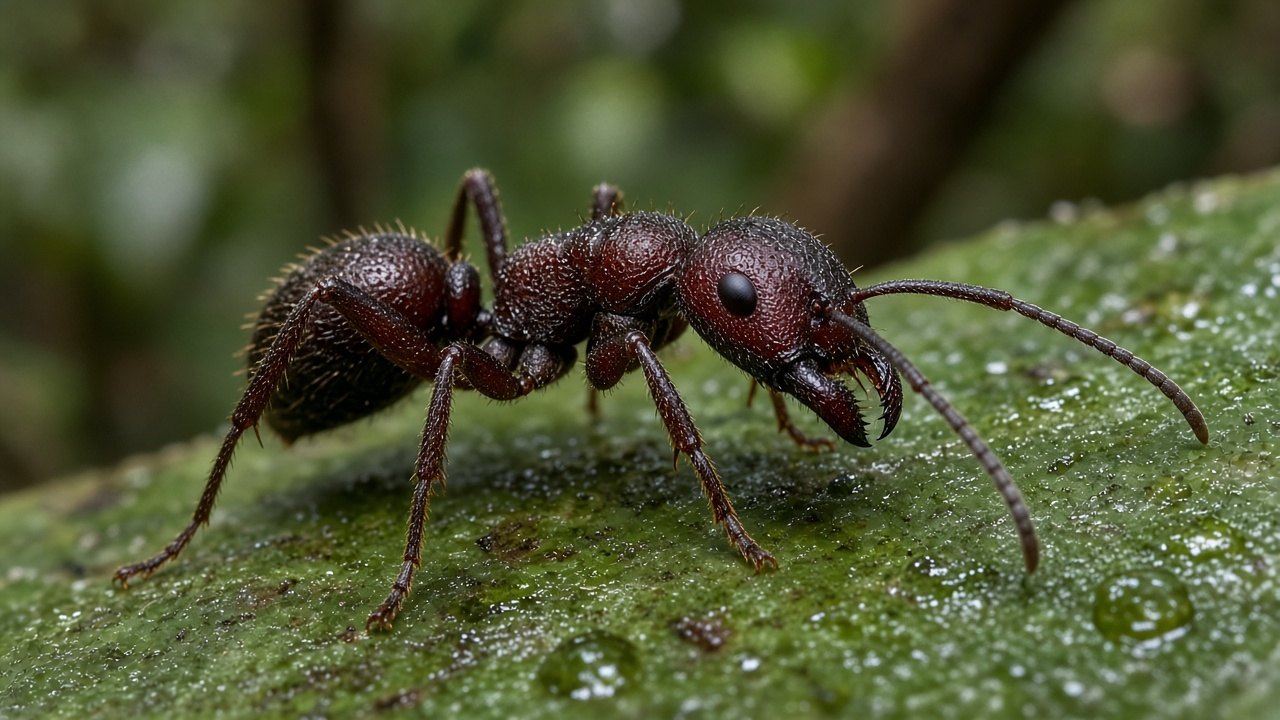
This is a generated illustration, not a photograph.
Species deep dive · bullet ant

Why the Bullet Ant's Sting Tops the Schmidt Pain Index
Search "bullet ant" and you will meet the same claim again and again: the most painful insect sting on Earth. That is not marketing copy. Entomologist Justin O. Schmidt ranked the bullet ant (Paraponera clavata) at 4.0+ on his informal sting pain index — the top of the scale — and described it as walking over flaming charcoal with a three-inch nail in your heel.
In Wilder TCG the Bullet Ant is an Uncommon Insecta creature with Venom and Herd. The card is shorthand for a real rainforest hunter whose defense is famous enough to earn nicknames across the Neotropics.
A sting that feels like a bullet
Workers are large for ants: about 18–30 mm, stout and reddish-black, often compared to wingless wasps. They are not especially aggressive foragers — but they defend the nest hard, stridulating loudly and stinging with ferocity when disturbed.
Victims report waves of burning, throbbing pain that can last up to 24 hours. That duration is why Venezuelan Spanish speakers call it hormiga veinticuatro — the "24 ant." English speakers landed on "bullet ant" because people compared the first hit to being shot. In parts of Brazil it is also known as tocandira, from a Tupi–Guarani root roughly meaning "the one that wounds deeply."
Even a single sting can bring lymphadenopathy, swelling, a racing heart, and systemic misery. It is defense chemistry, not theater.
Poneratoxin: the peptide behind the reputation
The pain is driven in large part by poneratoxin, a neurotoxic peptide in the venom. It modulates voltage-gated sodium channels (activating them / slowing inactivation), which produces intense pain and can paralyze insect prey. Older studies also described blocked synaptic transmission in the insect central nervous system as an effect of that disruption — not as a simple "channel blocker" story.
Researchers have studied poneratoxin for possible uses in biological insecticides and related applications. For a canopy forager, the ecological job is simpler: drop prey, and teach anything that bumps the nest to leave.
Life above the forest floor
Bullet ants live in humid lowland rainforest from Honduras and Nicaragua through Costa Rica and Panama into Colombia, Venezuela, Ecuador, Peru, Bolivia, and Brazil, mostly from sea level up to about 750 m (occasional higher records exist).
Colonies are usually at the bases of trees, a few hundred workers strong (large nests can reach a couple thousand). Most foraging is arboreal — nectar carried in the mandibles, plus small arthropods — in the canopy above the nest. Floor foraging is uncommon. Some studies on Barro Colorado Island and in Costa Rica reported on the order of about four nests per hectare (other sites and later surveys find higher densities), under a wide range of tree species, with some preference for trees that offer canopy access (and sometimes extrafloral nectaries).
They also have specialists hunting them: tiny phorid flies (Apocephalus paraponerae) that find injured workers within minutes and can lay many eggs on a single ant. Colony fights keep that supply of wounded ants coming.
The Sateré-Mawé initiation
Among the Sateré-Mawé people of Brazil, intentional bullet ant stings are part of a demanding initiation. Ants are sedated, woven into leaf or vine gloves with stingers facing inward (on the order of eighty ants), agitated with smoke, then worn for minutes at a time. Hands and arms can go temporarily numb or paralyzed; shaking can last days. Completing the rite traditionally means repeating the ordeal many times over months or years.
It is a cultural practice, not a wildlife stunt — and it is the starkest human measure of what P. clavata venom can do.
From rainforest to Wilder card
In the Bullet Ant field guide entry you will find taxonomy, habitat, and in-game stats. On the board, Venom echoes that "one clean hit ends the fight" reputation: combat damage this creature deals to a creature destroys it. Herd rewards swarming Insecta the way real colonies reward numbers at the nest.
If you have never tried Wilder, guest play is free in the browser — open packs, build a deck, and put a Bullet Ant on the table:
Quick facts
- Scientific name: Paraponera clavata (Fabricius, 1775)
- Schmidt pain index: 4.0+ (highest ranked)
- Worker size: ~18–30 mm
- Diet: nectar + small arthropods (opportunistic)
- Nest: tree bases; forage mostly in the canopy
- Wilder family: Insecta · Uncommon · Venom, Herd
Questions people ask
Can a bullet ant sting kill you?
Britannica notes that being stung many times can be lethal. A single sting causes extreme pain that comes in waves for hours, along with trembling, swelling, a racing heart, and temporary paralysis of the stung area. As with any sting, signs of an allergic reaction, such as trouble breathing or a swelling face or throat, need emergency care.
What other stings rank at the top of the Schmidt pain index?
Justin Schmidt's scale runs from 1 to 4. Alongside the bullet ant, tarantula hawk wasps (Pepsis) and the warrior wasp (Synoeca septentrionalis) also reach the top level. Schmidt described the tarantula hawk's sting as a running hair dryer dropped into your bath. The bullet ant is the one rated 4.0+, and its pain lasts far longer.
Are there bullet ants in the United States?
Not wild Paraponera clavata. It lives in lowland rainforests from Honduras and El Salvador to Brazil, Bolivia, and Peru. The so-called Texas bullet ant (Neoponera villosa), found in Texas and Mexico, is an unrelated ant, although it also has a painful sting.
What do bullet ants eat, and when do they forage?
They eat nectar and small animals, both hunted and scavenged: spiders, small frogs, and insects such as grasshoppers, beetles, and katydids. Workers forage mainly at dusk and at night, mostly in the canopy above the nest, and follow pheromone trails to good food.
Is the bullet ant the only species in its genus?
It is the only living one. Paraponera clavata is the sole living member of its genus and subfamily. An extinct relative, Paraponera dieteri, was discovered in 1994 and lived between about 45 and 15 million years ago.