Do Female Praying Mantises Really Eat the Males?
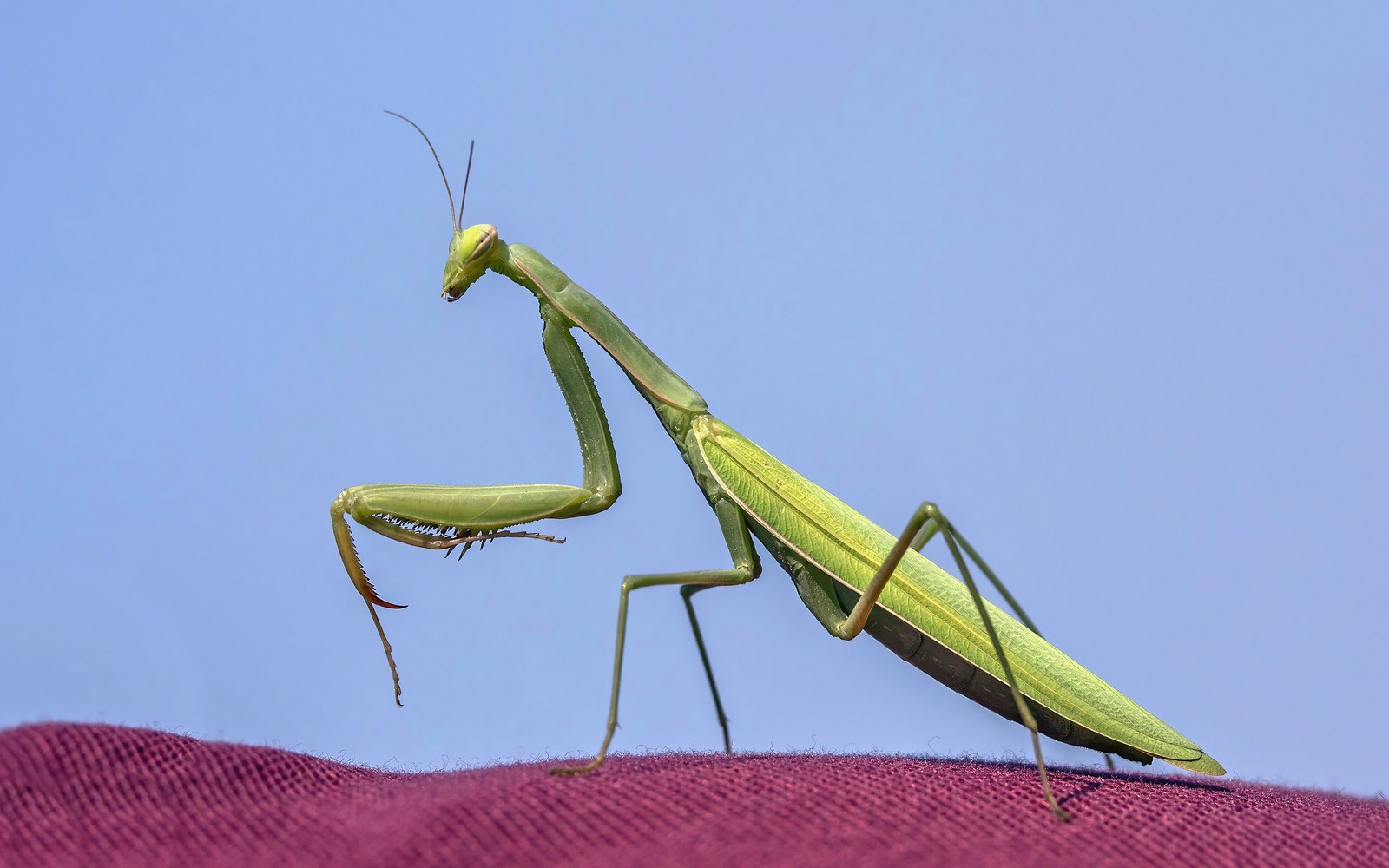
Species deep dive · european mantis
Yes, sometimes, but far less often than the legend suggests. In praying mantises that practise sexual cannibalism, field studies find a female eats her mate in roughly 13–28% of natural encounters, not every time (Brown & Barry 2016). For the European mantis (Mantis religiosa) it is not just a quirk of animals kept in boxes: a dedicated field study recorded sexual cannibalism in wild populations (Lawrence 1992).
The headless male keeps going
The most famous detail is real. In classic experiments on Mantis religiosa, Kenneth Roeder showed that a male's mating movements are run by a nerve centre at the rear of his abdomen, and that his head normally holds them back. Take the head away, whether a female bites it off or an experimenter removes it, and the body can carry on mating, or even start (Roeder 1935). It's grim, but it means losing his head doesn't automatically cost a male his chance to father young.
Why males take the risk, and how they cut it
Males don't walk in blindly. Mantis religiosa males watch the female and adjust how fast they approach depending on how active she is, which probably lowers their chance of being spotted and grabbed (Gemeno & Claramunt 2006).
When a male does get eaten, he isn't wasted. In a related species, the Chinese mantis (Tenodera sinensis), researchers fed males and females crickets with different radioactive labels. Females that ate their mate put more of his body into their eggs and went on to lay more eggs than females that didn't (Brown & Barry 2016). So the last meal is a final contribution to the next generation, even if the male would much rather have walked away.
October is the end of the season
If you're seeing big mantises right now, that's why. Mantises are hard to spot while they're small in early summer. By late summer and autumn the adults are large, hunting in gardens and looking for mates. The female then lays a foamy egg case (an ootheca) on a twig or stem. It can hold more than a hundred eggs, which survive the winter inside and hatch in spring (University of Maryland, Bug of the Week). The adults themselves don't make it: they're around "until the cold weather sets in, when they die rapidly" (State of Connecticut).
One ear and 3D eyes
The European mantis hears with a single ear in the middle of its chest, between the hind legs. Yager and Hoy called it the "cyclopean ear". It is tuned to ultrasound, and abrupt changes in flight path when it hears ultrasonic pulses point to an escape response from hunting bats (Yager & Hoy 1986).
Its eyes judge distance in 3D. Newcastle University researchers fitted mantises with tiny 3D glasses held on with beeswax, and the insects struck at virtual bugs only when the bugs appeared to float in front of the screen. That confirmed mantises hunt with stereo vision, as Samuel Rossel's experiments had first shown in the 1980s (Newcastle University).
A European that moved to America
Despite the name, the European mantis is native to southern Europe, North Africa and temperate Asia (State of Connecticut). It was first found in the United States in 1899 in New York State, apparently a stowaway on nursery stock from Europe, and has since spread across much of the eastern US and into Canada (University of Maryland, Bug of the Week). Connecticut made it the official state insect on 1 October 1977, even though it isn't native there (State of Connecticut). Globally it is listed as Least Concern (IUCN Red List).
On the Wilder card
The European mantis is an Uncommon Insecta (Forest) card: Cost 3, Attack 3, Health 2, with Ambush and Feast (Feast bonus +1 Attack / +1 Health). Ambush fits a sit-and-wait hunter that strikes the moment something comes into reach, and Feast fits a predator that grows on what it catches. The flavour text says it plainly: "Strikes faster than you can blink." It hits hard for its cost but breaks easily, which is a fair summary of the real insect, too. Play it in the free browser collectible card game.
The short version: female mantises do sometimes eat their mates, in about 13–28% of encounters in field studies, not every time. A headless male can keep mating, careful males creep in slowly, and by the first frosts the adults are gone, leaving egg cases to hatch in spring.
Photo credit
Hero photograph: Charles J. Sharp, European praying mantis (Mantis religiosa) green female Dobruja, Wikimedia Commons, CC BY-SA 4.0. Cropped for the Field Journal hero.

Questions people ask
Is a praying mantis dangerous to people?
No. The State of Connecticut, which has the European mantis as its state insect, describes it as harmless to humans. It eats insects such as aphids, flies, grasshoppers, small caterpillars and moths (State of Connecticut).
When do praying mantises die?
Adult European mantises die in autumn: they're around from May or June "until the cold weather sets in, when they die rapidly" (State of Connecticut). Their eggs survive the winter inside a foamy egg case and hatch in spring (University of Maryland, Bug of the Week).
Is the European mantis native to North America?
No. It was first found in the US in 1899 in New York State, apparently arriving on nursery stock from Europe, and has since spread through much of the eastern US and into Canada (University of Maryland, Bug of the Week).
Can praying mantises see in 3D?
Yes. Newcastle University researchers fitted mantises with tiny 3D glasses, and the insects struck at virtual prey only when it appeared to float in front of the screen, confirming stereo (3D) vision (Newcastle University).
Is the European mantis endangered?
Not globally. Mantis religiosa is listed as Least Concern on the IUCN Red List (IUCN). In Wilder it's the European mantis card, an Uncommon ambush hunter.
Sources
- Brown & Barry 2016, Proceedings of the Royal Society B — Sexual cannibalism increases male material investment in offspring
- Lawrence 1992, Animal Behaviour — Sexual cannibalism in the praying mantid, Mantis religiosa: a field study
- Roeder 1935, Biological Bulletin — An experimental analysis of the sexual behavior of the praying mantis (Mantis religiosa L.)
- Gemeno & Claramunt 2006, Journal of Insect Behavior — Sexual approach in the praying mantid Mantis religiosa
- Yager & Hoy 1986, Science — The cyclopean ear: a new sense for the praying mantis
- Newcastle University (2016) — Bug eyes: tiny glasses confirm 3D vision in insects
- University of Maryland Extension, Bug of the Week (Michael J. Raupp) — European Mantis, Mantis religiosa
- State of Connecticut — The State Insect
- IUCN Red List — Mantis religiosa (Battiston 2016)