Why Do Bearded Dragons Wave, Head-Bob and Turn Their Beards Black?
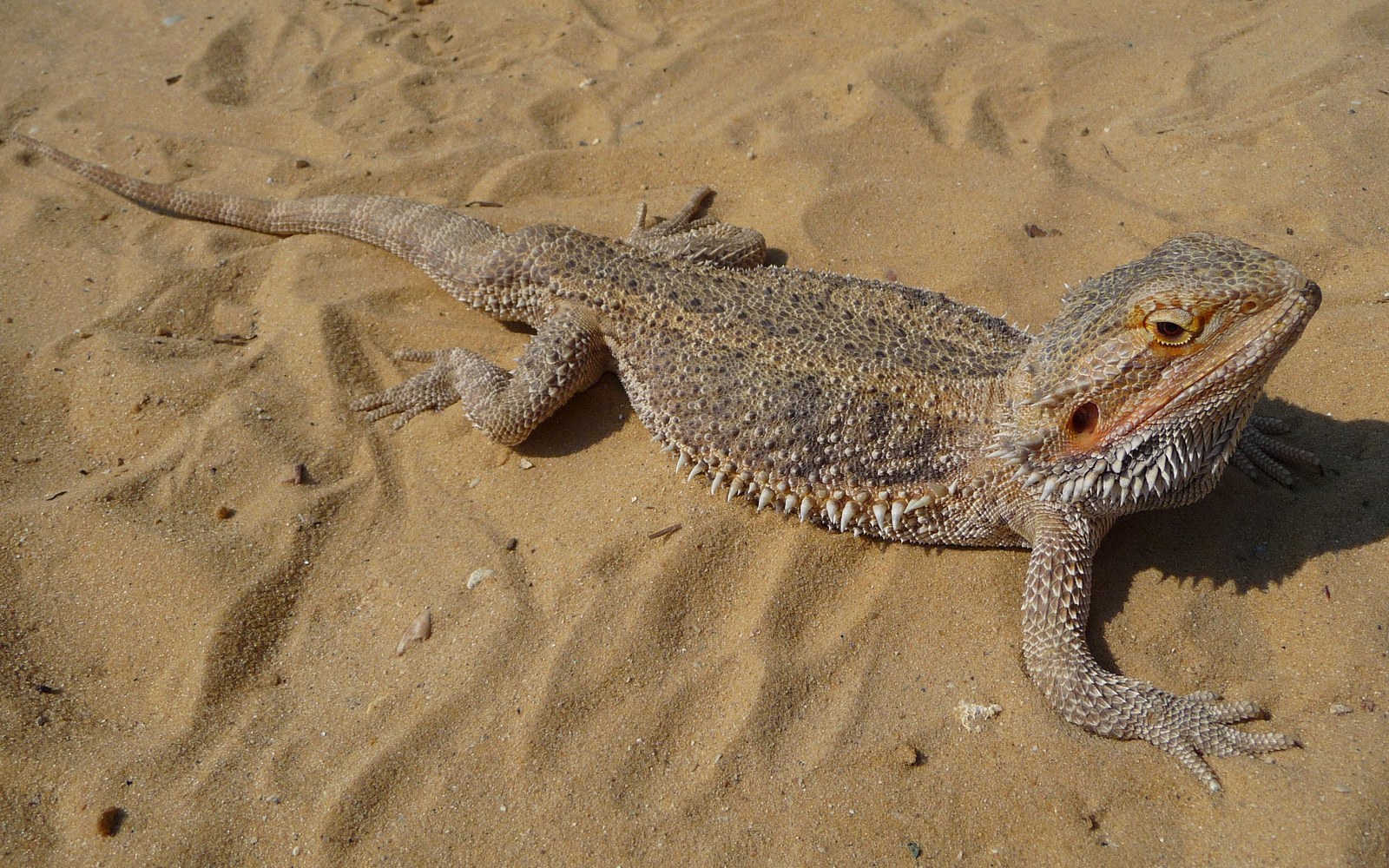
Species deep dive · central bearded dragon
*A slow, circling wave of one front leg is a central bearded dragon (Pogona vitticeps) saying "I'm no threat." A fast head bob with a puffed-out, blackened beard says the opposite: "this rock is mine."* Bearded dragons don't really vocalise beyond a low hiss, so almost everything they say to each other goes through arm waves, head bobs, posture and colour (Australian Museum).
Wave, bob, puff: a quick decoder
In the wild these lizards are usually loners, but they crowd together at the best basking spots and around rich food, and a clear pecking order forms. The Australian Museum describes the signals like this (Australian Museum):
- Arm wave: used by both sexes. A male waves to show submission to a dominant male, and a female waves (with a slow head bob) to show she is responsive to a male. A wave usually defuses a stand-off.
- Slow head bow: often an adult female signalling submission to a male.
- Fast head bob with an inflated black beard: a male signalling dominance.
- Violent whole-body bobbing: a male just before mating.
If neither lizard backs down, they circle each other, and a stand-off or fight follows. In spring, rival males flare their beards, circle and even bite each other's tails for mating rights.
Why the beard turns black
The beard is a signal you can turn up and down. The Australian Museum notes that a bearded dragon can go from mostly yellow to almost black within a few minutes, and mature males often darken their beard so a defensive puff looks even more striking (Australian Museum).
Researchers at the University of Melbourne measured how much it matters. In staged contests between males, how dark a male's beard got strongly predicted who won, but beard colour did not predict whether a male tried to mate with a female (Dickerson et al. 2020). An earlier study of wild-caught dragons found that the body splits the jobs: the beard and upper chest changed most during social encounters, while the back darkened and lightened with temperature. A darker back soaks up more sun, and the team's heat models suggested it could cut about 22 minutes off the time needed to warm up each active day, saving around 85 hours of basking over a season (Smith et al. 2016). That's the same trick, colour as both message and thermostat, that you see in our common chameleon piece.
More bluff than bite
Those spiky "beard" scales look armoured, but they are fairly rubbery and mainly there to make the lizard look unappealing. When alarmed, a bearded dragon faces the threat, gapes, puffs out the beard and gulps air to inflate its body so it looks bigger and more rigid (Australian Museum).
Hot nests can flip a dragon's sex
Here's the strangest part. Central bearded dragons have sex chromosomes, like birds: ZZ animals are normally male and ZW animals female. Hot incubation can override that. In 2015, a University of Canberra team reported genetically male (ZZ) dragons living in the wild as females. This was the first report of reptile sex reversal in the wild. When those sex-reversed females mated with normal males, their young had their sex set by incubation temperature alone, and the W chromosome dropped out of the line within one generation (Holleley et al. 2015). The authors flag it as a way a warming climate could reshape how a species makes males and females.
Where they live and what they eat
Pogona vitticeps lives in a band across the semi-arid interior of eastern Australia, in open woodland, shrubland and hummock grassland. It basks on stumps, boulders and fence posts, and it eats both plants and animals: fruit and leaves, plus ants, beetles and the occasional small lizard (Australian Museum). It is assessed as Least Concern on the IUCN Red List (IUCN), and it is protected in Australia, so wild animals can't be collected (Australian Museum).
On the Wilder card
The central bearded dragon is a Common Reptilia (Desert) card: Cost 2, Attack 2, Health 3, with Cold-Blooded and Resilient. Cold-Blooded makes it cost 1 less in Summer and 1 more in Winter, which suits a lizard that runs on sunshine, and Resilient fits an animal that wins its fights by looking bigger and outlasting the other side. Its flavour text is pure beard display: "Puffs its beard to say, 'Back off, this rock is mine!'" In the free browser collectible card game, that bluff is the whole personality.
The short version: a wave says "I give up" (or "I'm interested"), a fast bob with a black beard says "I'm the boss", the darkest beard usually wins, and a hot enough nest can turn a genetic male into a female.
Photo credit
Hero photograph: George Chernilevsky, Pogona vitticeps 2009 G3, Wikimedia Commons, public domain. Cropped for the Field Journal hero.

Questions people ask
Do bearded dragons bite?
Rarely, and only as a last resort. An adult's bite can hurt, break the skin and bruise, but a bearded dragon will usually puff, hiss, display and run before it bites, and only bites if it feels physically threatened (Australian Museum).
Are bearded dragons venomous?
Not in any way that matters to people. Research found that bearded dragons have primitive venom glands, but what dragon lizards use them for isn't understood, and a bite should cause no long-term ill effect. Clean it like any animal bite (Australian Museum).
What do wild bearded dragons eat?
They are omnivores. Wild central bearded dragons eat fruit and leaves plus invertebrates such as ants and beetles, and sometimes small vertebrates like other lizards. They grab food with a quick lunge of a sticky tongue (Australian Museum).
Where do central bearded dragons live in the wild?
In a band across the semi-arid interior of eastern Australia, in open woodland, shrubland and hummock grassland. They bask on stumps, boulders and fence posts to watch for predators, prey and rivals (Australian Museum).
Are bearded dragons endangered?
No. Pogona vitticeps is listed as Least Concern on the IUCN Red List (IUCN). It is still protected in Australia, where wild animals can't be collected (Australian Museum). See the Wilder card.
Sources
- Australian Museum — Central Bearded Dragon
- Dickerson et al. 2020, Animal Behaviour — Rapid beard darkening predicts contest outcome, not copulation success, in bearded dragon lizards
- Smith et al. 2016, Proceedings of the Royal Society B — Colour change on different body regions provides thermal and signalling advantages in bearded dragon lizards
- Holleley et al. 2015, Nature — Sex reversal triggers the rapid transition from genetic to temperature-dependent sex
- IUCN Red List — Pogona vitticeps (Melville & Wilson)