Common Garter Snake: Live Young, Mild Venom, and Backyard Ecology
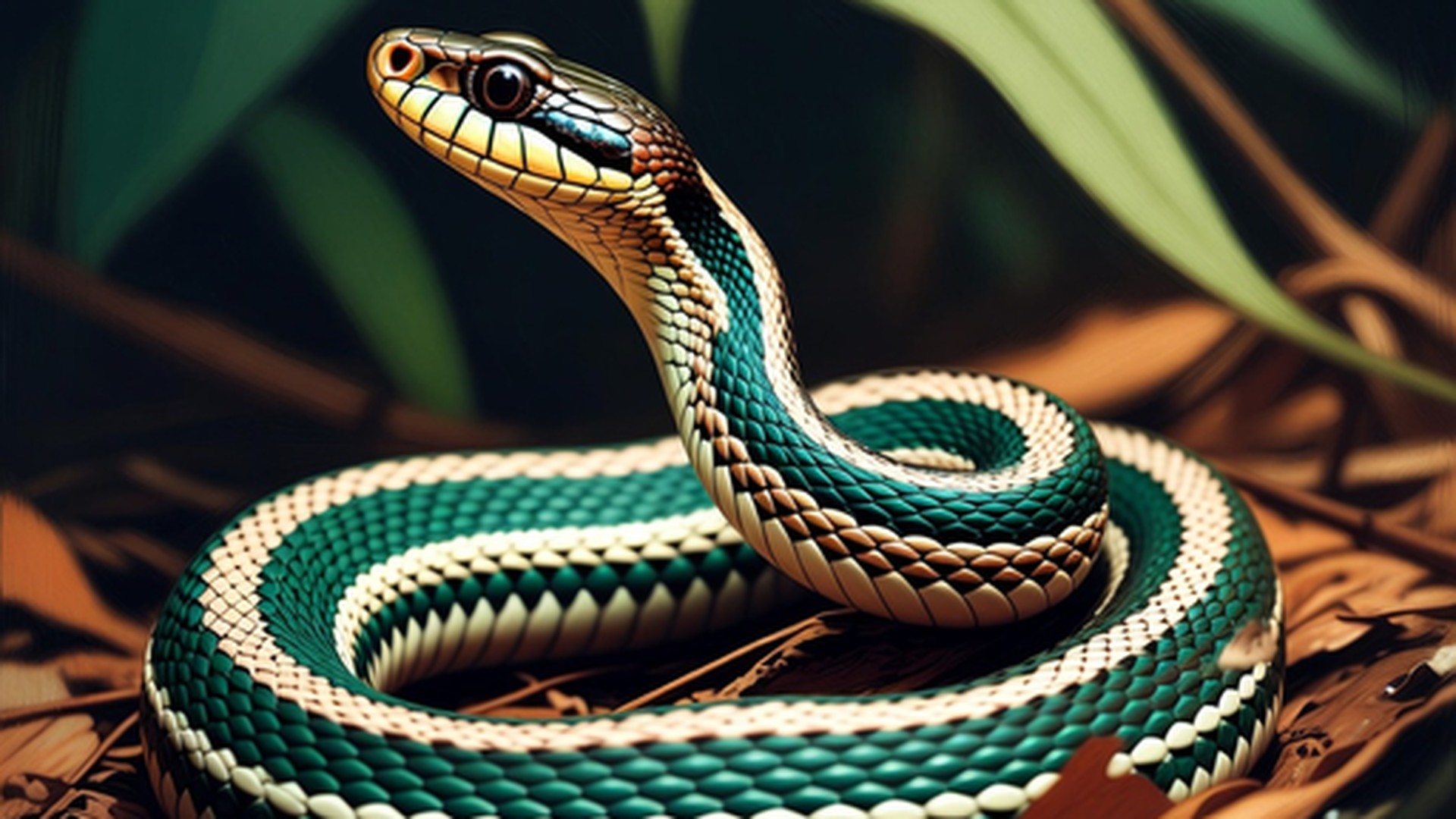
This is a generated illustration, not a photograph.
Species deep dive · common garter snake
Search "are garter snakes venomous," "do garter snakes lay eggs," or "are garter snakes dangerous" and you get a tangle of backyard lore. Thamnophis sirtalis — the common garter snake — is North America's most familiar striped colubrid: a moisture-loving hunter that gives birth to live young, packs mild oral toxins useful against prey, and almost never belongs in the same risk category as rattlesnakes or copperheads.
In Wilder TCG the Common Garter Snake is a Reptilia Forest creature (Cost 1). The card is shorthand for a real, widespread reptile whose stripes, spring mating balls, and frog-and-worm appetite make it the snake most people actually meet.
Striped colubrid of moist edges
Common garter snakes are native only to the Nearctic. Animal Diversity Web maps them across much of North America — Florida to coastal Quebec, west toward British Columbia and less-arid southwestern pockets — largely skipping the driest deserts. They use meadows, marshes, woodlands, hillsides, and suburban edges, usually near ponds, ditches, lakes, or streams. Cover matters: boards, debris, logs, rocks, and dense grass.
Adults typically show three light stripes on a black, brown, gray, or olive body. Stripe color ranges from yellow and white to blue, greenish, or brown; some populations look checkered rather than cleanly striped, and a few are nearly black. The head is wider than the neck and usually dark; the tongue is red with black tips; body scales are keeled. Total length commonly falls between about 46 and 137 cm (~18–54 in), with females larger than males. Wilder field-guide averages sit near the lower adult range — roughly 55 cm typical, with maxima over four feet.
These snakes are mainly diurnal and tolerate cooler temperatures better than many reptiles. In colder parts of the range they hibernate from late fall into early spring in rodent burrows, crayfish tunnels, rock piles, or stumps — sometimes packed in large communal dens that keep bodies from freezing.
Live young, not eggs
Do they lay eggs? No. Common garter snakes are ovoviviparous: embryos develop inside the female, and she gives birth to independent live young after roughly two to three months of gestation. Animal Diversity Web reports litters of 4–80 neonates (most often about 10–40), sized to the mother; newborns measure roughly 12.5–23 cm and look like miniature adults. Northern births concentrate from late July into October. There is no lasting parental care — neonates may linger near the mother for hours or a few days, then hunt alone.
Males can mature around 1.5 years, females around two. That live-birth strategy is a big reason these snakes push farther north than many egg-layers: developing young ride inside a thermoregulating mother instead of a buried clutch.
Mild toxins — not a rattlesnake story
Are they venomous? In the technical sense that matters for prey, yes — mildly. Common garters possess a Duvernoy's gland that produces oral secretions delivered under low pressure while the snake chews, not through hollow front fangs like a pit viper. NPS natural-history notes for the species describe saliva as slightly toxic, helpful for subduing small prey that are swallowed whole.
Rosenberg and colleagues (1983) documented how that Duvernoy's secretion is released in T. sirtalis — a delivery system built for chewing restraint, not high-pressure injection.
Are they dangerous to people? Their reputation as harmless backyard snakes is well deserved. Animal Diversity Web notes that allergic-type reactions after bites are extremely rare. A prolonged defensive bite can cause local swelling or discomfort in uncommon cases, but that is not medically comparable to rattlesnake or coral-snake envenomation. When grabbed, garters more often writhe, musk with foul cloacal secretions, and urinate — drama, not a medical emergency. Give them space, wash any bite with soap and water, and treat them as pest-control allies rather than threats.
Mating balls, pheromone tricks, and winter dens
Spring emergence is theater. Males leave communal dens first and wait. When females exit, dozens of suitors may coil into a mating ball around one female. Skin lipids act as pheromones for sex recognition. Some males express female-like chemical cues — the famous "she-male" trick — and can draw rival attention long enough to improve their own mating odds (Shine et al., 2000, summarized in ADW and NPS accounts).
Females can store sperm and may skip mating if no suitable partner appears; after mating they leave for summer habitat while males stay near the den for more opportunities.
Outside the breeding season, garters are mostly solitary. Chemical trailing with the forked tongue and vomeronasal organ lets them follow scent paths; vision and vibration sense round out the toolkit. Preferred daytime body temperatures sit roughly in the high 20s to low 30s °C when basking is available.
Diet, toad immunity, and a newt arms race
Diet is opportunistic and wet-edge: earthworms, amphibians, leeches, slugs, snails, insects, crayfish, small fish, and other snakes, plus occasional lizards, nestling birds, or small mammals. They locate prey by smell and sight, then seize with sharp teeth and quick strikes. Critically, they tolerate many toad skin toxins that stop other predators — one reason they matter in garden and wetland food webs.
Their most famous predator–prey story is coevolution with rough-skinned newts (Taricha), which produce tetrodotoxin (TTX). Brodie and Brodie (1990) showed T. sirtalis populations evolving elevated TTX resistance — an arms race in which newt toxicity and snake resistance escalate together in geographic hotspots. Resistant snakes can eat prey that would kill almost anything else; extreme resistance can carry performance trade-offs, but the ecology is clear: some garters are chemical specialists.
In turn, garters feed hawks, herons, crows, raccoons, foxes, larger snakes, bullfrogs, snapping turtles, and more. Escape tools are camouflage, a dash into water, a bluff coil-and-strike, then musk. Globally, IUCN lists the species Least Concern. One subspecies — the San Francisco garter snake (T. s. tetrataenia) — is federally Endangered and tightly restricted on the San Francisco Peninsula; abundance at the species level does not erase local crises.
From backyard to Wilder card
In the Common Garter Snake field guide entry you will find taxonomy, habitat, and in-game stats. On the board it plays as a low-cost Forest Reptilia presence — the game echo of a real striped hunter that thrives at the wet edge of human landscapes.
If you have never tried Wilder, guest play is free in the browser — open packs, build a deck, and put a backyard live-bearer on the table:
Quick facts
- Scientific name: Thamnophis sirtalis (Linnaeus, 1758)
- Family: Colubridae (garter and related snakes)
- Hook: live-bearing striped colubrid; mild Duvernoy's / oral toxins for prey; famous newt–TTX arms race
- Size: ~46–137 cm total length; females larger; neonates ~12.5–23 cm
- Reproduction: ovoviviparous / live young; gestation ~2–3 months; litters often 10–40 (range ~4–80)
- Diet: worms, amphibians, fish, slugs, invertebrates; toad-toxin tolerant; some populations TTX-resistant to Taricha
- Defense toward people: musk, thrash, occasional bite; typically not medically significant
- Status: IUCN Least Concern; San Francisco subspecies federally Endangered
- Wilder family: Reptilia · Forest · Cost 1
Sources
- Animal Diversity Web — Thamnophis sirtalis
- NPS — Common Garter Snake (Bighorn Canyon NRA)
- IUCN Red List — Thamnophis sirtalis
- Rosenberg et al. (1983) Journal of Morphology — Duvernoy's gland secretion in T. sirtalis
- Brodie & Brodie (1990) Evolution — TTX resistance in garter snakes
- U.S. Fish & Wildlife Service — San Francisco Garter Snake
- Wilder TCG — Common Garter Snake field guide