King Cobra: World's Longest Venomous Snake (Not a True Cobra)
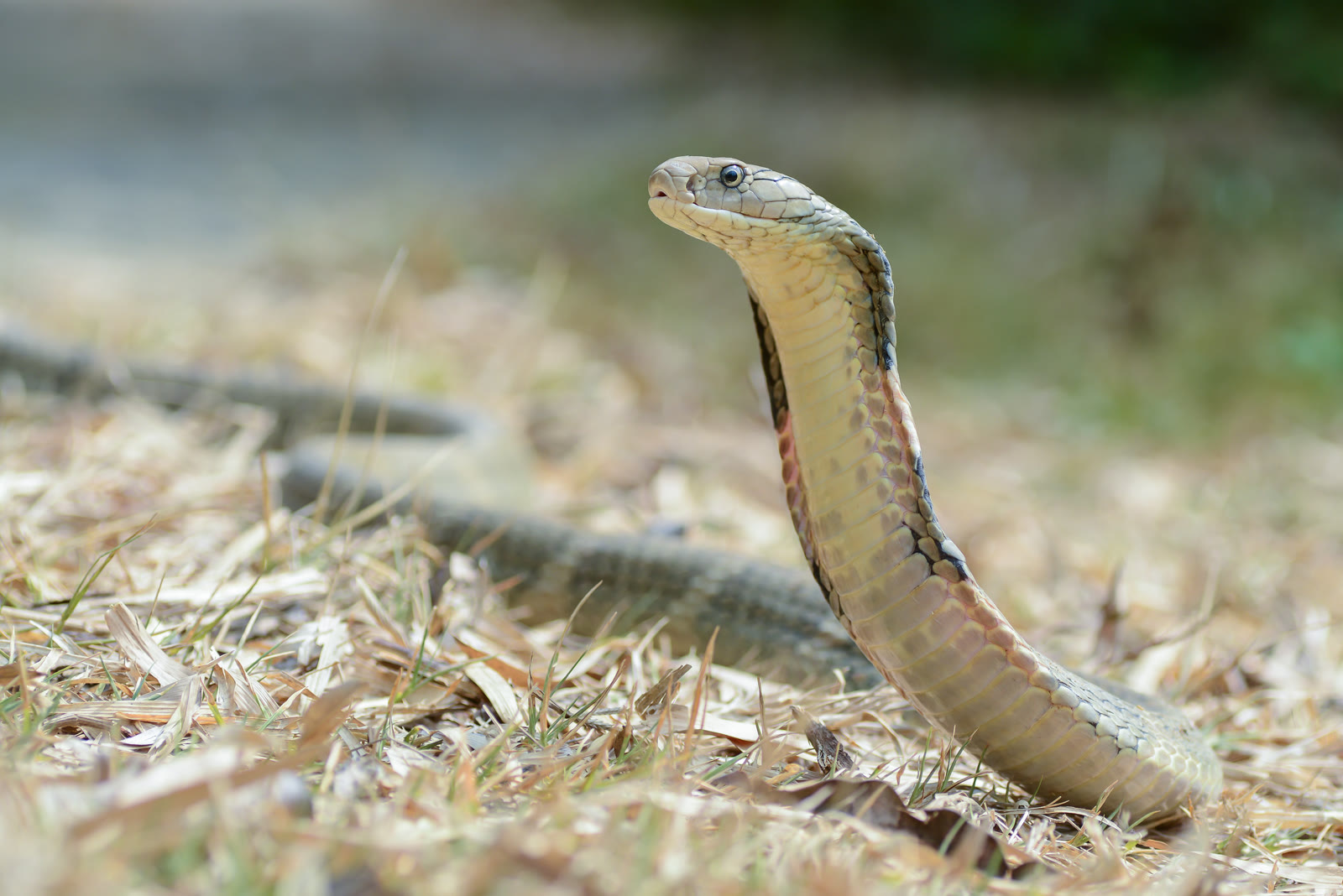
Species deep dive · king cobra
King Cobra: World's Longest Venomous Snake (Not a True Cobra)
Search "king cobra" and two claims usually win: longest venomous snake on Earth, and a hooded serpent that stares you down at eye level. Both hold. The catch is taxonomic. Ophiophagus hannah is an elapid — same broad family as cobras and mambas — but it is not a true cobra in the genus Naja. It sits alone in Ophiophagus, a name that literally means "snake eater."
In Wilder TCG the King Cobra is a Rare Reptilia creature with Cold-Blooded and Venom. The card is shorthand for Asia's forest heavyweight: long reach, a flare that freezes the table, and a bite built to end snake fights.
Length, hood, and a growl that is not a hiss
Adults commonly measure about 3–4 m (roughly 10–13 ft). Verified giants push toward 5.8 m (about 19 ft) — the record class that keeps the "longest venomous snake" title out of reach of other elapids. Weight is lean for the length, often on the order of several to a dozen kilograms depending on sex and region.
When threatened, a king cobra rears the front third of its body, spreads an oval hood, shows the fangs, and produces a low, breathy sound people compare to a dog's growl more than a snake's hiss. Comparative anatomy points to tracheal diverticula that act as resonating chambers, shifting the dominant frequency far below a typical snake hiss.
It is not a mindless charger. Most wild encounters end with the snake slipping away; aggression spikes around incubating nests or when an animal is cornered.
A diet written into the genus name
Ophiophagus is not marketing. The staple prey is other snakes — including large and venomous species — with lizards and other small vertebrates taken more opportunistically when snakes are scarce. After a big meal, slow reptile metabolism can stretch the gap between hunts for a long time.
That specialization is why the hood-and-rear display reads as theater to humans and as a serious warning to anything that shares the leaf litter.
The only snakes that build a nest
Among snakes, king cobras are the standout nest builders. From late dry season into early rains, females gather leaf litter into an above-ground mound — often near a tree base — and lay a clutch that can run from roughly 7 to 40+ eggs. The female may guard the nest for days to weeks; incubation commonly lasts on the order of two to three months depending on temperature and site.
Hatchlings arrive already venomous and often more high-strung than adults. Facultative parthenogenesis has also been documented in the species — virgin births in the lab sense, not folklore.
Forest Asia, Vulnerable status, and a shifting name
The range runs across South and Southeast Asia into southern China: rainforest, bamboo, mangroves, and edges of farmland, often near streams, from lowlands up toward about 2,000 m in places. IUCN lists O. hannah as Vulnerable, driven mainly by habitat loss, persecution, and trade; it is also on CITES Appendix II.
Recent taxonomic work treats "king cobra" as a species complex. A 2024 revision proposed additional named lineages across the range (for example Western Ghats and Sunda forms). Field guides and cards still lean on O. hannah as the familiar label while that split settles into checklists — a reminder that the animal people search for is both a headline species and an evolving name.
Culturally it carries weight from India to Myanmar and beyond — India's national reptile in popular framing, and a figure in regional myth and ritual. Treat those stories as culture, not field biology.
Venom without the campfire stories
King cobra venom is dominated by three-finger toxins (including potent alpha-neurotoxins) with a substantial share of snake-venom metalloproteinases. Clinically, serious bites are a medical emergency: local swelling and pain can progress to descending paralysis and respiratory failure without prompt antivenom and supportive care. Yield can be large; composition varies by region and age, which is one reason treatment is specialist work.
What this piece will not do is invent nest densities, bite-mortality percentages, or home remedies. The honest line is enough: this is a long, snake-specialist elapid whose defense chemistry is real, and whose reputation outruns how often it seeks a fight with people.
From leaf nest to Wilder card
In the King Cobra field guide entry you will find taxonomy, habitat, and in-game stats. On the board, Venom echoes the "one clean hit ends the fight" ecology of an ophiophagous hunter. Hood Flare pacifies — a rules nod to that reared display that makes prey (and players) freeze. Cold-Blooded tracks the seasonal cost curve reptiles live on.
If you have never tried Wilder, guest play is free in the browser — open packs, build a deck, and put a King Cobra on the table:
Quick facts
- Scientific name: Ophiophagus hannah (Cantor, 1836); species complex under active revision
- Not a true cobra: genus Ophiophagus, not Naja
- Size: typically ~3–4 m; record class near ~5.8 m
- Diet: primarily other snakes (ophiophagous)
- Nest: only snakes that build an above-ground leaf nest; female guards eggs
- IUCN: Vulnerable · CITES Appendix II
- Wilder family: Reptilia · Rare · Cold-Blooded, Venom
Photo credit
Hero photograph: Rushenb, "Ophiophagus-hannah-kaeng-krachan-national-park" (Wikimedia Commons), CC BY-SA 4.0. Cropped for the Field Journal hero.

Questions people ask
Is the king cobra the most venomous snake in the world?
No. It is the longest venomous snake, not the most toxic. The Australian Venom Research Unit lists its mouse LD50 at 1.80 mg/kg, against 0.025 mg/kg for the inland taipan at the top of the table (AVRU). Our LD50 showdown explains the ranking.
How long do king cobras live?
About 20 years in the wild, according to Smithsonian's National Zoo.
How good is a king cobra's eyesight?
Better than most snakes'. Smithsonian's National Zoo says a king cobra can see a moving person almost 100 m (330 ft) away (National Zoo).
How high can a king cobra stand up?
In a threat display it can lift the front of its body about 1–1.2 m (3–4 ft) off the ground, and it can follow an enemy in that raised posture over considerable distances (Smithsonian's National Zoo).