Most Venomous Snakes: Inland Taipan, LD50 Rankings, and Why Deadliest Differs
Showdown · king cobra, western diamondback rattlesnake
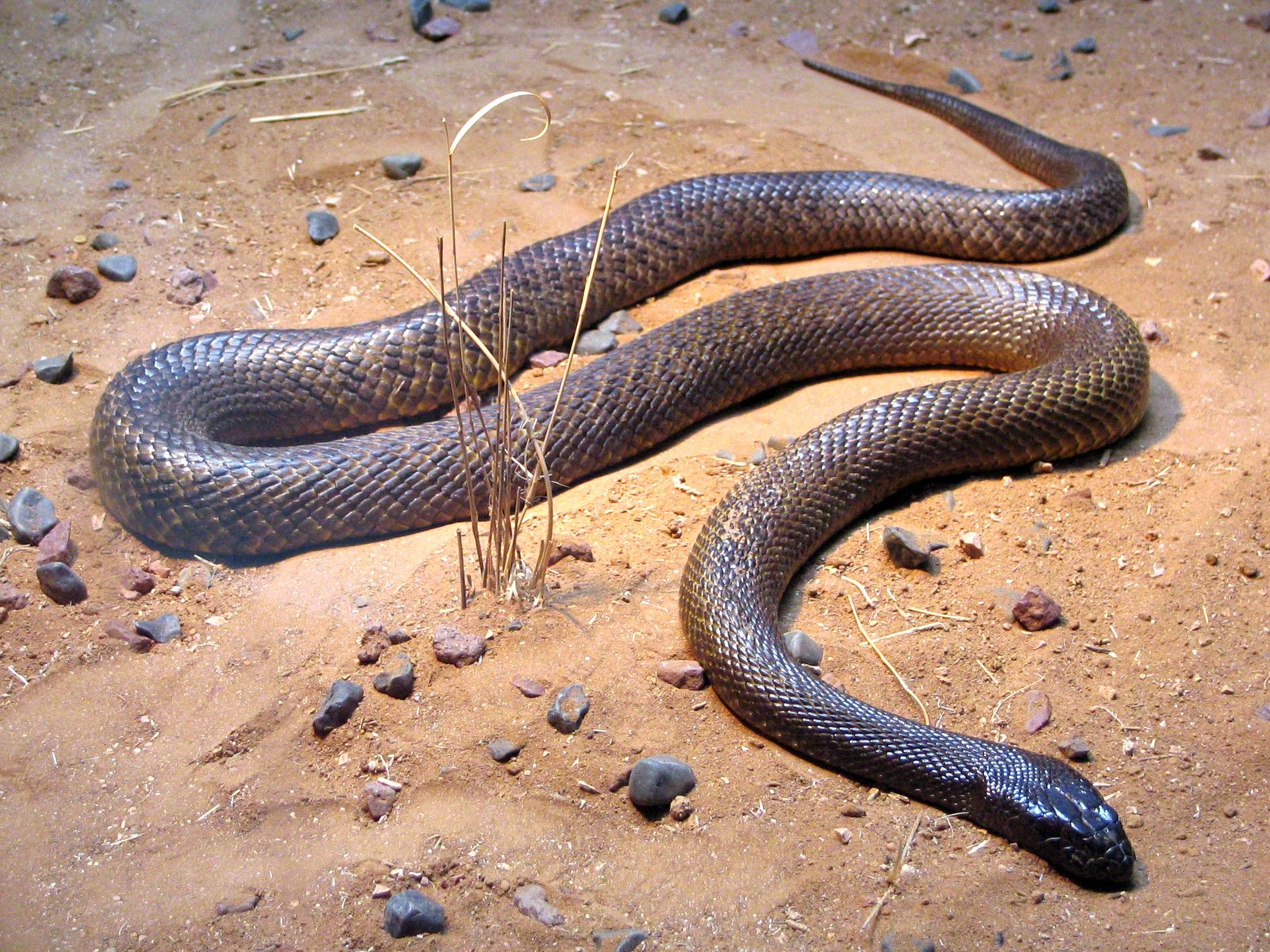
The most venomous snake in the world, measured by murine subcutaneous LD50, is Australia's inland taipan (Oxyuranus microlepidotus). Laboratory mice need only about 0.025 mg/kg of its venom (injected under the skin in saline) for a median lethal dose — the lowest figure in the classic ranking published by the Australian Venom Research Unit.
That answer is clear. What people usually mean by "deadliest," though, is a different question.
Venomous is not the same as dangerous
LD50 asks how toxic a milligram of venom is in a standardized mouse test. It does not weigh how much venom a snake delivers, how long its fangs are, whether it lives near people, how often it bites, or how readily antivenom is available. A shy desert specialist with hyper-toxic venom can kill fewer humans than a common snake with milder venom and frequent encounters.
Fish get a parallel confusion: the reef stonefish is often called the most venomous fish by pain and potency of its spines, yet "most venomous" still is not a simple global danger ranking. Snakes deserve the same honesty.
Ranked by murine subcutaneous LD50
Figures below follow AVRU's compilation of subcutaneous LD50 in mice (mg/kg in saline) unless noted. Lower number = more toxic drop-for-drop. Species order is AVRU's; scientific names are the standard binomials for those common names. Belcher's sea snake is not listed as #1 here — popular claims mixed different injection routes; when researchers compare like with like, the inland taipan still leads, and Dubois' sea snake (Aipysurus duboisii, ~0.044 mg/kg s.c.) is among the most toxic sea snakes without beating the taipan.
| Rank | Common name | Scientific name | LD50 (mg/kg, s.c. mice) | Region | Notes |
|---|---|---|---|---|---|
| 1 | Inland taipan | Oxyuranus microlepidotus | 0.025 | Inland Australia | Top by this metric; rarely meets people |
| 2 | Eastern brown snake | Pseudonaja textilis | 0.053 | Eastern Australia | High human bite significance in Australia |
| 3 | Coastal taipan | Oxyuranus scutellatus | 0.099 | N/E Australia, New Guinea | Large elapid; high yield |
| 4 | Tiger snake | Notechis scutatus | 0.118 | Southern Australia | Potent; antivenom well studied |
| 5 | Black tiger snake | Notechis ater | 0.131 | Southern Australia | Closely related to tiger snake |
| 6 | Beaked sea snake | Hydrophis schistosus | 0.164 | Indo-West Pacific | Marine; not a land encounter risk for most people |
| 7 | Common death adder | Acanthophis antarcticus | 0.400 | Australia | Ambush elapid; short body, long fangs |
| 8 | Gwardar (northern brown) | Pseudonaja nuchalis | 0.473 | Australia | Brown-snake group |
| 17* | King cobra | Ophiophagus hannah | 1.80 | South / SE Asia | Longest venomous snake; huge potential yield |
| — | Western diamondback rattlesnake | Crotalus atrox | ~7.8 | SW USA / Mexico | Not top-tier by LD50; major medical snake via encounters & hemotoxic venom |
\*AVRU rank among its top-25 list. Western diamondback LD50 ≈ 7.8 mg/kg s.c. in mice is reported in Toxicon geographic-variation work (Minton & Weinstein, 1986; RTECS summary); values vary with locality and age.
Wilder snakes in this picture
Wilder already cards two venomous snakes that belong in an honest conversation — and two that do not belong in a "most venomous" top list.
- King cobra (Ophiophagus hannah) — AVRU lists subcutaneous LD50 at 1.80 mg/kg, far milder drop-for-drop than Australian taipans and browns. It still matters because adults can deliver a large dose, rear a third of their body in a threat display, and specialize in eating other snakes. See our Field Journal on the longest venomous snake.
- Western diamondback rattlesnake (Crotalus atrox) — hemotoxic pit viper of deserts and scrub. By murine LD50 it sits well below the Australian elapids above; by emergency-room reality in the American Southwest it is one of the snakes clinicians actually treat. Read diamonds, warning buzz, and desert life.
- Common garter snake — mildly venomous rear-fanged colubrid. Useful pest control in yards; not a candidate for "most venomous" rankings (viviparity and mild venom).
- Green anaconda — a constrictor, not a venomous snake. Enormous and impressive (heaviest snake in flooded basins), but it does not belong on an LD50 venom table.
In Wilder TCG, the king cobra plays as a costly Forest heavyweight; the western diamondback is a mid-cost arid ambusher. Neither needs to win a toxicity Olympics to be interesting cards — taxonomy and ecology are the point of the game.
How to read the table without panic
Australia dominates the top of the LD50 list because many of its elapids evolved mammal-killing neurotoxins, and researchers there published the classic comparative assays. That does not mean every walk in Queensland is more dangerous than a hike in Arizona. Inland taipans live in remote cracking-clay plains and have a tiny bite record compared with browns, rattlesnakes, or cobras that share space with people.
If you want one sentence for searchers: inland taipan for venom potency (LD50); local medically important species for real-world risk. The showdown on Wilder is about getting that distinction right — and about queuing the missing taipans and browns so the card set can eventually match the science.
Photo credit
Hero photograph: XLerate — Fierce Snake (Oxyuranus microlepidotus) — Wikimedia Commons, CC BY-SA 3.0.

Questions people ask
Is Belcher's sea snake the most venomous snake?
No — that claim mixed different LD50 test routes. When researchers compare subcutaneous mouse assays like-for-like, Australia's inland taipan still ranks first (~0.025 mg/kg). Dubois' sea snake is among the most toxic sea snakes (~0.044 mg/kg s.c.) but remains less potent than the inland taipan.
Why do Australian snakes dominate LD50 rankings?
Many Australian elapids evolved highly toxic neurotoxic venoms aimed at warm-blooded prey, and Australian labs published the classic comparative mouse assays compiled by AVRU. Dominance on a toxicity table is not the same as dominance in global human fatalities.
Is the king cobra more venomous than a taipan?
Drop-for-drop, no. AVRU lists king cobra subcutaneous LD50 at 1.80 mg/kg versus 0.025 for the inland taipan. The king cobra can still deliver a large volume of venom and is the longest venomous snake — different kind of threat.
Where does the western diamondback rank for venom toxicity?
Well below Australian taipans and browns by murine LD50 (on the order of ~7.8 mg/kg s.c. in published C. atrox work). It remains medically important in the Southwest because of fang size, venom yield, and how often people encounter western diamondbacks.
Is a green anaconda venomous?
No. The green anaconda is a constrictor. It belongs in conversations about the heaviest snakes, not on an LD50 venom ranking.
Sources
- Australian Venom Research Unit — World's Most Venomous Snakes
- Broad, Sutherland & Coulter 1979 — The lethality in mice of dangerous Australian and other snake venom
- Wikipedia — Inland taipan (toxicity & Belcher's sea snake clarification)
- Minton & Weinstein 1986 — Geographic variation in Crotalus atrox venom
- RTECS — Crotalus atrox venom toxicity summary
- Wilder — King cobra Field Journal
- Wilder — Western diamondback Field Journal
- Wilder — Reef stonefish Field Journal