Southern Cassowary: Most Dangerous Bird Myth, Casque, and Rainforest Gardener
Species deep dive · southern cassowary
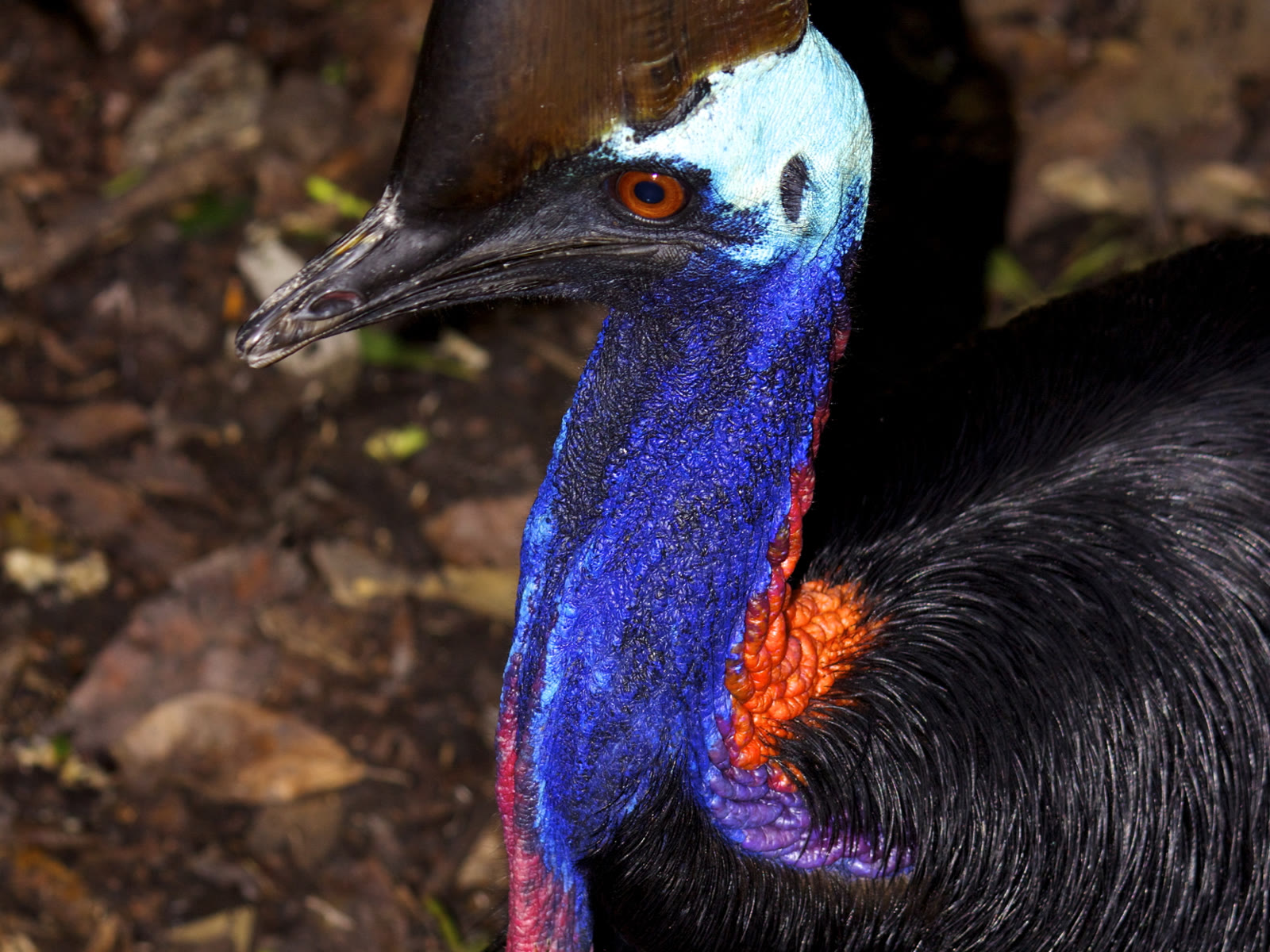
Search “most dangerous bird,” “cassowary kick,” or “cassowary casque,” and you meet Casuarius casuarius — the southern (double-wattled) cassowary, a flightless rainforest giant with a blue neck, red wattles, hair-like black plumage, and a tall grayish casque. Queensland’s environment agency still dubs it the world’s most dangerous bird, then immediately adds the useful caveat: it is not typically aggressive unless provoked, cornered, or defending chicks. The dagger claw is real. The movie-monster personality is mostly myth.
In Wilder TCG the Southern Cassowary is a Cost 5 Aves Forest Uncommon with Guardian and Thorns (ATK 6 / HP 5) — a pricey trail boss whose kick and presence reshape the board the way a real cassowary reshapes a fruiting forest.
Helmet with a thermostat
For nearly two centuries naturalists guessed the casque was a battering helmet, a sound amplifier, or a status ornament. Micro-CT work has cast doubt on a hollow resonance chamber tightly linked to the airway. Infrared thermography tells a clearer story: Eastick and colleagues (2019, Scientific Reports) showed the casque behaves as a thermal window — dumping heat when ambient temperatures are high and restricting heat loss when it is cool. On hot days the casque can account for a disproportionate share of heat exchange for its small surface area. Display and age signalling can still matter; thermoregulation is no longer speculation.
Adults stand up to about 2 m tall. Females may weigh up to about 76 kg, males about 55 kg. Each foot carries three toes; the inner toe ends in a large dagger-shaped claw up to about 120 mm long — the structure behind serious kick injuries.
Rainforest gardener, not cartoon villain
Southern cassowaries live in dense tropical rainforest and related vine forest from New Guinea and nearby islands into northeast Queensland. Globally, BirdLife/IUCN treat the species as Least Concern, but Australia’s southern subspecies (C. c. johnsonii) is listed Endangered under Australian law, with remaining populations concentrated in the Wet Tropics and two Cape York areas. Habitat loss, vehicle strikes, dogs, pigs, and cyclone damage are the main threats Queensland managers emphasise.
Diet is mostly fallen fruit — Queensland researchers have recorded over 238 plant species, including fruits toxic to people. Cassowaries also take fungi, insects, snails, and occasional carrion. Their large droppings move seeds that few other animals can swallow, sometimes acting as a germination partner. That is why conservation groups call them rainforest gardeners: lose the bird and you lose a long-distance delivery service for big-seeded trees.
Dads do the night shift
Breeding is a female-dominance system. A female may mate with several males in a season (roughly May–November in Queensland accounts) and lay 3–5 large olive-green eggs in a ground scrape. The male incubates for about 50 days, then guards striped chicks for roughly 8–18 months before driving them off. Parental males are the birds most likely to stand their ground near people — not because they hate hikers, but because chicks are nearby.
Kofron’s classic Queensland review of attack records (1999) documented 221 cassowary attacks in the dataset, including 150 directed at humans; about 75% of human attacks involved birds previously fed by people, and most incidents were chases or charges rather than contact kicks. Serious injuries were uncommon; a single recorded human fatality involved a person who had attacked the bird. The practical rule from wildlife agencies is blunt: never feed cassowaries, never corner them, and never get between a male and his chicks.
On the Wilder card
The Southern Cassowary field guide tags Forest on a Cost 5 Aves Uncommon with Guardian + Thorns — high attack, punishing contact, and a board presence that matches a keystone frugivore you should respect from a safe distance.
If you have never tried Wilder, guest play is free in the browser:
Quick facts
- Scientific name: Casuarius casuarius (southern / double-wattled cassowary; Australian subsp. johnsonii)
- Family: Casuariidae (cassowaries and emus)
- Hook: Flightless rainforest gardener; casque as thermal window; dangerous if cornered
- Size: up to ~2 m tall; females to ~76 kg, males to ~55 kg
- Look: black hair-like plumage, blue neck, red wattles, tall casque, dagger inner claw
- Range: New Guinea, Aru and nearby islands, northeast Queensland
- Diet: fallen fruit (238+ plant spp. recorded in Qld), fungi, invertebrates, occasional carrion
- Breeding: female lays 3–5 eggs; male incubates ~50 days and raises chicks
- Status: IUCN Least Concern globally; Australian southern cassowary Endangered
- Wilder family: Aves · Forest · Cost 5 · ATK 6 / HP 5 · Guardian + Thorns · Uncommon
Photo credit
Hero photograph: Nick Hobgood — Casuarius casuarius, Papua New Guinea — Wikimedia Commons, CC BY-SA 3.0.

Questions people ask
Is the southern cassowary really the most dangerous bird?
It can seriously injure people with a kick from its dagger-like inner claw (up to about 120 mm), but Queensland wildlife guidance stresses it is usually not aggressive unless provoked, cornered, or defending chicks. Feeding wild birds raises risk — Kofron (1999) found most human attacks involved previously fed birds.
What is a cassowary casque for?
Eastick et al. (2019) showed the casque acts as a thermal window, shedding heat in hot conditions and conserving it when cool. Older ideas (battering helmet, sound amplifier) are not fully ruled out for every function, but micro-CT work makes a simple hollow resonance chamber unlikely.
Do male or female cassowaries raise the chicks?
Males. After the female lays 3–5 large green eggs, the male incubates for about 50 days and guards the striped chicks for roughly 8–18 months. Females may mate with more than one male in a season.
Why are cassowaries called rainforest gardeners?
They swallow large fallen fruits — Queensland records list over 238 plant species — and deposit seeds in nutrient-rich droppings far from the parent tree. Some seeds are too big for other animals to disperse, so cassowaries help regenerate rainforest structure.
Is the southern cassowary endangered?
Globally BirdLife/IUCN treat Casuarius casuarius as Least Concern, but Australia's southern subspecies is Endangered, mainly from habitat loss, cars, dogs, and pigs. See Wilder's Southern Cassowary card.
Sources
- Queensland Government — Southern cassowary
- Eastick et al. (2019) — Cassowary casques act as thermal windows (Scientific Reports)
- BirdLife Australia — Southern Cassowary
- Kofron (1999) — Attacks to humans and domestic animals by the southern cassowary (Journal of Zoology)
- Brassey & O'Mahoney — casque microCT / resonance doubts (BOU summary)
- Wilder TCG — Southern Cassowary field guide