Komodo Dragon: World's Largest Lizard, Venom, and Island Rule
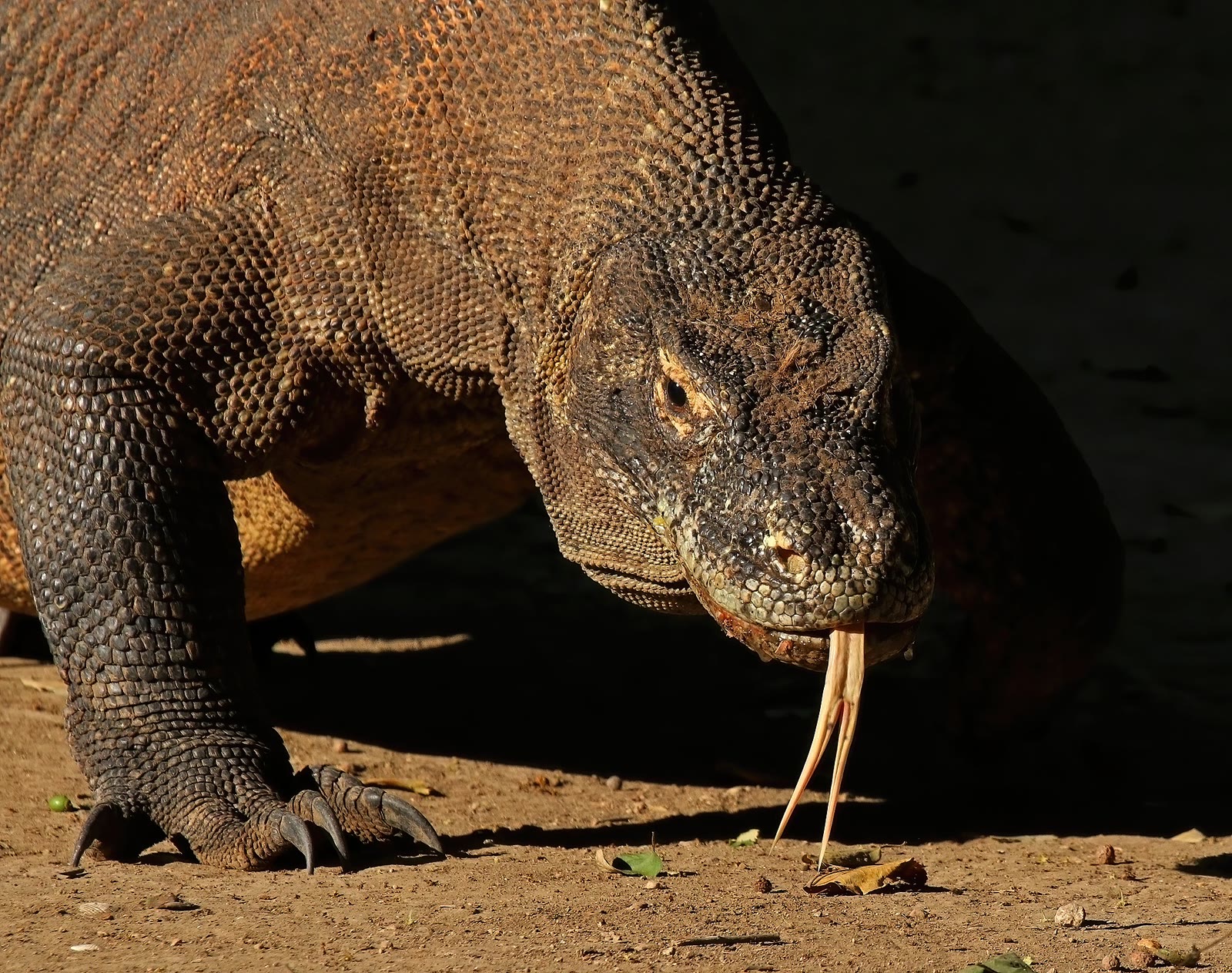
Species deep dive · komodo dragon

Komodo Dragon: World's Largest Lizard, Venom, and Island Rule
Search "Komodo dragon" and the internet still argues with itself: septic bacteria versus venom, lazy scavenger versus ambush hunter, movie monster versus monitor lizard. The animal on the ground is clearer. Varanus komodoensis is the largest living lizard, an Indonesian island apex predator that kills with a combination of slash trauma, blood loss, and oral toxins — then digests meals large enough to idle for weeks.
In Wilder TCG the Komodo Dragon is a Rare Reptilia creature with Cold-Blooded, Feast, and Thorns. The card is shorthand for patience with teeth: wait, bite hard, get stronger when the prey goes down.
Island giant, chain-mail skin
Wild adults commonly weigh on the order of 70 kg, with large males pushing toward 3 m and captive extremes recorded above 150 kg (including gut contents). The body is a classic monitor plan stretched to apex-predator scale: long forked tongue, powerful forelimbs, and a tail that can double as a prop or a weapon.
Adult skin is reinforced with bony osteoderms — a kind of biological chain mail that thickens with age and competition. Hatchlings lack that armor and spend much of their early life in trees, partly to avoid cannibalistic adults.
Teeth are ziphodont: laterally flattened, recurved, serrated. Recent work even finds iron-enriched coatings on the cutting edges — an adaptation for keeping a meat-slicing bite sharp as teeth turn over roughly every month or so.
Hunt first, then wait on digestion — not on sepsis folklore
For a long time popular accounts claimed Komodos relied on filthy, septic saliva to finish prey days later. Modern field and lab work pushed that story aside. Mouth bacteria look ordinary for a carnivore; dragons clean their mouths after feeding. Failed attacks on water buffalo that later festered in warm wallows were easy to misread as a deliberate "septic strategy."
What the jaws do carry are mandibular venom glands. Proteins isolated from those glands include components linked to anticoagulation, blood-pressure drop, and shock physiology (Fry and colleagues, 2009). Scientists still debate how much the venom alone, versus massive laceration and hemorrhage, decides each kill — and a depositing duct system in the teeth is not as neat as a viper's. The careful summary: venom is real anatomy; "walking bacteria bomb" is an outdated cartoon.
Observed hunts on deer and pigs are often over in minutes when they succeed. Adults favor large ungulates (Javan rusa, pigs, buffalo) and will take carrion; juveniles start on insects, birds, and small reptiles. After swallowing up to roughly 80% of body mass, a dragon may bask to speed digestion and then go long stretches between meals.
Smell does the long-range work. Tongue-flicking into the Jacobson's organ, helped by wind, can point a dragon toward carrion kilometers away — field summaries often cite on the order of 4–9 km under good conditions.
Five islands, Endangered, and a climate squeeze
Wild Komodo dragons live on a handful of Indonesian islands — notably Komodo, Rinca, Flores, and smaller satellites inside and around Komodo National Park (founded 1980; UNESCO World Heritage). Preferred habitat is low-elevation savanna, grassland, and monsoon forest; they dig burrows to hold overnight heat and hunt from shade into the cooler afternoon.
IUCN raised the species to Endangered in 2021. Adult numbers are low and fragmented; park populations have looked relatively stable in recent counts, while unprotected Flores habitat and climate-driven sea-level / aridification risk remain the long game. Commercial international trade is banned under CITES Appendix I.
Local languages have their own names and stories — including Komodo sebae ("twins") for a shared spiritual kinship with people. Tourism pays for protection and also presses behavior and habitat; both can be true at once.
Parthenogenesis: virgin births with a ZW twist
Captive females have produced fertile clutches without males — documented parthenogenesis. Because Komodos use ZW sex chromosomes, those unfertilized pathways produce only male (ZZ) offspring; WW combinations fail. It is a striking reproductive footnote for an island species, and a genetic-diversity warning for zoo managers who lean on it too hard.
From island ridge to Wilder card
In the Komodo Dragon field guide entry you will find taxonomy, habitat, and in-game stats. On the board, Septic Bite granting Venom is flavor for the old septic myth reframed as what the science now emphasizes: a bite that ends fights. Feast mirrors gorging after a kill. Thorns is the armored hide talking back. Cold-Blooded keeps the seasonal cost honest.
If you have never tried Wilder, guest play is free in the browser — open packs, build a deck, and put a Komodo Dragon on the table:
Quick facts
- Scientific name: Varanus komodoensis (Ouwens, 1912)
- Size: world's largest living lizard; adults often ~2.3–3 m; wild weights commonly tens of kilograms
- Diet: ambush carnivore — ungulates and carrion as adults; smaller prey as juveniles
- Bite: mandibular venom glands + lacerating teeth; septic-bacteria story largely outdated
- Range: Indonesian islands (Komodo National Park core + Flores pockets)
- IUCN: Endangered (2021) · CITES Appendix I
- Wilder family: Reptilia · Rare · Cold-Blooded, Feast, Thorns
Photo credit
Hero photograph: Charles J. Sharp, "Komodo dragon (Varanus komodoensis)" (Wikimedia Commons), CC BY-SA 4.0. Cropped for the Field Journal hero.
