Great White Shark: Apex Ambush Hunter with Warm Muscles
Species deep dive · great white shark
Great White Shark: Apex Ambush Hunter with Warm Muscles
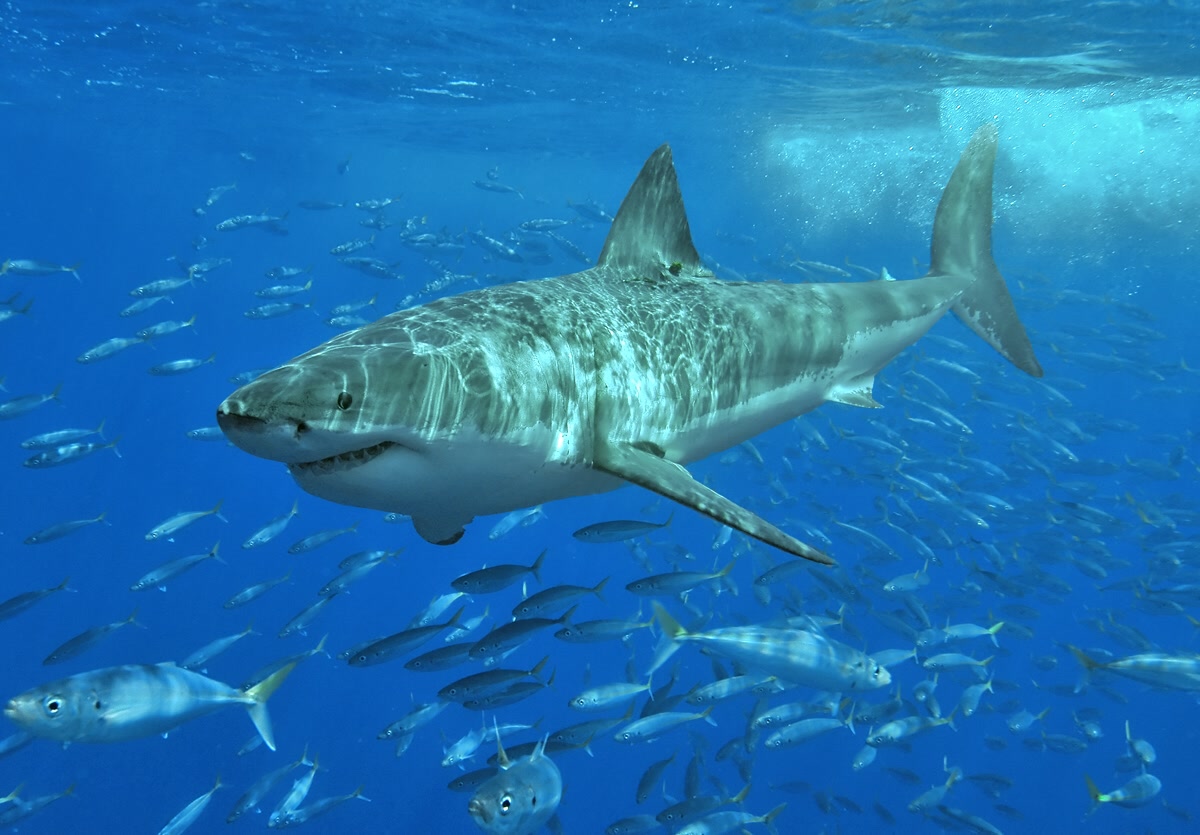
Search "great white shark" and you get the movie first. Fair. Carcharodon carcharias is the animal Jaws turned into a cultural brand. The biology underneath is stranger and more interesting: a partially warm-blooded lamnid that ambushes fat-rich seals from below, migrates across ocean basins, and ranks as Vulnerable on the global IUCN Red List — Critically Endangered in European and Mediterranean waters.
In Wilder TCG the Great White Shark is a Rare Pisces creature with Ambush. The card is shorthand for a real coastal and oceanic hunter whose reputation outruns how often it seeks a fight with people.
Not the biggest fish — still a giant
Great whites are among the largest living predatory sharks, though still smaller than filter-feeding giants like the whale shark and basking shark. Females typically mature around 4.6–4.9 m; males around 3.4–4.0 m. Reliable maximum lengths cluster near 6 m (about 20 ft). Older claims of 11 m animals belong in the folklore pile.
Adults commonly weigh on the order of hundreds to a few thousand kilograms depending on sex and condition. A 2014 northwest Pacific catch review put the longest reliably measured specimen near 6.02 m and the heaviest near 2,530 kg. Treat viral "largest ever" posts with a raised eyebrow.
Regional endothermy: warm muscles in cold water
Unlike most fishes, white sharks keep selected tissues warmer than the surrounding sea. A countercurrent vascular network — a rete mirabile — retains heat generated by dark swimming muscle and can warm the stomach, brain region, and swimming machinery. Stomach temperatures in the mid-20s °C have been recorded in water in the low teens.
That regional endothermy is why a great white can hunt hard in temperate seal colonies instead of shutting down when the water cools. It is not full mammalian warm-bloodedness; it is a lamnid specialty shared with relatives like makos and porbeagles.
Ambush from below
Diet shifts with size. Juveniles lean on fish and cephalopods in shallower coastal water. Larger sharks take marine mammals — seals and sea lions especially — plus fish, other sharks, and scavenged whale carcasses when available. Preferred prey is often high in fat.
Classic hunting footage from California and South Africa shows the same pattern: approach from depth, strike near the surface, sometimes breaching clear of the water on Cape fur seals. Success drops as a chase lengthens; seals that buy time with agility often escape. White sharks also scavenge large whales in groups, assessing chunks more than fighting over them.
Bite-force numbers you see online are usually modeled projections scaled from smaller specimens (notably Wroe and colleagues' 2008 jaw-mechanics work), not everyday field measurements. The ecological story is clearer than any single newton figure: serrated triangular teeth, a jaw that can protrude, and a strategy built around surprise.
Wanderlust with a map
White sharks use both coasts and the open ocean. Famous tracks include multi-thousand-kilometre runs between South Africa and Australia, and northeastern Pacific shuttles between California–Mexico feeding grounds and offshore habitat sometimes nicknamed the White Shark Café. Dive depths can exceed 1,000 m, though much hunting happens nearer the surface at coastal aggregations.
They are generally solitary, yet they gather where seals concentrate. Body language — parallel passes, lateral displays, even tail-splash contests — helps settle rank without constant violence. Orcas can and do kill white sharks in some regions, often targeting the liver; sharks sometimes leave an area when killer whales arrive.
Reputation, bites, and conservation
Jaws (1975) fixed the man-eater myth in popular culture; Peter Benchley later regretted how that framing stuck. Among shark species, white sharks account for the largest share of recorded unprovoked bites on people, but most are non-fatal, and humans are poor prey. Researchers still debate "mistaken identity" versus exploratory investigation — the honest summary is that white sharks explore novel objects with their mouths more often than they hunt people as staple food.
IUCN lists C. carcharias as Vulnerable globally (population decline on the order of roughly 30–49% over roughly a century and a half in the assessment framing), with Critically Endangered regional status in Europe and the Mediterranean. Major pressures include bycatch, beach protection nets, and historical sport and commercial take. The species is on CITES Appendix II. Several countries protect it outright; recovery is uneven and slow because maturity can take decades.
From blue water to Wilder card
In the Great White Shark field guide entry you will find taxonomy, habitat, and in-game stats. On the board, Ambush echoes that deep-to-surface strike — the fight that starts before the opponent has a clean look at the board.
If you have never tried Wilder, guest play is free in the browser — open packs, build a deck, and put a Great White on the table:
Quick facts
- Scientific name: Carcharodon carcharias (Linnaeus, 1758)
- Family: Lamnidae (mackerel sharks)
- Size: mature females ~4.6–4.9 m; males ~3.4–4.0 m; reliable maxima near ~6 m
- Diet: seals and other marine mammals (adults); fish and cephalopods (especially juveniles); scavenges whales
- Key adaptation: regional endothermy via rete mirabile
- IUCN: Vulnerable (global); Critically Endangered (Europe / Mediterranean) · CITES Appendix II
- Wilder family: Pisces · Rare · Ambush
Photo credit
Hero photograph: Pterantula (Terry Goss), "White shark" (Wikimedia Commons), CC BY 2.5. Cropped for the Field Journal hero.
