Honey Badger: Loose Skin, Tough Attitude, and Real Limits
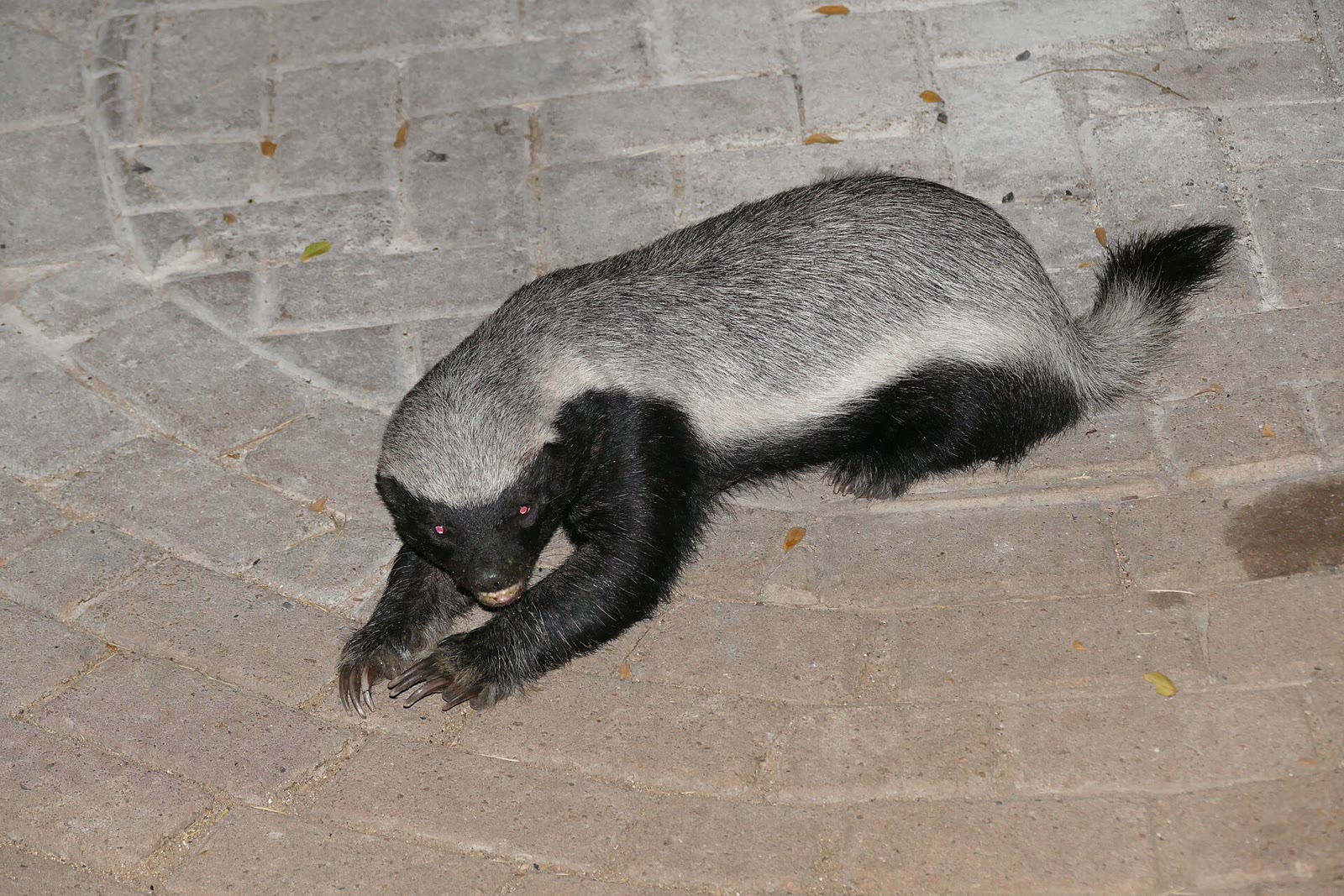
Species deep dive · honey badger
Honey Badger: Loose Skin, Tough Attitude, and Real Limits
Search "honey badger" and the internet hands you a meme: fearless, unstoppable, "don't care." Mellivora capensis — also called the ratel — really is a hard animal to bully. It is also a regular mustelid with a diet, home range, cub mortality, and conservation file. The truth sits between invincible cartoon and ordinary weasel.
In Wilder TCG the Honey Badger is an Uncommon Mammalia creature with Ambush and Resilient, plus a Fearless ability. The card is shorthand for Africa and Asia's thick-skinned hive raider — tough, not magical.
A mustelid that is not a "true" badger
Honey badgers are the sole living members of genus Mellivora and the subfamily Mellivorinae inside Mustelidae. They look badger-ish (stocky, digging claws, bold dorsal stripe), but they are closer to the marten/wolverine side of the family tree than to Eurasian badgers in Melinae.
Adults typically measure about 55–77 cm in body length, with a 12–30 cm tail. African males often weigh roughly 9–16 kg; females 5–10 kg, with regional means commonly landing around 6–12 kg. Shoulder height is on the order of 23–28 cm. It is Africa's largest terrestrial mustelid — still a compact tank, not a bear.
Loose skin and a chemical deterrent
The signature adaptation is remarkably loose skin, especially thick around the neck (about 6 mm). Grabbed by a predator or rival, a honey badger can twist inside its own pelt and bite back. Short ears that are little more than ridges, sturdy plantigrade feet, and long foreclaws complete a dig-and-fight toolkit.
It also carries an eversible anal pouch. The secretion is famously foul — sometimes described as suffocating at close range — and figures in both scent-marking and defense displays. Threat behavior can include rattling sounds, a raised tail, and a straight-on charge that has made larger carnivores rethink the afternoon.
Bee stings and porcupine quills often fail to stop a raid. That is toughness and thick hide, not immunity to every hazard on Earth.
Snake bites: resistance with receipts
Honey badgers eat venomous snakes — including cobras and puff adders in parts of the range — and have a documented reputation for surviving bites that would drop many mammals. Molecular work (notably Drabeck and colleagues, 2015) shows convergent changes in the muscular nicotinic acetylcholine receptor that reduce binding by snake α-neurotoxins. Similar receptor tweaks appear independently in some other resistant mammals.
Read that carefully. It is evidence for resistance to a class of neurotoxins, not a blanket "venom does nothing" spell. Different snake venoms use different toxin cocktails; anecdotes of recovery after bites are not a license for invented medical claims. The field story is still remarkable: a mid-sized mustelid that regularly puts elapids and vipers on the menu.
Diet without the honeyguide fairy tale
Next to the wolverine, the honey badger has one of the least specialized diets in the weasel family: rodents, lizards, snakes, birds, eggs, insects, fruit, roots, and — yes — bee larvae and honey from raided hives. In the southern Kalahari, studies found heavy use of geckos, skinks, gerbils, and mice, plus larger items such as cobras and springhares.
What about the greater honeyguide leading badgers to hives? Popular nature writing loves the partnership. Controlled evidence for true guiding of honey badgers is weak; researchers have argued the classic story is largely a fallacy, and field workers sometimes see honeyguides arrive after a badger is already opening a hive. Treat mutualism claims as unproven folklore until better data lands. Badgers find hives fine on their own.
Range, dens, and Least Concern status
The species spans most of sub-Saharan Africa into Arabia, Iran, and the Indian subcontinent. Habitats run from arid scrub to woodland and mountain slopes — recorded up to about 2,600 m in Morocco's High Atlas and 4,000 m in Ethiopia's Bale Mountains. Activity flips with climate: more nocturnal in hot dry seasons, more diurnal when cool and wet in places like the Serengeti.
Home ranges are large. Southern Kalahari work put adult males around ~550 km² on average and females around ~140 km², overlapping many females per male. Dens are short dug tunnels or borrowed aardvark/warthog/termite structures. Gestation is roughly 50–70 days; litters are usually one or two cubs that may stay with the mother for a year or more. Captive animals can live roughly 20+ years; wild lifespan is less cleanly known.
IUCN lists M. capensis as Least Concern thanks to the huge range, while local pressure from beekeepers, farmers, poison, traps, bushmeat, and traditional medicine still hits some populations. Botswana and Ghana list it on CITES Appendix III; India protects it under Schedule I.
From Kalahari dig to Wilder card
In the Honey Badger field guide entry you will find taxonomy, habitat, and in-game stats. On the board, Resilient and Fearless echo the animal that twists free and keeps coming; Ambush nods to the dig-and-pounce foraging style.
If you have never tried Wilder, guest play is free in the browser — open packs, build a deck, and put a Honey Badger on the table:
Quick facts
- Scientific name: Mellivora capensis (Schreber, 1776)
- Also called: ratel
- Size: ~55–77 cm body; ~6–16 kg typical adult range (sex- and region-dependent)
- Diet: opportunistic carnivore/omnivore — vertebrates, invertebrates, honey and bee brood, plant parts
- Key adaptations: loose thick skin; anal-pouch deterrent; α-neurotoxin receptor resistance
- IUCN: Least Concern
- Wilder family: Mammalia · Uncommon · Ambush, Resilient
Photo credit
Hero photograph: Bernard DUPONT, "Honey Badger (Mellivora capensis)" (Wikimedia Commons), CC BY-SA 2.0. Cropped for the Field Journal hero.
