African Wild Ass: Desert Ancestor of Every Donkey
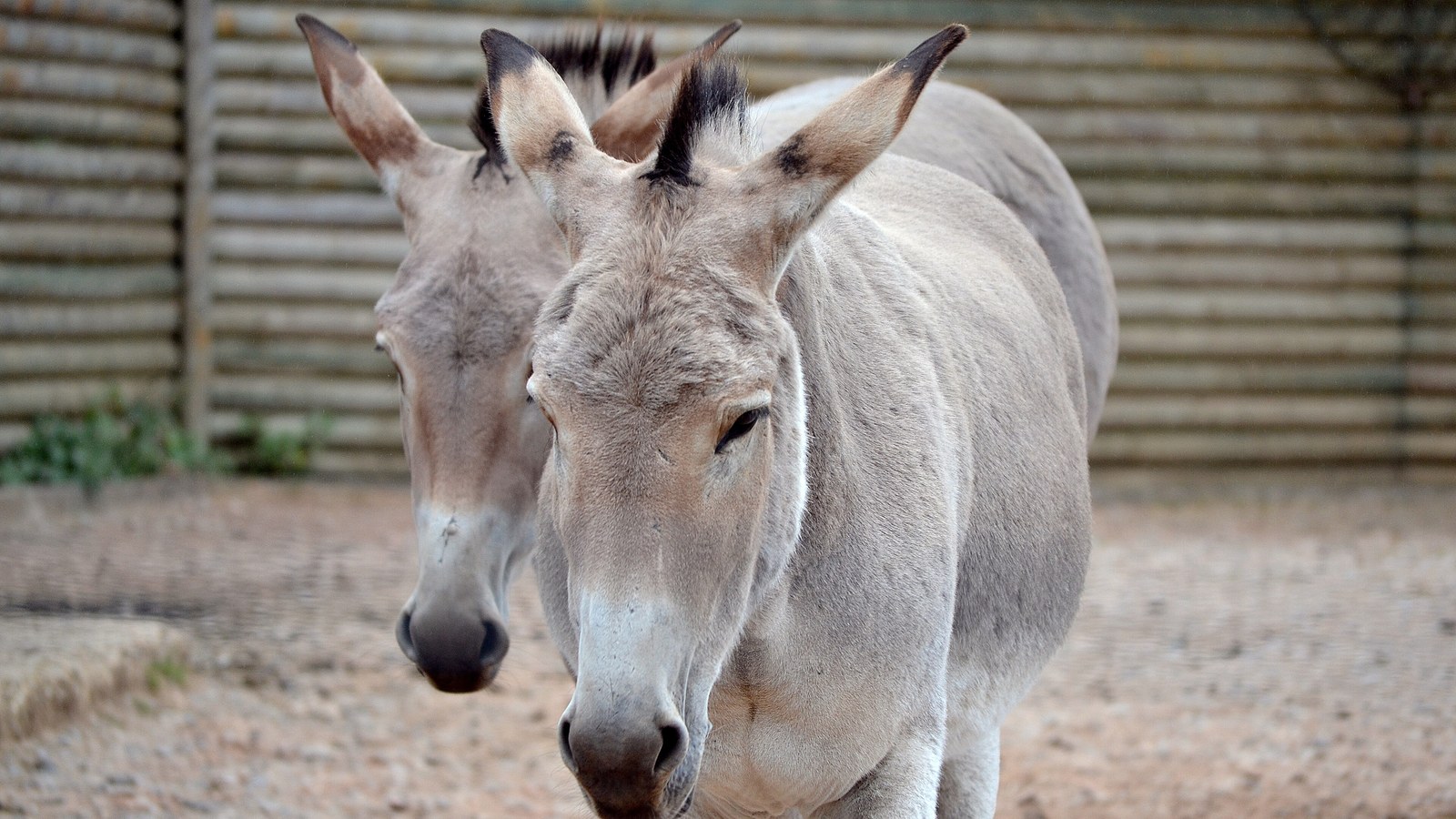
Species deep dive · african wild ass
African Wild Ass: Desert Ancestor of Every Donkey
Most people meet this animal only as a farmyard donkey. The wild source species is Equus africanus — the African wild ass — a lean, striped-legged equid of rocky semi-desert that once ranged across much of northern Africa and now survives in a handful of arid strongholds.
In Wilder TCG the African Wild Ass is a Mammalia creature with Herd and Resilient. The card nods at a social grazer that endures harsh country — useful shorthand for a species whose real-world numbers are measured in hundreds, not thousands.
Taxonomy and the donkey connection
Equus africanus belongs to the horse family Equidae. Two historical subspecies are usually discussed: the Nubian wild ass (E. a. africanus) and the Somali wild ass (E. a. somaliensis), distinguished in part by shoulder-cross and leg-stripe patterns. Ancient DNA and mitochondrial work point to the Nubian lineage as the primary wild ancestor of domestic donkeys (Equus asinus), with domestication extending back several thousand years in northeastern Africa.
That ancestry is the SEO hook and the conservation irony: donkeys are common worldwide, while their wild forebear is among the most endangered equids left.
Built for rock, heat, and thin forage
African wild asses favor stony volcanic plains, scrub, and hill country rather than deep sand dunes. Elevations in occupied habitat run from below sea level in parts of the Danakil Depression up toward roughly 2,000 m. They are grazers and browsers — tough grasses, shrubs, bark, and leaves — active mainly in cooler hours and seeking shade by day.
Desert physiology is extreme. Studies on feral and domestic asses (descendants that still carry the arid toolkit) show animals can lose on the order of 30% of body water and restore fluid in a few minutes of drinking. They tolerate brackish water better than many mammals. Even so, wild asses still need surface water; lactating females and young foals are especially constrained by water and forage. Reported running speeds around 50 km/h (about 30 mph) matter less than sure-footed travel over jagged ground.
Social map: dung piles and loud brays
Adult males often hold large territories (on the order of tens of square kilometers; classic field notes cite figures around 23 km²) marked with conspicuous dung piles — visual and olfactory billboards in open desert. Other males may be tolerated as subordinates rather than expelled from every hectare. Females and young move in small, fluid groups. Loud braying carries across empty country and intensifies around estrous females.
This is not a dense herd species like plains zebra. Low density tracks low primary productivity: the landscape simply does not support large, stable groups year-round.
A Critically Endangered remnant
IUCN assesses Equus africanus as Critically Endangered (criterion C2a(i) in the widely cited 2015 assessment): at best on the order of ~200 mature individuals, with no subpopulation reliably exceeding 50 mature animals, and a possible continuing decline. Broader counts of all ages often put fewer than about 600 animals in the wild. Confirmed populations persist mainly in the Danakil Desert of Eritrea and Ethiopia; Eritrea holds the more stable stronghold. Possible remnants elsewhere (for example Somalia or Djibouti) remain uncertain without fresh genetic confirmation.
Main pressures are hunting for meat and traditional medicinal use of body parts, competition with livestock for water and forage, and climate stress on already thin desert productivity. Hybridization with domestic donkeys is a theoretical genetic risk; recent field genetics in Eritrea–Ethiopia have not shown clear wild-population admixture, though hybrids can occur near people.
Paper protection exists; enforcement across remote pastoral landscapes is hard. Community-engaged conservation in Eritrea is repeatedly cited as the brightest practical hope.
From Danakil stone to Wilder card
In the African Wild Ass field guide entry you will find taxonomy, habitat, and in-game stats. On the board, Herd rewards keeping family on the table the way real equids lean on loose association; Resilient mirrors a species that refuses to quit in country that looks empty on a map.
If you have never tried Wilder, guest play is free in the browser — open packs, build a deck, and put an African Wild Ass on the table:
Quick facts
- Scientific name: Equus africanus
- Ancestry: wild source of the domestic donkey
- Habitat: rocky desert / semi-arid northeast Africa (especially Danakil)
- Key adaptations: extreme dehydration tolerance; brackish-water use; heat-timed activity
- Social: territorial males; small fluid female–young groups; dung-pile landmarks
- IUCN: Critically Endangered; roughly tens to low hundreds of mature individuals
- Wilder family: Mammalia · Herd, Resilient
Photo credit
Hero photograph: The Land, "Somali wild ass pair" (Wikimedia Commons), CC BY-SA 3.0. Cropped for the Field Journal hero.
