American Bison: National Mammal, Prairie Keystone, and Near-Extinction Recovery
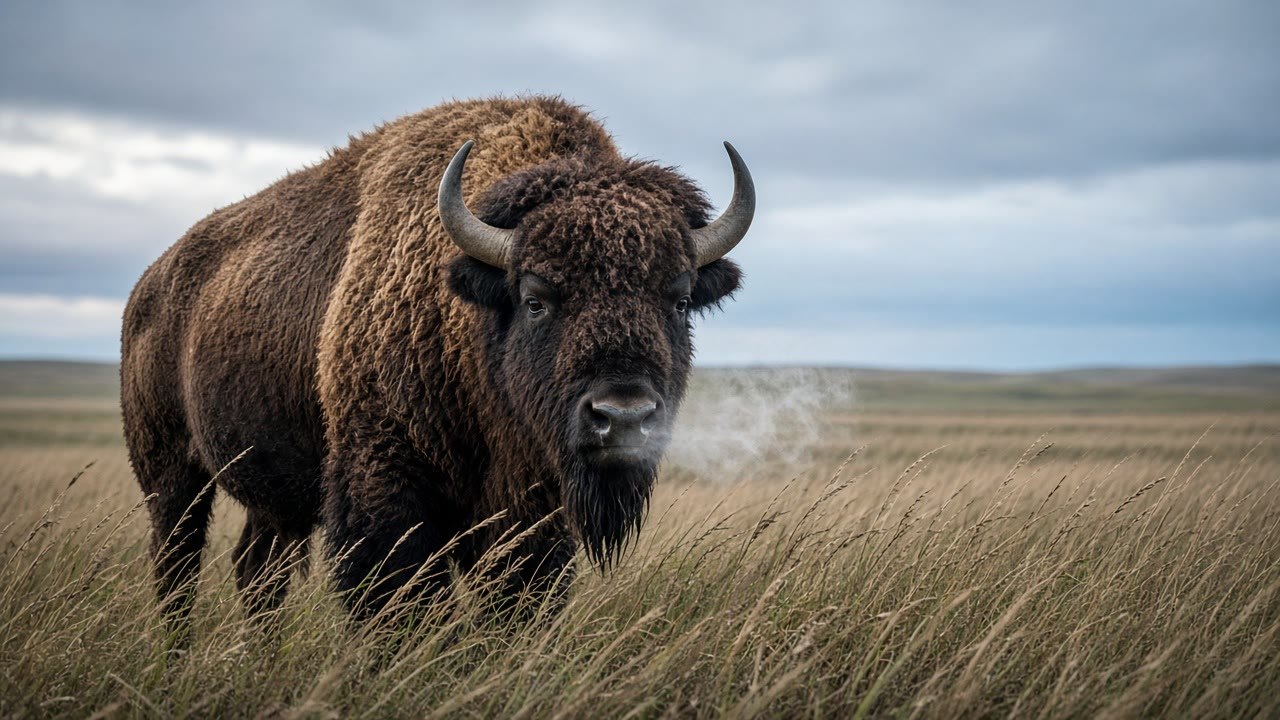
This is a generated illustration, not a photograph.
Species deep dive · american bison
Search "American buffalo" and you get a frontier myth — endless herds, then sudden silence. The living animal is Bison bison: North America's heaviest land mammal, a grassland engineer that almost disappeared in a single human generation, and since 2016 the official national mammal of the United States.
In Wilder TCG the American Bison is an Uncommon Mammalia creature with Guardian and Herd. The card is shorthand for a plains keystone that protects the group and shapes the prairie under its hooves.
Taxonomy of a prairie icon
Bison bison (Linnaeus, 1758) sits in Bovidae, order Artiodactyla. Two living subspecies (or ecotypes) are widely recognized: plains bison (B. b. bison) — the form on the Wilder card — and the larger wood bison (B. b. athabascae) of northern Canada. English speakers still say "buffalo," but true buffalo are African and Asian bovines; American bison are a separate lineage that crossed into North America from Asia in the Pleistocene.
Bulls commonly weigh on the order of 460–1,000+ kg (roughly 1,000–2,200+ lb), with exceptional wild plains bulls recorded near 1,270 kg (~2,800 lb); cows are substantially lighter. Shoulder height for plains animals often falls around 1.5–2 m. Both sexes carry short, curved horns. The massive shoulder hump is muscle and ligament supporting a huge head — a snowplow as much as a battering ram.
Wilder files the card under Mammalia as a Grassland creature. That matches the open prairie and sage-steppe core of the historic range — game taxonomy for a species that also used river valleys, scrub, and mountain meadows when forage allowed.
From tens of millions to a few hundred
Before intensive 19th-century commercial hunting and U.S. Army–linked slaughter campaigns, plains herds numbered in the tens of millions across a "great bison belt" from Canada into northern Mexico. By the late 1880s, U.S. counts had collapsed to a few hundred animals. Yellowstone's remnant wild herd dropped to roughly two dozen by 1902; a handful of private ranch herds and that park nucleus became the genetic bottleneck almost all modern plains bison descend from.
The crash was ecological and cultural at once. For many Plains Indigenous nations, bison were food, shelter, tools, and ceremony — not a sporting trophy. Recovery since then has been real but uneven: hundreds of thousands of animals now exist continent-wide, yet the great majority are managed as commercial livestock. IUCN treats wild Bison bison as Near Threatened because free-ranging, conservation-oriented herds remain few, often small and isolated, and dependent on ongoing management. Roughly tens of thousands sit in public and nonprofit conservation herds; only a minority of those function as large, wild herds under natural selection.
Wallows, snowplows, and herd geometry
Bison are grazers first: grasses and sedges dominate, with browse when grass is scarce. They spend much of the day in graze–rest–ruminate cycles. In winter they swing the head to clear snow from forage. Daily water (or snow) matters.
Wallowing — rolling in shallow dust or mud pits — sheds winter coat, knocks insects, and during the rut helps bulls advertise. Those wallows become habitat mosaics for plants, amphibians, and invertebrates: classic keystone engineering, not scenery. Herds structure by age and sex: cow–calf groups for much of the year; bachelor bulls alone or in small bands until summer. The rut peaks roughly July–August (into early fall by region). Gestation is about 9–9.5 months; calves — bright reddish "red dogs" at birth — can stand and run within hours. Wild longevity is commonly on the order of 12–20 years.
Do not mistake bulk for clumsiness. Healthy adults can run on the order of 50–70 km/h (~30–45 mph), clear roughly two-meter vertical obstacles, and swim rivers. In Yellowstone and similar parks they injure more visitors than bears when people approach too closely — curiosity is not consent.
Yellowstone remains the only place in the lower 48 with a continuously free-ranging bison population since prehistoric times. Recent park estimates have hovered near ~5,000 animals across northern and central breeding herds — a living link through the bottleneck, still managed amid disease, migration, and politics beyond the fence line.
National mammal, unfinished recovery
The National Bison Legacy Act (signed May 9, 2016) adopted the North American bison as the U.S. national mammal. Symbolism outruns ecology: bison still occupy a tiny fraction of historic Great Plains range, cattle gene introgression complicates "purity" debates in many herds, and Tribal-led restoration remains central to bringing wild herds back onto working landscapes. Near Threatened is not extinct — and it is not "problem solved."
From prairie to Wilder card
In the American Bison field guide you will find taxonomy, habitat, and in-game stats. On the board, Guardian and Herd echo a species that survives as a group on open ground — calves in the middle, mass and momentum at the edge.
Play it in Wilder — then give the next roadside giant the space a national mammal still earns the hard way.
Quick facts
- Scientific name: Bison bison (Linnaeus, 1758); card form plains bison B. b. bison
- Hook: U.S. national mammal (2016); prairie keystone; near-extinction bottleneck and managed recovery
- Size: bulls often ~460–1,000+ kg (exceptional wild records higher); cows lighter; shoulder ~1.5–2 m
- Diet: grasses and sedges; browse when scarce; daily water/snow
- Range: historically Alaska to northern Mexico across grasslands; today conservation and commercial herds, with Yellowstone the largest continuously wild U.S. herd
- Behavior: cow–calf herds + bachelor bulls; summer rut; wallowing; fast and agile despite bulk
- IUCN: Near Threatened (conservation-dependent wild herds; few large free-ranging populations)
- Wilder family: Mammalia · Uncommon · Guardian, Herd · Grassland · Cost 5
Questions people ask
How close can you get to a bison in Yellowstone?
No closer than 25 yards (23 m). Yellowstone tells visitors to stay at least that far from bison and elk, and 100 yards (91 m) from bears, wolves and cougars; if a bison walks closer, back away and keep your distance (NPS safety).
What animals hunt bison?
Only wolves and grizzly bears are large predators of adult bison, and Yellowstone says predation has little effect on the population. Bison usually face attackers and defend themselves as a group, though wolves and grizzlies also kill calves (NPS). Meet the hunters on our gray wolf and grizzly bear cards.
How do bison survive the winter?
With thick skin, dense underfur, long guard hairs and layers of fat, plus a muscular hump that lets them swing their heads to sweep snow off the grass. Winter still takes a toll; Yellowstone reports that about 9 in 100 adults die over a winter, and 20–40 in 100 first-year bison may die (NPS).