Axolotl: Forever Young, Extreme Regeneration, and Xochimilco's Edge
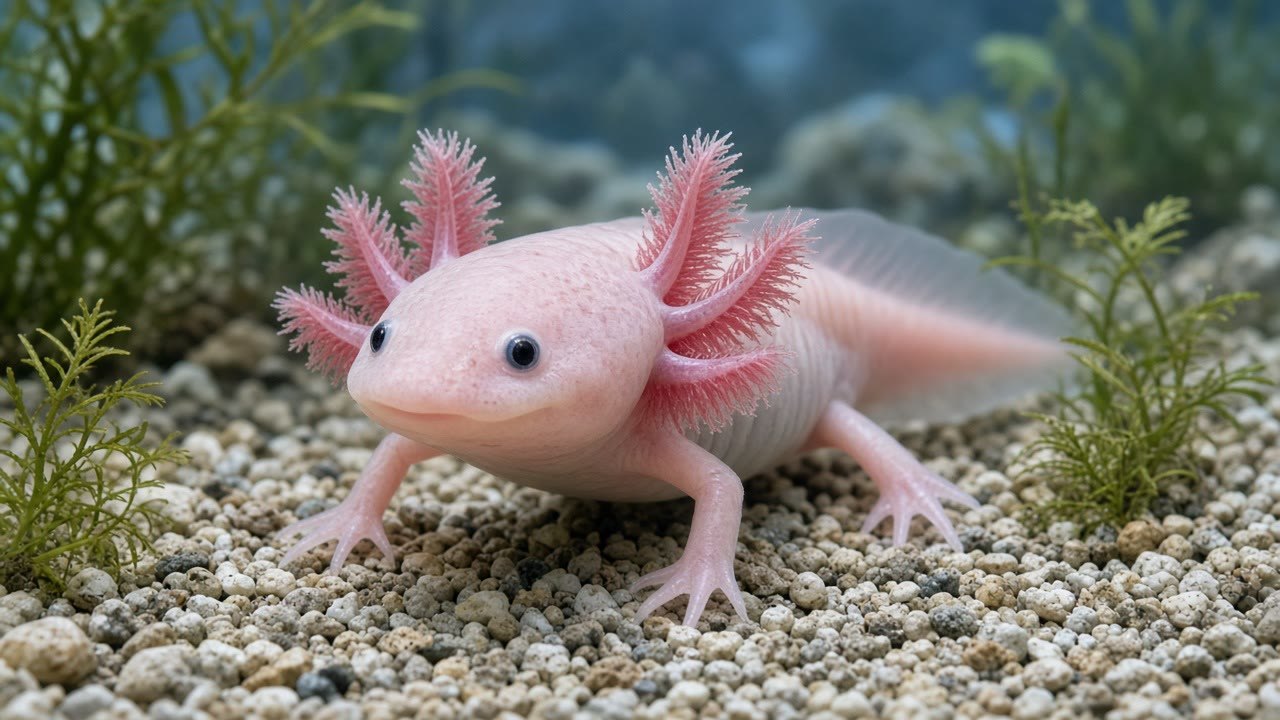
This is a generated illustration, not a photograph.
Species deep dive · axolotl
Search "axolotl" and you will mostly meet pink lab celebrities — but Ambystoma mexicanum in the wild is a mottled brown-grey mole salamander that never quite leaves larval life. It keeps external gills, stays fully aquatic, and still reaches sexual maturity: classic neoteny (paedomorphosis), not a cartoon forever-baby myth.
In Wilder TCG the Axolotl is an Amphibia creature tied to Water habitats (Cost 2). The card is shorthand for a canal endemic whose real headlines are regeneration biology and a Critically Endangered wild range measured in shrinking Mexican wetlands.
Mole salamander that skipped the land chapter
Axolotls belong to Ambystomatidae — the mole salamanders — alongside tiger salamanders (Ambystoma tigrinum and kin). Most relatives metamorphose: gills give way to lungs, lids form on the eyes, and adults spend much of life on land. Axolotls largely refuse that exit. They develop enough lung capacity to gulp air, also breathe through skin, and breed while retaining frilly external gills and a long aquatic tail.
That life-history bet likely tracked lake and canal conditions in Mexico's Central Valley: staying wet was often safer than risking dry land. Closely related Ambystoma species can stay aquatic or leave if a lake shrinks; axolotls appear locked into the water specialist path. Experimentally forced metamorphosis (for example via iodine-driven hormone cascades) is possible but harsh and is not a pet-owner trick — natural paedomorphic animals fare better as permanent aquatics.
Wild animals are typically dark and cryptic; the famous pink leucistic and albino morphs are captive and lab products shaped by breeding, not the default canal look. Adults in good condition may reach on the order of ~25–30 cm and tens to a couple hundred grams (lab and field summaries differ by condition); diet is carnivorous suction feeding — worms, insect larvae, crustaceans, molluscs, and small fish vacuumed rather than chewed with mammalian-style teeth.
Regeneration without miracle-cure hype
Lose a limb and an axolotl can regrow it — often with little scarring. Labs also document regeneration of parts of the spinal cord, heart, and even portions of the brain and eye tissue. Researchers treat the species as a premier model for developmental gene reactivation after injury. Shared vertebrate gene toolkits make the work relevant to human medicine as research, not as a promise that axolotls "cure" human limbs. Precision beats hype here.
The ability may relate to retaining a developmental state that most vertebrates silence after metamorphosis or adulthood candidate genes and protein expression during blastema formation are still being mapped. Treat regeneration claims as documented lab biology, not medical advice and not a reason to buy a pet for "healing powers."
Xochimilco canals and a conservation paradox
Historically the species occupied lakes of the Mexican Central Valley around present-day Mexico City. Lake Chalco was largely drained; wild axolotls now hang on mainly in the canal and wetland network of Xochimilco (with possible remnants around Chalco and contested records elsewhere). They need deepish water, aquatic vegetation for egg attachment, and water quality that urbanization has steadily eroded.
Habitat loss, urban pollution, and invasive carp and tilapia — competitors and predators of eggs and larvae — drove catastrophic declines. IUCN lists A. mexicanum as Critically Endangered (2020 assessment). Order-of-magnitude estimates often cite roughly 50–1,000 mature individuals in the wild; treat those figures as approximate and declining, not a precise census. Some recent surveys put local densities extremely low; a few researchers have argued the wild population is effectively near extinct in the wild even while IUCN still frames it as CR rather than EW.
Captive axolotls are abundant in labs, zoos, and the pet trade — a conservation paradox where aquarium shelves do not equal wild recovery. Captive stocks are also frequently bottlenecked and inbred (many lab lines trace to a small 19th-century European founding group, with later tiger-salamander introgression in some lines), so genetic diversity for restoration is a separate problem from "lots of pink pets exist."
The name traces to Nahuatl āxōltl — often glossed as "water monster" and linked in Aztec tradition to the god Xolotl. That cultural thread is brief and real; it is not a substitute for canal restoration, chinampa-friendly farming, and control of invasive fish.
From chinampa canals to Wilder card
In the Axolotl field guide entry you will find taxonomy, habitat, and in-game stats. On the board it plays as a Water Amphibia presence — the game echo of an animal that wins by staying aquatic, regenerating, and outlasting damage rather than metamorphosing away.
If you have never tried Wilder, guest play is free in the browser — open packs, build a deck, and meet the forever-gilled salamander on the table:
Quick facts
- Scientific name: Ambystoma mexicanum (Shaw and Nodder, 1798)
- Family: Ambystomatidae (mole salamanders)
- Hook: neoteny — sexual maturity with larval traits (external gills, fully aquatic life)
- Superpower (lab): regenerates limbs and portions of spinal cord, heart, brain, and eye tissue
- Wild range: largely Xochimilco canals / wetlands, Mexico City region (historic lakes largely drained)
- Status: Critically Endangered (IUCN 2020); ~50–1,000 mature individuals often cited (approximate)
- Threats: habitat loss, pollution, invasive carp/tilapia; captive abundance ≠ wild recovery
- Wilder family: Amphibia · Water · Cost 2