Hairy Frog: Bone Claws, Breeding Hair, and the Horror-Frog Myth
Species deep dive · hairy frog
Hairy Frog: Bone Claws, Breeding Hair, and the Horror-Frog Myth
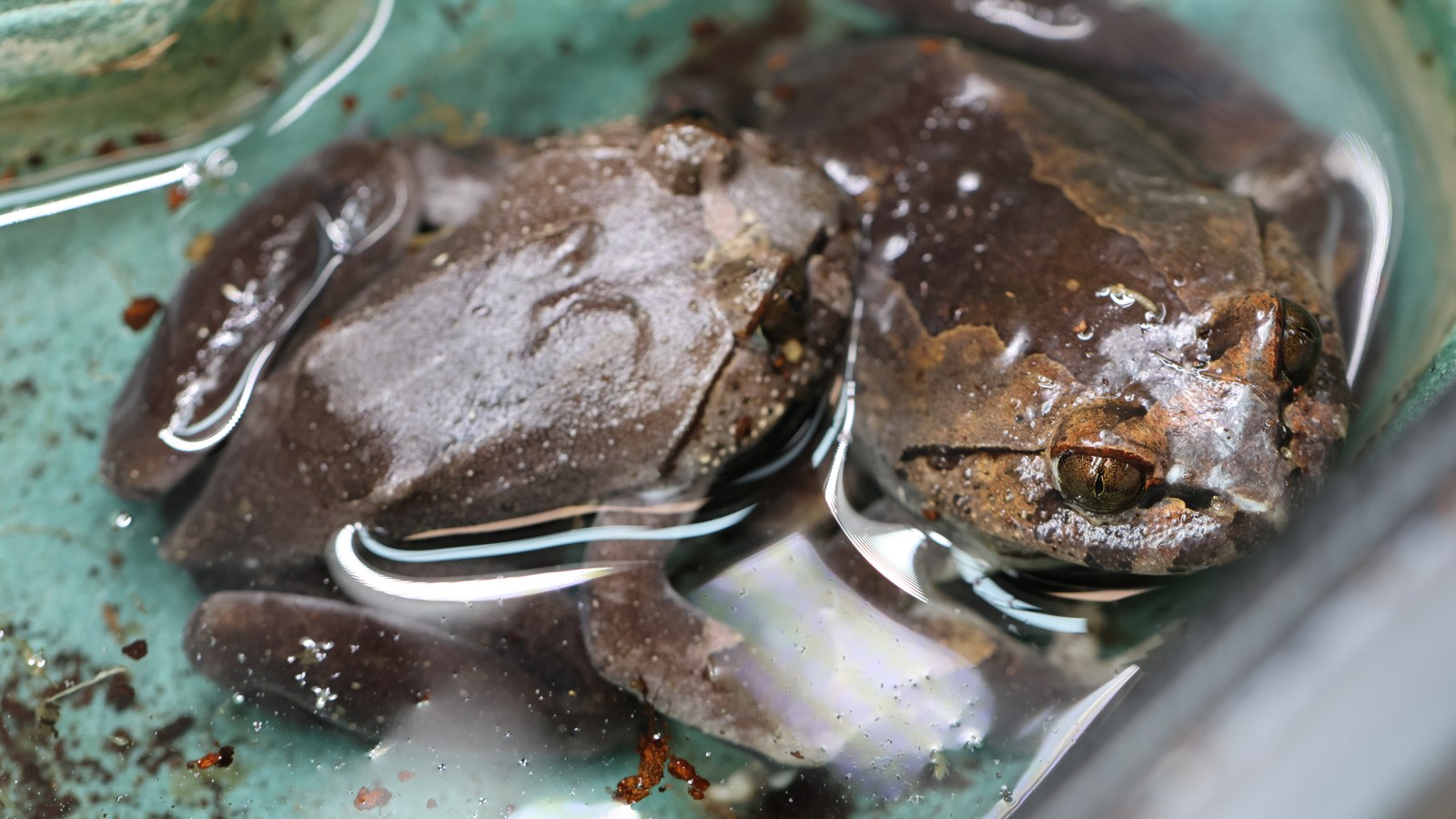
Search "hairy frog" and you will meet nicknames first: horror frog, Wolverine frog — an amphibian that supposedly snaps its own bones into switchblades. That headline is close to the anatomy. Trichobatrachus robustus really does force sharpened toe bones through the skin. The rest of the animal is quieter field biology: a chunky Central African stream frog whose breeding males grow vascular "hair" to babysit eggs underwater.
In Wilder TCG the Hairy Frog is a Common Amphibia creature with Thorns and a Project Claws ability. The card is shorthand for a frog that turns defense into contact damage.
Taxonomy without the comic-book framing
Kingdom Animalia → Chordata → Amphibia → Anura → Arthroleptidae → Trichobatrachus → T. robustus (Boulenger, 1900). The genus is often treated as monotypic; some genetic work argues it belongs inside Astylosternus. Field notes here keep the familiar Trichobatrachus name until field guides settle the split.
Males measure about 10–13 cm snout-to-vent; females 8–11 cm. The head is broad and stubby. Adults are mostly terrestrial hunters that return to water to breed.
Claws that are bone, not keratin
The defense that made headlines is not a cat claw. Hind-toe "claws" are bone, not keratin. At rest, each sharpened terminal phalanx sits inside connective tissue and anchors to a small bony nodule with tough collagen. When the frog contracts the deep digital flexor, that connection breaks and the tip punches through the ventral toe pad.
Harvard anatomists (Blackburn, Hanken & Jenkins, 2008) described the mechanism from museum specimens — so we know the architecture well and the live behavior less well. Retraction is still hypothesized as largely passive, with amphibian skin regenerating the puncture. Treat "it heals and redeploys on demand like Wolverine" as vivid shorthand, not a timed clinical study. An older grip hypothesis (better purchase on wet rock) still gets mentioned; defense remains the leading ecological story.
Related African frogs in Astylosternus share similar bony tips. The Otton frog has a different thumb spike. None of that licenses inventing wound rates or medical claims about human bites from grabbing one bare-handed — Cameroon hunters' preference for spears and machetes is cultural caution with receipts, not an ER dataset.
Breeding "hair" that breathes
The common name is about breeding males, not fur. Along the flanks and thighs they grow hair-like dermal papillae packed with arteries — extra surface area for cutaneous gas exchange while the male stays with eggs in fast water. Females lack the full fringe. Egg masses go onto rocks in streams; muscular tadpoles are carnivorous, with rows of horned teeth.
Adult diet is streamside carnivory: slugs, spiders, beetles, millipedes, centipedes, grasshoppers. Broad heads and strong bodies help with awkward prey.
Range, people, and Least Concern with local pain
Range spans Cameroon, Nigeria, Equatorial Guinea, Gabon, the Democratic Republic of the Congo, and Angola — fast-flowing forest streams and agricultural land that still keeps cover (including plantations), from lowlands into roughly mid-elevation forest.
IUCN lists T. robustus as Least Concern on range size, while some populations decline under habitat loss, pollution, hunting for food, limited pet trade, and the usual amphibian worry of chytrid. In parts of Cameroon the frogs are roasted and eaten. Among the Bakossi, traditional stories say the frogs fall from the sky and that eating them can help childless couples conceive — folklore to report carefully, not to exoticize.
From Central African stream to Wilder card
In the Hairy Frog field guide entry you will find taxonomy, habitat, and in-game stats. On the board, Thorns and Project Claws echo the contact cost of grabbing something that punches bone through skin.
If you have never tried Wilder, guest play is free in the browser — open packs, build a deck, and put a Hairy Frog on the table:
Quick facts
- Scientific name: Trichobatrachus robustus (Boulenger, 1900)
- Also called: horror frog, Wolverine frog
- Size: males ~10–13 cm SVL; females ~8–11 cm
- Hook: bone claws via broken nodule connection; breeding-male dermal papillae
- Habitat: fast forest streams (Central Africa)
- IUCN: Least Concern (local declines)
- Wilder family: Amphibia · Common · Thorns / Project Claws
Photo credit
Hero photograph: Melvin TOULLEC, "Hairy frog (Trichobatrachus robustus)" (Wikimedia Commons.jpg)), CC BY-SA 4.0. Cropped for the Field Journal hero.