Chinese Giant Salamander: How Big It Gets and Why It's Now Several Species
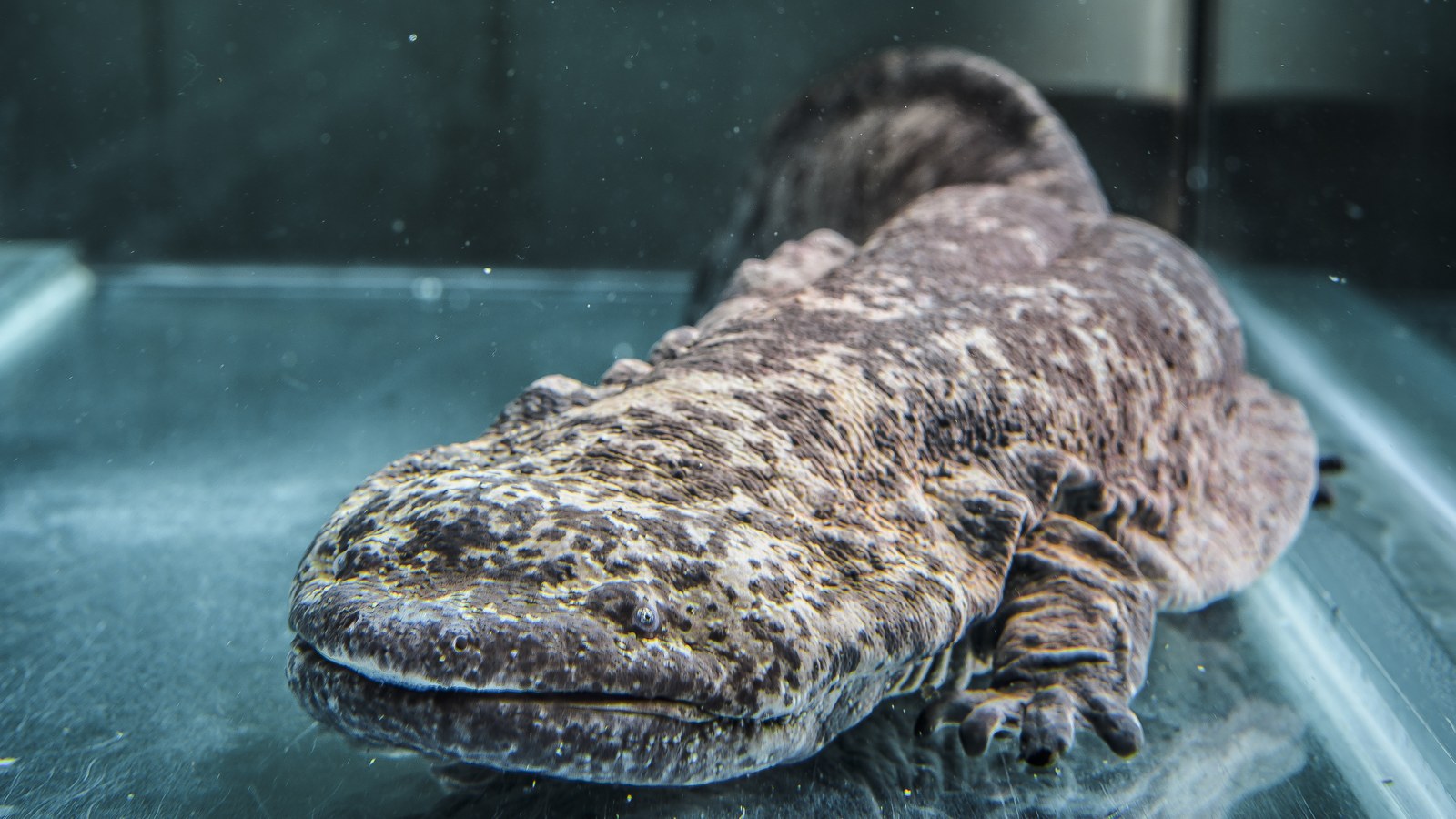
Species deep dive · chinese giant salamander
How big does the Chinese giant salamander get? Big enough to be counted as the world's largest amphibian. The biggest one ever reported measured about 1.8 m (five feet nine inches) and was caught near Guiyang, in Guizhou province, in the early 1920s. Most are much smaller. Animal Diversity Web gives an average of about 1 m and 11 kg, and the San Diego Zoo Wildlife Alliance fact sheet lists a maximum weight of about 60 kg. The tail makes up more than half of that length.
Is it one species? Not any more. For more than a century, all of China's giant salamanders were treated as one species, Andrias davidianus. Genetic studies have since split them, and in 2026 the count of living Andrias species reached six, including Japan's giant salamander. That record 1.8 m animal may not even have belonged to the species on our card.
One giant, several species
The salamanders live in separate river systems and can't cross land, so populations had millions of years to drift apart. In 2018 a genetic study in Current Biology found at least five, and possibly as many as eight, distinct lineages among China's giant salamanders. In 2019 a team working with historical museum specimens identified three clades as separate species:
- Andrias davidianus, in the northern Yangtze and Sichuan region
- Andrias sligoi, the South China giant salamander, from the Pearl River and Nanling mountains
- an unnamed species from the Huangshan area
They also pointed out that recent samples from Guizhou, where the 1.8 m giant was caught, match the sligoi lineage. That means A. sligoi, and not A. davidianus, may be the world's largest amphibian.
New names followed. The Jiangxi giant salamander, Andrias jiangxiensis, was described in 2022 from a genetically pure wild population. In 2023, Andrias cheni, the Qimen giant salamander, was named from the Huangshan area of Anhui. Then in 2026, Andrias yaoluopingensis was described from a river in the Yaoluoping National Nature Reserve, also in Anhui. Its male holotype measures 65 cm, and its description brought the genus to six species. The Wilder card uses the classic name Andrias davidianus, which now refers to the Yangtze lineage specifically.
Why the split matters
The split comes as wild giant salamanders are disappearing. Between 2013 and 2016, researchers surveyed 97 sites in 16 provinces and carried out 2,872 interviews, possibly the largest wildlife survey ever conducted in China. They found populations critically depleted or wiped out across every surveyed area and could not confirm that wild salamanders survived at any of the sites. Illegal poaching was widespread, driven by demand for giant salamander meat as a luxury food.
Farming hasn't been a fix. In 2011, licensed farms in Shaanxi province alone held about 2.6 million giant salamanders. Many farms still rely on wild-caught breeding stock, and some have swapped animals between distant regions. Farm-bred salamanders have also been released into rivers. Because nobody knew the "one species" was really several, those releases can mix lineages that kept apart for millions of years. The IUCN lists the Chinese giant salamander as Critically Endangered, and it's on CITES Appendix I, the strictest level of trade protection.
Life at the bottom of a mountain stream
Chinese giant salamanders live in fast-flowing, rocky mountain rivers and streams. Adults have lungs and come up to breathe, but they also take in oxygen through their skin. The loose, wrinkled folds along their sides add surface area for that. Their small eyes have no lids and see poorly. Instead, sensory nodes along the head and body pick up vibrations in the water. They hunt mainly at night with a "gape and suck" strike: the throat expands and the broad, flat mouth opens to suck in water and prey together. If threatened, they release a sticky white skin secretion that, according to ZSL London Zoo, smells peppery.
The fathers do the childcare. In August, a male claims an underwater den in a cave or under a rock and spends up to 8 days pushing out sand and gravel to clean it. One or more females lay strings of 300 to 560 eggs inside, which the male fertilizes and then guards. He fans them with his tail to bring in oxygen-rich water, shakes his body to keep mould off, and eats eggs that are unfertilized or infected. The eggs hatch after 40 to 60 days.
On the Wilder card
*Chinese Giant Salamander (Andrias davidianus) is a Cost 5 Amphibia Water Rare with Ambush, Regenerate and Cold-Blooded (ATK 4 / HP 7). Ambush lets it attack the turn it's played, which suits a sit-and-wait predator that strikes from cover. Regenerate heals it to full Health at the end of your turn if it survived, a nod to the healing powers salamanders are famous for (see the Axolotl and its Journal piece). Cold-Blooded makes it cost 1 less in Summer and 1 more in Winter. That matches the real animal, which breeds when the water is warmest and slows right down in winter. Its fellow cave-and-stream salamander, the Olm*, has a Journal piece too.
Photo credit
Hero photograph: Petr Hamerník / Zoo Praha, "Velemlok čínský zoo praha 1", a Chinese giant salamander at Prague Zoo (Wikimedia Commons), CC BY-SA 4.0. Cropped for the Field Journal hero.

Questions people ask
How long do Chinese giant salamanders live?
At least 60 years, based on animals in captivity. Their maximum lifespan in the wild isn't known. Their closest relative, the Japanese giant salamander, has a recorded maximum of 72 years (ADW).
What do Chinese giant salamanders eat?
Almost anything they can catch: crabs, fish, frogs, worms, insects, snails and even water shrews. They are also highly cannibalistic. One analysis found other giant salamanders made up about 27% of the diet by weight (ADW; San Diego Zoo).
Why is the Chinese giant salamander called the baby fish?
Its Chinese folk name is wawayu (娃娃鱼), "baby fish", because the sounds it makes, especially when caught, are said to resemble a human baby crying. It also barks, hisses and whistles. Its standard Chinese name is dani (大鲵) (SDZWA fact sheet; ADW).
Is the Chinese giant salamander related to the hellbender?
Yes. Asian giant salamanders and North America's hellbender form the family Cryptobranchidae, a lineage that dates back to the Jurassic. Andrias and the hellbender's genus split roughly 55 to 70 million years ago. The hellbender is much smaller, reaching about 70 cm (SDZWA fact sheet; San Diego Zoo).
Where do Chinese giant salamanders live in the wild?
In fast-flowing mountain rivers and streams in central, eastern and southern China. They are usually found at 300 to 800 m elevation, sometimes from 190 to 1,330 m, in water averaging about 1 m deep. They were once recorded from 18 Chinese provinces (ADW; Turvey et al. 2019).
Sources
- Turvey et al. 2019 — Historical museum collections clarify the evolutionary history of cryptic species radiation in the world's largest amphibians (Ecology and Evolution 9:10070–10084)
- Yan et al. 2018 — The Chinese giant salamander exemplifies the hidden extinction of cryptic species (Current Biology 28:R590–R592)
- Turvey et al. 2018 — Imminent extinction in the wild of the world's largest amphibian (Current Biology 28:R592–R594)
- EurekAlert!/Cell Press — Giant Chinese salamander is at least five distinct species, all heading toward extinction (21 May 2018)
- Chai et al. 2022 — Discovery of a wild, genetically pure Chinese giant salamander creates new conservation opportunities (Zoological Research 43:469–480)
- Jiang et al. 2026 — A new species of the giant salamander genus Andrias from Yuexi, Anhui, China (Zoosystematics and Evolution 102:649–658)
- Pensoft blog — New species of giant salamander discovered in Anhui, China (15 Jul 2026)
- BBC Discover Wildlife — new giant salamander species (20 Jul 2026)
- Animal Diversity Web (University of Michigan) — Andrias davidianus
- San Diego Zoo Wildlife Alliance Library — Chinese giant salamanders (Andrias spp.) fact sheet
- San Diego Zoo Wildlife Alliance — Chinese giant salamander
- ZSL London Zoo — Chinese giant salamander
- Wilder — Chinese Giant Salamander card