Why Do Scorpions Glow Under UV Light? The Emperor Scorpion Explains
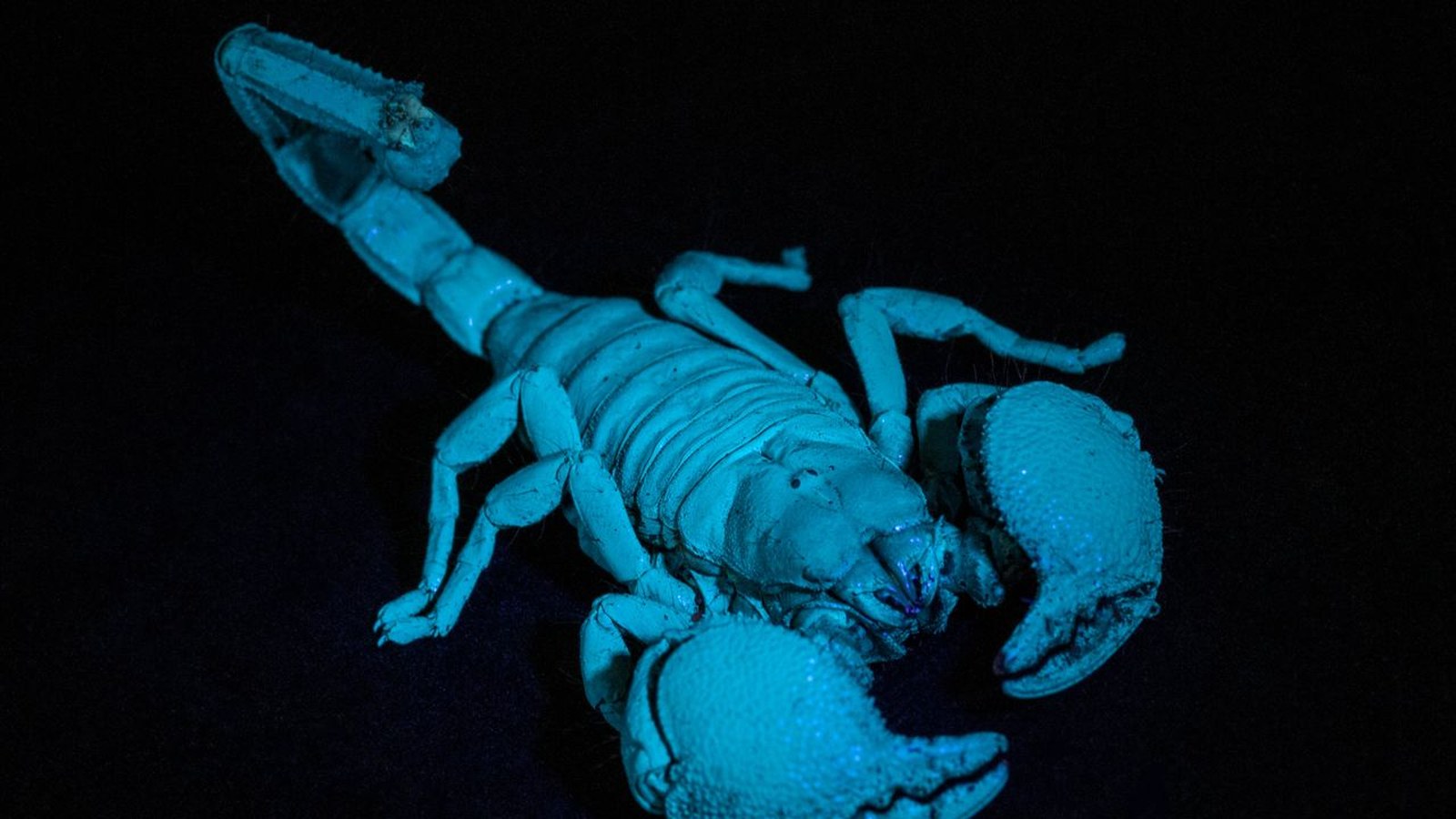
Species deep dive · emperor scorpion
Why do scorpions glow under UV light? Their exoskeleton fluoresces. A thin, clear outer layer of the cuticle, called the hyaline layer, holds compounds that soak up invisible ultraviolet light and give it back as visible blue-green light. Chemists have identified two of them: β-carboline, isolated from the cuticle of the emperor scorpion (Pandinus imperator) and the striped bark scorpion, and a coumarin, 7-hydroxy-4-methylcoumarin. A scorpion doesn't glow in the dark on its own, though. Switch off the UV lamp and the blue-green is gone.
What is the glow for? Nobody knows for sure, but the best-supported idea is that it helps scorpions detect light. In a 2010 experiment, researchers faded the fluorescence of Paruroctonus becki scorpions by keeping them under black lights for weeks. Under UV light, scorpions that still glowed cut back their activity, while the faded ones didn't. Under white light or infrared alone, the two groups behaved the same.
A whole-body light sensor?
A 2012 study of the desert grassland scorpion Paruroctonus utahensis came to a similar conclusion. Scorpion eyes are most sensitive to green light of around 500 nm. In the arena tests, the scorpions reacted most strongly to UV (395 nm) and to cyan-green (505 nm). With their eyes covered, they were much less likely to react to the cyan-green light than to UV. The authors suggested that the whole cuticle may work as a photon collector, turning UV into the cyan-green that scorpions see best. That could tell a scorpion whether any part of its body is sticking out of cover. The 2010 team linked the idea to moonlight, which contains some UV, and to scorpions staying hidden on bright nights.
Luring prey is a less likely explanation. In a 2005 field test, sticky traps baited with glowing scorpions caught fewer flying insects than traps with non-glowing ones on full-moon nights, when the glow is strongest. There was no difference at the new moon. If anything, the glow seems to cost scorpions some meals, which suggests it pays off in another way.
Built into the armour
The glow comes with hardening. Scorpions build up strong fluorescence as their new cuticle hardens after a molt, and a 2024 study of molting scorpions found that different body parts regain their glow at different speeds. It isn't even across the body either: in a 2020 study, the pincers (pedipalps) and the segments of the tail glowed more intensely than the broad middle of the body. Weeks under a black light do wear it down, though. In one lab method, scorpions kept under constant low-level UV lost their visible fluorescence after about 4.5 weeks.
The trait is very old. A 2017 survey of living chelicerates (the group that includes spiders, mites and horseshoe crabs) found that only scorpions and horseshoe crabs have a fluorescing cuticle, and both have the hyaline layer. The researchers also found a hyaline layer in exceptionally preserved fossil sea scorpions, which suggests the glow may go back to a shared ancestor. For field biologists it's simply useful. Since at least the 1970s, researchers have surveyed scorpions at night with portable UV lamps.
The emperor scorpion: big claws, mild venom
The emperor scorpion is one of the largest scorpions in the world, averaging about 20 cm long, and pregnant females can weigh more than 28 g. It lives in hot, humid forests of West Africa, including Nigeria, Togo, Sierra Leone and Ghana. It digs burrows under leaf litter and along stream banks and often moves into termite mounds, because termites are its main prey. Adults usually tear prey apart with their huge pincers rather than stinging it. Juveniles depend more on the stinger.
It is also unusually social for a scorpion. Emperor scorpions have been seen living in colonies of up to 15, and cannibalism is rare. After a gestation of about 9 months, a female gives birth to live young, usually 10 to 12, and carries them on her back until they can manage alone. Its venom is mild, but it has interested drug researchers. A peptide from it called scorpine has shown anti-malarial and antibacterial activity in the lab.
On the Wilder card
*Emperor Scorpion (Pandinus imperator) is a Cost 3 Arachnida Forest Uncommon with Venom and Camouflage (ATK 3 / HP 4). Camouflage means enemy Actions, Signatures and abilities can't target it until it attacks, which suits a night hunter that spends the day hidden in a burrow. Venom makes any combat damage it deals to a creature lethal. That's a game simplification: the real animal's sting is mild, and its claws do most of the work. Its flavor text sums it up: "Burrows by day, rules the leaf litter by night with outsized claws." For arachnids whose venom really does matter, see the Sydney Funnel-web Spider (Journal) and the Southern Black Widow. The Texas Brown Tarantula* is another big arachnid in the deck.
Photo credit
Hero photograph: Rosa Pineda, "Emperor Scorpion Under UV Light" (Wikimedia Commons), CC BY-SA 3.0. Cropped for the Field Journal hero.

Questions people ask
Is an emperor scorpion sting dangerous to people?
Usually not. Animal Diversity Web describes the emperor scorpion's sting as generally mild and not fatal, and notes that a pinch from its big pedipalps can be painful. Adults are timid, tend to flee rather than fight, and rarely use the stinger on prey (ADW).
Are emperor scorpions endangered?
They haven't been assessed. The IUCN lists the emperor scorpion as Not Evaluated. Heavy collection for the pet trade got it listed on CITES Appendix II in 1995, so international trade needs permits meant to keep it sustainable. Many exported animals have come from Ghana and Togo (ADW; CITES).
How long do emperor scorpions live?
About 5 to 8 years in captivity, according to Animal Diversity Web, which says wild lifespans are probably shorter. They take about 4 years to reach maturity (ADW).
Do all scorpions glow under UV light?
Nearly all that have been checked do. A 2020 study of 24 species from 4 families found practically the same fluorescence spectrum in all of them, with brightness varying by species. The family Chaerilidae has been discussed as a possible exception (López-Cabrera et al. 2020; Lourenço 2012).
Do shed scorpion skins glow under UV light?
Yes. The fluorescent compounds sit in the hardened cuticle, so the shed skin (exuvia) carries them too. Chemists have extracted β-carboline compounds from shed scorpion skins, and a 2020 study isolated another fluorescent compound from the shed skins of Liocheles australasiae (Stachel et al. 1999; Yoshimoto et al. 2020).
Sources
- Stachel, Stockwell & Van Vranken 1999 — The fluorescence of scorpions and cataractogenesis (Chemistry & Biology 6:531–539)
- Rubin, Lamsdell, Prendini & Hopkins 2017 — Exocuticular hyaline layer of sea scorpions and horseshoe crabs suggests cuticular fluorescence is plesiomorphic in chelicerates (Journal of Zoology 303:245–253)
- Kloock, Kubli & Reynolds 2010 — Ultraviolet light detection: a function of scorpion fluorescence (Journal of Arachnology 38:441–445)
- Gaffin, Bumm, Taylor, Popokina & Mann 2012 — Scorpion fluorescence and reaction to light (Animal Behaviour 83:429–436)
- Kloock 2005 — Aerial insects avoid fluorescing scorpions (Euscorpius 21)
- López-Cabrera et al. 2020 — Characterization of the fluorescence intensity and color tonality in the exoskeleton of scorpions (J. Photochemistry & Photobiology B 209:111945)
- Liu et al. 2024 — Differential fluorescence features and recovery speeds of different scorpion exoskeleton parts during the molting process (Spectrochimica Acta A 316:124309)
- Stahnke 1972 — UV light, a useful field tool (BioScience 22:604–607)
- Lourenço 2012 — Fluorescence in scorpions under UV light; can chaerilids be a possible exception? (Comptes Rendus Biologies 335:731–734)
- Yoshimoto et al. 2020 — A fluorescent compound from the exuviae of the scorpion, Liocheles australasiae (Journal of Natural Products 83:542–546)
- Animal Diversity Web (University of Michigan) — Pandinus imperator
- Conde et al. 2000 — Scorpine, an anti-malaria and anti-bacterial agent purified from scorpion venom (FEBS Letters 471:165–168)
- CITES — Emperor scorpion (species gallery)
- Wilder — Emperor Scorpion card