Sydney Funnel-web Spider: How Dangerous Is the Bite — and Why Antivenom Wins
Species deep dive · sydney funnel web spider
Search “how dangerous is a Sydney funnel-web bite,” “funnel-web antivenom,” or “deadliest spider Australia,” and you get a two-part answer. Atrax robustus — the Sydney funnel-web spider — earned its reputation: male venom can kill an untreated adult, and thirteen deaths are attributed to this species complex between 1927 and the early 1980s. The second half matters just as much: since clinical antivenom arrived in 1981, Australian Museum sources report no recorded deaths.
Atrax robustus is a mygalomorph in family Atracidae. In Wilder TCG the Sydney Funnel-web Spider is a Cost 4 Arachnida Forest Rare with Ambush and Venom — a board threat that mirrors a burrow ambusher whose real-world story is as much about hospitals and antivenom as fangs.
What it looks like — and how it warns you
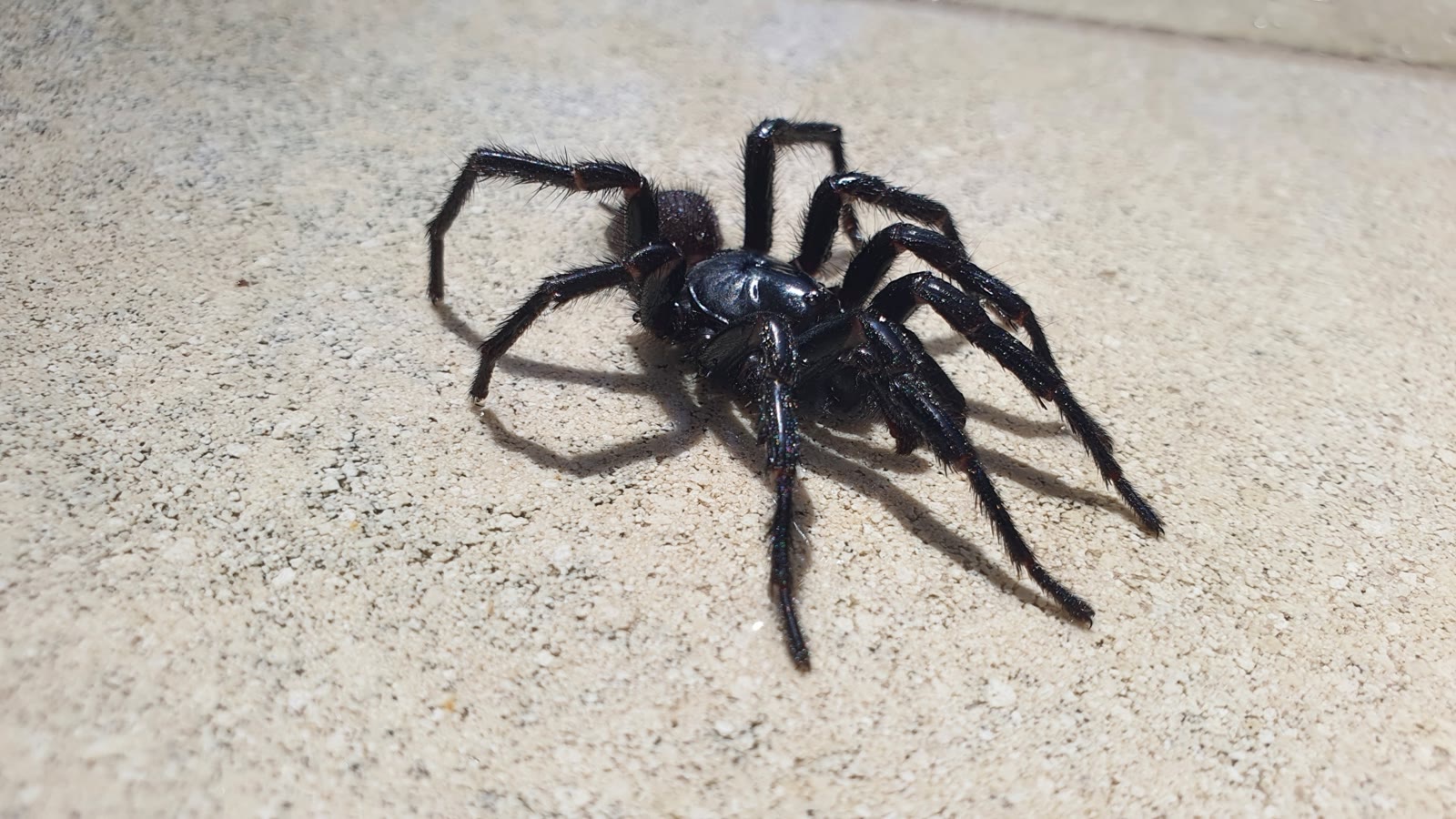
Sydney funnel-webs are shiny dark brown to black, with finger-like spinnerets at the abdomen tip. Males carry a large mating spur on the middle segment of the second pair of legs. Body length is roughly 2–4 cm (Australian Museum size range). If threatened, they often rear up and display impressive fangs — defensive theatre that looks aggressive and should be treated as a serious warning, not a dare.
Look-alikes include mouse spiders, trapdoor spiders, and black house spiders. Museum guidance is blunt: if a bite might be a funnel-web, treat it as an emergency and get identification later.
Bite risk: males, venom chemistry, and suburbs
Most medically serious funnel-web bites involve wandering males seeking females in warm months (roughly summer–autumn). Males leave burrows at night, turn up in gardens, garages, shoes left outdoors, and even swimming pools (they can survive many hours submerged by trapping an air film in body hairs — they are not “swimming” in any cheerful sense).
Male Sydney funnel-web venom contains robustoxin (δ-atracotoxin-Ar1 / δ-HXTX-Ar1a), a neurotoxin that disrupts vertebrate voltage-gated sodium channels. Australian Museum material notes this component is largely a male story for A. robustus, which helps explain why recorded deaths track male bites — but female and other funnel-web bites are still not “safe.” Not every atracid species shows the same sex difference, and first aid does not wait for a lab sexing the spider.
Human symptoms of severe envenoming can progress to breathing and circulatory failure within hours if untreated. Dogs and cats are famously less sensitive; primates are not. The ecological oddity — a defensive toxin that hits humans hard — is an active research topic (see PNAS work on δ-hexatoxins), not a reason to romanticise the bite.
A 2025 Australian Museum / systematics update also reframes “Sydney funnel-web” as part of an Atrax species complex (additional named forms such as southern Sydney A. montanus and Newcastle A. christenseni). For first aid and antivenom, the practical message did not change: treat suspected funnel-web bites as medical emergencies; current antivenom already covers a wide set of related species.
Antivenom since 1981 — the scoreboard that matters
Clinical funnel-web antivenom was developed for use in 1981 by Dr Struan Sutherland and colleagues at the Commonwealth Serum Laboratories, with venom milking support historically linked to the Australian Reptile Park near Gosford. Australian Museum summaries state no deaths have been recorded since introduction. A 2005 Medical Journal of Australia systematic review of recorded clinical cases (Isbister et al.) documented serious envenoming patterns across funnel-web taxa and supported antivenom as effective treatment when indicated.
First aid still matters before the IV bag arrives. Recommended technique is pressure immobilisation (same family of care as snake bite): firm pressure bandage from the bite area along the limb, immobilise with a splint, keep the person still, and get to hospital — even if symptoms are not yet obvious. Do not cut the wound or apply a tourniquet. Keep the spider for ID if it is safe to do so.
Burrow life when nobody is panicking
Away from headlines, A. robustus is a silk-lined burrow ambusher of moist sclerophyll forest, shady gullies, and bushy Sydney suburbs — rockeries, logs, and cool humid retreats. Trip-lines radiate from a funnel-like entrance vestibule; beetles, cockroaches, millipedes, and small vertebrates that cross the silk trigger a rush from the burrow. The core distribution sits in the greater Sydney region (museum maps currently emphasise Central Coast south toward the Georges River / Parramatta-area records, with overlap against newly separated southern forms). Dry western plains hold fewer spiders; leafy moist suburbs hold more.
That geography — millions of people overlapping a medically significant burrower — is why folklore and first-aid posters stay useful even after antivenom won the scoreboard.
On the Wilder card
In the Sydney Funnel-web Spider field guide entry you will find Forest habitat tagging and Ambush + Venom on a Cost 4 Arachnida Rare — the game echo of a glossy burrow specialist whose real human story ends, since 1981, at the antivenom fridge rather than the obituaries.
If you have never tried Wilder, guest play is free in the browser — open packs, build a deck, and respect the trip-lines:
Quick facts
- Scientific name: Atrax robustus (Sydney funnel-web; part of a broader Atrax complex)
- Family: Atracidae (Australian funnel-web spiders)
- Hook: Medically significant male venom; no recorded deaths since 1981 antivenom
- Size: ~2–4 cm body length (Australian Museum)
- Look: glossy dark brown–black; finger-like spinnerets; males with leg-II mating spur; defensive rearing
- Range: greater Sydney region moist forests and bushy suburbs (see Museum maps for current limits vs sister species)
- Diet: beetles, cockroaches, millipedes, small lizards/frogs — ambush from silk trip-lines
- First aid: pressure immobilisation + urgent hospital care; antivenom if indicated
- Wilder family: Arachnida · Forest · Cost 4 · ATK 4 / HP 4 · Ambush + Venom · Rare
Photo credit
Hero photograph: dreworme — Atrax robustus male lateral — Wikimedia Commons / iNaturalist, CC BY 4.0.

Questions people ask
How is funnel-web spider antivenom made?
From venom milked from live spiders at the Australian Reptile Park, which is frozen and sent to CSL Seqirus in Melbourne. There, rabbits get slowly increasing doses over about six months until they can withstand six times the lethal dose; their blood is then spun in a centrifuge to separate the antibodies that make the antivenom (Australian Reptile Park).
Where can you drop off a funnel-web spider?
At the Australian Reptile Park in Somersby or one of its official drop-off points, mostly hospitals and vet clinics around Sydney, the Central Coast and Newcastle. The park asks people to coax the spider into a smooth glass jar with a long spoon, add damp soil, and never touch it by hand (Australian Reptile Park).
How can you avoid funnel-web spider bites at home?
Keep clothes, shoes and towels off the floor, check shoes before putting them on, wear footwear outdoors at night, and wear gloves when gardening. Males wander most after dark in the warmer months, often into shoes left outside (Australian Reptile Park). More on the species on our Sydney funnel-web card.
Sources
- Australian Museum — Sydney Funnel-web Spider (Atrax robustus)
- Australian Museum — Australian Funnel-web Spiders group
- Australian Museum — Spider bites and venoms
- Australian Museum blog — Sydney funnel-web splits into three (2025)
- Isbister et al. 2005 — Funnel-web spider bite systematic review (MJA)
- PNAS — δ-hexatoxins / defensive venom (2020)
- Loria et al. 2025 — Atrax robustus species complex (BMC Ecol Evol)
- Wilder TCG — Sydney Funnel-web Spider field guide