Rock Dove: Are City Pigeons the Same as Wild Rock Doves?
Species deep dive · rock dove
Search “are city pigeons rock doves,” “pigeon vs dove,” or “what is a rock dove,” and the tidy answer is yes: the familiar city pigeon is Columba livia — the same species as the wild cliff-nesting rock dove. The twist is ancestry and setting. Most urban birds are feral descendants of domesticated pigeons that escaped or were released; true wild rock doves still cling to remote cliffs and caves, and in many regions they are genetically mixed with feral stock.
Columba livia belongs to Columbidae (pigeons and doves — there is no scientific split between those English names). In Wilder TCG the Rock Dove is a Cost 1 Aves Air Common with Resilient and Flock: a cheap board presence that echoes a bird built for colony life and hard ledges, whether those ledges are sea cliffs or window sills.
Same species, different life stories
Wild rock doves are the undomesticated form of C. livia: Africa–Eurasia cliff and cave specialists that roost on rock and forage on open ground. Humans domesticated them for food, message-carrying, and fancy breeds; escaped and released birds founded the feral populations that now fill cities worldwide. Cornell Lab notes Rock Pigeons were introduced to North America from Europe in the early 1600s. Charles Darwin kept pigeons after the Beagle voyage and used breed diversity versus wild stock while thinking about selection — a historical footnote that still shows up in every “how evolution works” pigeon story.
So when someone asks whether park pigeons “are” rock doves, the honest reply is: species yes, wild ancestry usually no. A blue-bar bird on a Sydney ledge or a New York plaza is still Columba livia; it is rarely a pure wild cliff bird that never passed through a dovecote.
How to tell wild-type from typical city flocks
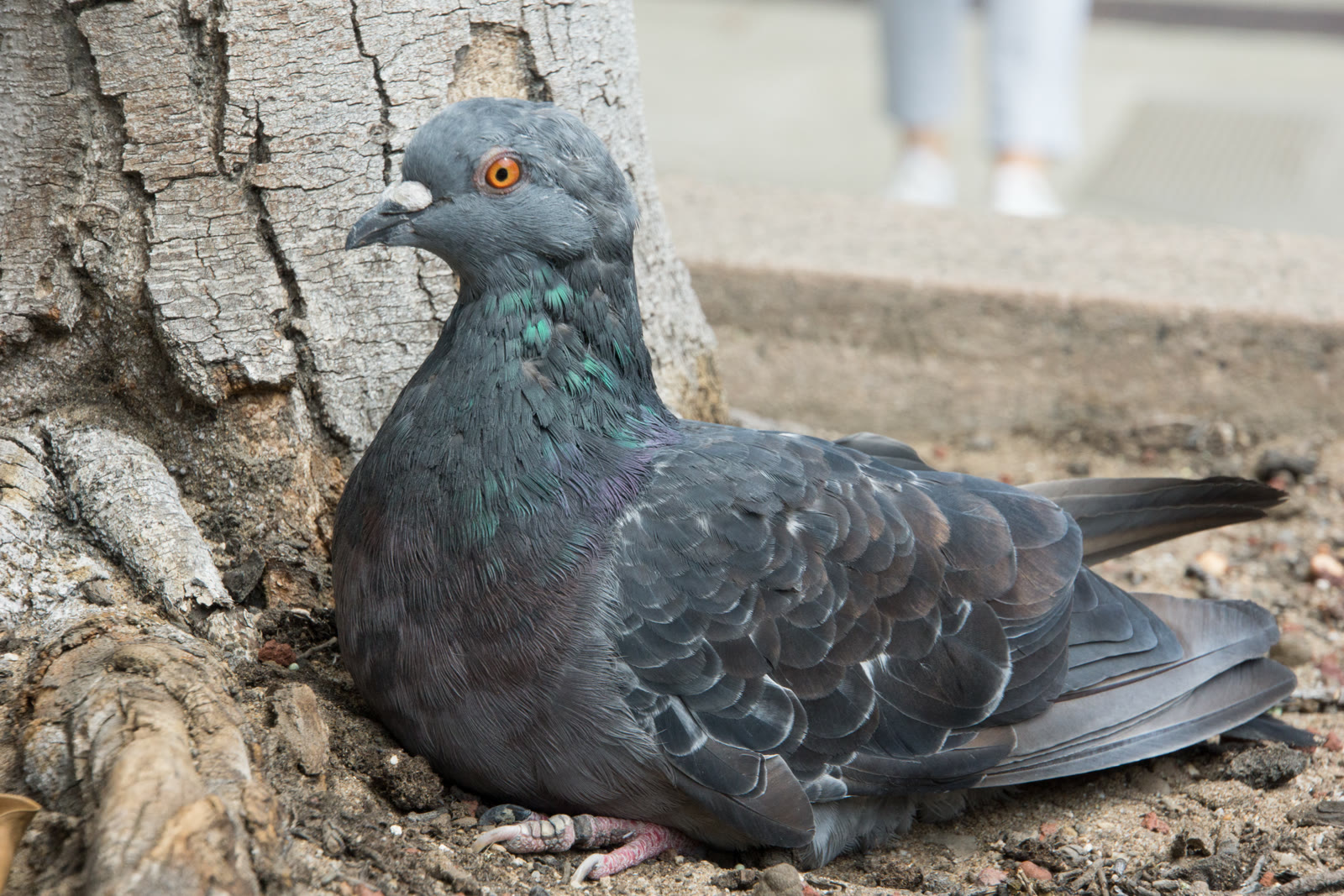
Classic wild-type plumage is the “blue-bar” look RSPB and field guides describe: pale grey body, two bold black wing bars, whitish rump, and an iridescent green/purple neck patch, with coral-pink feet. City flocks explode that palette — black, checkers, rusty red, piebald, nearly white — because domestic breeding dumped color genes into the feral pool. Some feral individuals still look wild-type, so plumage alone cannot certify a “true” wild bird.
Location and flock uniformity help more than a single bird’s feathers. In Britain, RSPB notes remaining wild Rock Dove colonies are largely confined to rocky coasts of north and west Scotland, offshore islands, and Northern Ireland; elsewhere, hybridization with ferals has erased clear wild stocks. Recent Current Biology and BOU summaries make the same point globally: most living C. livia individuals carry domestic or feral ancestry, and hybridisation is the main threat to genetically wild rock doves.
Cliff hardware on concrete cliffs
Wild birds nest and roost in caves and on cliffs; feral birds treat bridges, barns, grain towers, and building ledges as artificial cliffs. That is not a new lifestyle so much as a familiar one with different geology. They are colonial, often raise multiple broods, typically lay two eggs, and both parents feed chicks crop milk — a nutritious secretion from the crop lining (rare among birds, shared by other pigeons and doves). Size from Wilder’s field-guide summary (aligned with standard ranges): about 29–37 cm long, 62–72 cm wingspan, roughly 230–380 g.
Diet is granivore-first — seeds and grain — plus fruit, scraps, and occasional invertebrates in cities. Navigation and homing in domestic lines made the species famous as message carriers; feral flocks still show strong site fidelity to favored roosts. IUCN lists the species as Least Concern, with a vast global population, even while pure wild populations shrink through mixing.
Cornell’s life-history notes are a useful reality check for city birds: feral Rock Pigeons often average only a few years in the wild (one oft-cited figure is about 2.4 years), while some captive or carefully managed birds live far longer — including celebrated homing individuals. City abundance is about breeding rate and food, not individual immortality.
On the Wilder card
In the Rock Dove field guide entry you will find Air habitat tagging, Least Concern status, and Resilient + Flock on a Cost 1 Aves Common — the game echo of a cliff colonist that turned concrete canyons into nest shelves and still answers to Columba livia.
If you have never tried Wilder, guest play is free in the browser — open packs, build a deck, and put a blue-bar flock on the table:
Quick facts
- Scientific name: Columba livia
- Family: Columbidae (pigeons and doves — no scientific pigeon/dove split)
- Hook: City pigeons = same species as wild rock doves; most urban birds are feral domestics
- Wild-type look: blue-grey body, two black wing bars, iridescent neck, coral-pink feet
- Size: ~29–37 cm; wingspan ~62–72 cm; ~230–380 g
- Range: wild Afro-Eurasian cliffs/caves; feral worldwide on buildings and bridges
- Diet: seeds, grains, fruit, scraps; occasional invertebrates
- Breeding: colonial; typically two eggs; both parents produce crop milk
- Status: IUCN Least Concern (pure wild stocks threatened by hybridisation)
- Wilder family: Aves · Air · Cost 1 · ATK 1 / HP 2 · Resilient + Flock · Common
Photo credit
Hero photograph: Bramans — Rock pigeon or common pigeon (Columba livia) — Wikimedia Commons, CC BY-SA 4.0.
