Thorny Devil: How It Drinks Through Its Skin and Eats Only Ants
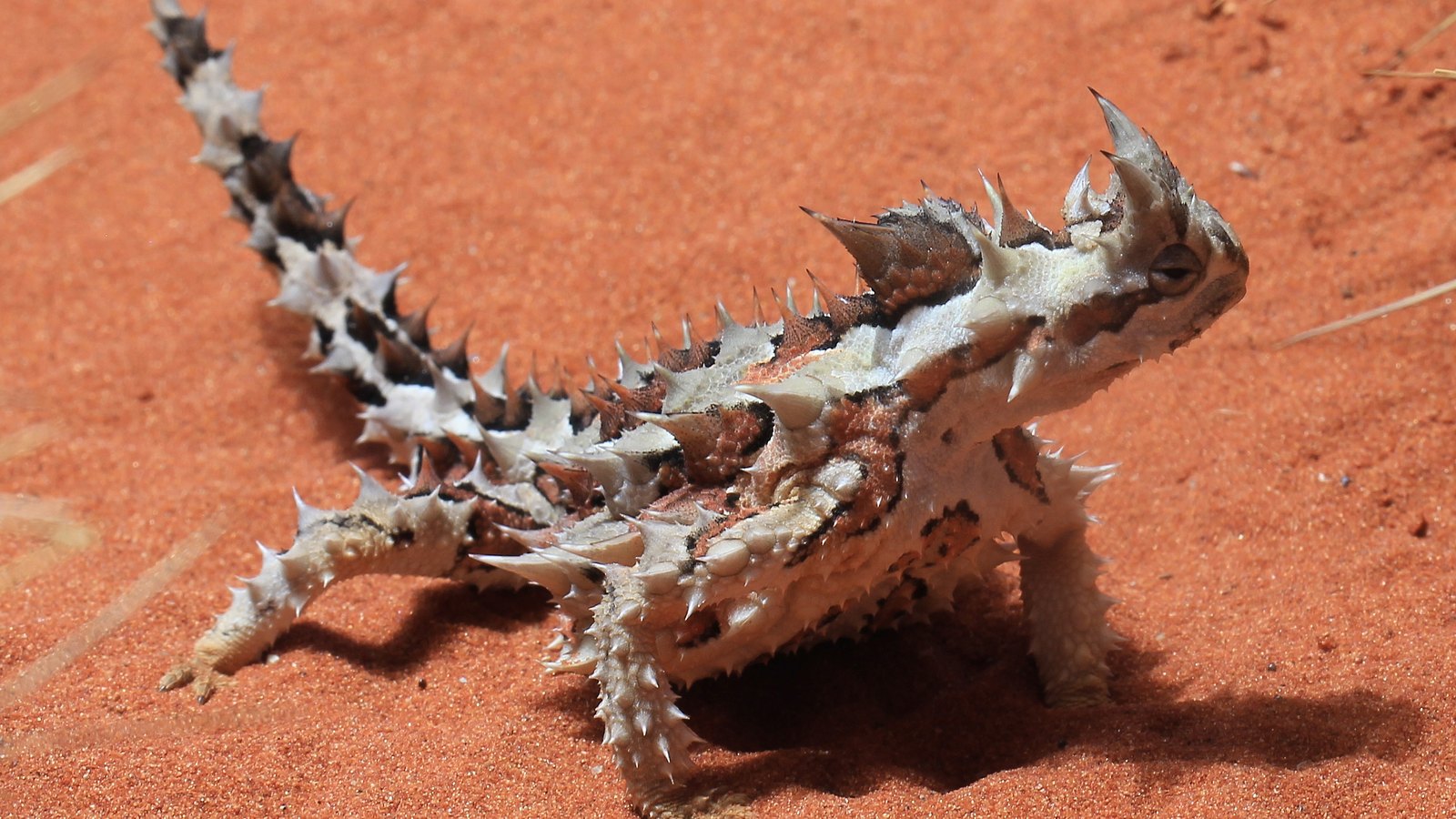
Species deep dive · thorny devil
How does a thorny devil drink? Through its skin, more or less, although it still swallows with its mouth. Between the overlapping scales of the thorny devil (Moloch horridus) runs a network of tiny grooves. Water that touches the skin is pulled into them by capillary action and carried along the body, even uphill, to the corners of the mouth. To drink, the lizard first has to fill the whole network. Lab work puts that at about 3.19% of its body mass. After that, it gulps the water down at roughly 0.7 microlitres per jaw movement.
Where does the water come from? Mostly rain and damp sand. A thorny devil standing in a puddle can fill its grooves and drink. One standing on nearly saturated sand filled them to only 59% of capacity and didn't drink. But wild thorny devils shovel damp sand onto their backs, and tests on skin replicas showed that, with help from gravity, this can fill the channels. Condensation, often given as the explanation, provided only about 0.22% of body weight in water, which isn't enough to drink from. The researchers concluded that rain and moist sand are the likely everyday sources.
Plumbing built into the scales
A 2017 high-speed video study of live thorny devils found that a 7-microlitre drop on the skin spread out in every direction, more than 9.2 mm from where it landed. That makes it unlike the North American horned lizards, which move water in one direction. Under the microscope, each large channel between the scales is split into smaller sub-channels. The big channels soak up water fast, and the fine ones carry it about 39% farther, which may mean the lizard needs less water before it can start drinking.
The horned lizards are a good comparison because they evolved the same tricks independently. Animal Diversity Web calls thorny devils and Phrynosoma horned lizards an example of convergent evolution: armoured, slow-moving ant specialists on two different continents. In June 2026 a PNAS study finally showed how desert horned lizards get the water from their skin into their mouths. They open their jaws slowly and snap them shut quickly, pumping the film of water into the corners of the mouth. The researchers then copied the motion in a device that collects water from damp soil.
An ants-only diet
Thorny devils eat only ants, mostly small trail-forming Iridomyrmex on the ground and Crematogaster on shrubs. They're sit-and-wait feeders: a lizard parks beside an ant trail and flicks up passing workers with its tongue. In a Western Australian field study, feeding rates ranged from under 1 to more than 10 ants a minute and averaged 2.9. In short bursts they managed about one ant per second, roughly as fast as a lizard can find, catch and swallow an ant. Older captive accounts describe much faster feasts.
Ants are hard, chitin-heavy food, and in lab trials thorny devils absorbed only about 59% of the usable energy in them. Matching that against field measurements of the lizards' water and energy use, researchers concluded that a wild thorny devil eats about 750 ants a day. The teeth are built for this diet too: the lower teeth fit between the upper ones to form shears for cracking hard ant bodies.
Spines, a fake head and the stutter walk
The spines aren't bone. Only two small spines on the head have bony support underneath. When threatened, a thorny devil tucks its real head down between its front legs. That leaves a spiny knob on the back of its neck, the "false head", facing the attacker. It can also puff itself up with air, which makes it even harder to swallow. Its other defence is not being seen. The lizard walks with a slow, rocking gait and freezes mid-step when approached, and its colour shifts through the day, from brown or olive in the cool morning to pale yellow as it warms up.
They're small animals. Females average about 45.5 g and 91 mm from snout to vent. Males average 31.2 g and 78.7 mm and never top 49 g. Thorny devils live across the sandy deserts and spinifex country of arid and semi-arid Australia, and Moloch horridus is the only species in its genus.
On the Wilder card
*Thorny Devil (Moloch horridus) is a Cost 2 Reptilia Desert Common with Camouflage, Thorns and ColdBlooded (ATK 1 / HP 4). It barely hits back but takes a lot of punishment, and Thorns makes attackers pay, the way real predators get a mouthful of spines. Its flavor text sums up the animal: "Spines that drink the desert and a head that isn't there." For an armoured ant-eater from a different branch of the tree of life, compare the Indian Pangolin, which also carries Thorns (Journal). Its desert neighbour, the Central Bearded Dragon*, is a fellow Australian agamid.
Photo credit
Hero photograph: Stu's Images, "Moloch horridus, Thorny Devil, Alice Springs", photographed at Alice Springs Desert Park (Wikimedia Commons), CC BY-SA 4.0. Cropped for the Field Journal hero.

Questions people ask
Are thorny devils dangerous to humans?
No. Despite the name and the spikes, the thorny devil is a harmless, slow-moving ant-eater. Bush Heritage Australia calls it one of the most placid reptiles you could meet in the outback. Its defences are camouflage, freezing, puffing up and a spiny false head (Bush Heritage; ADW).
Are thorny devils endangered?
No. The IUCN Red List assessed Moloch horridus as Least Concern in 2017. Because it depends on healthy ant populations and intact desert habitat, changes to fire regimes, invasive species and habitat damage can still hit local populations, and many are killed on roads while basking (Bush Heritage).
How long do thorny devils live?
Usually about 6 years in the wild, with some living up to 20, according to Animal Diversity Web. Females keep growing until about age 5 (ADW; Bush Heritage).
What eats thorny devils?
Recorded predators include Australian bustards, black-breasted buzzards, sand goannas and racehorse monitors, plus people. Snakes, dingoes and introduced red foxes are possible predators too. The spines and the false head make them awkward to swallow (ADW; National Museum of Ireland).
How do thorny devils lay eggs?
Mainly from August to December, a female digs a special nesting burrow up to about 22 cm deep and lays 3–10 eggs (median 8). She then fills it in and smooths the surface. The eggs hatch after 90–132 days, and the hatchlings weigh about 1.8 g (ADW).
Sources
- Comanns et al. 2016 — Cutaneous water collection by a moisture-harvesting lizard, the thorny devil (Journal of Experimental Biology 219:3473)
- Comanns et al. 2017 — Adsorption and movement of water by skin of the Australian thorny devil (Royal Society Open Science 4:170591)
- University of Western Australia — Flat out like a lizard drinking (2016)
- Withers & Dickman 1995 — The role of diet in determining water, energy and salt intake in the thorny devil (J. Royal Society of Western Australia 78:3–11)
- Animal Diversity Web (University of Michigan) — Moloch horridus
- Bush Heritage Australia — Thorny Devils
- National Museum of Ireland — Thorny Devil from Australia
- Phys.org — Thirsty desert lizards inspire a new water-harvesting system (25 Jun 2026; PNAS)
- Lee et al. 2026 — Soil water harvest inspired by desert horned lizards, Phrynosoma platyrhinos (PNAS)
- Wilder — Thorny Devil card