Olm: Blind Cave Salamander, Century Lifespan, and the Human Fish
Species deep dive · olm
Search “olm salamander,” “human fish,” or “longest-lived amphibian,” and you meet Proteus anguinus — Europe’s pale cave salamander, nicknamed the human fish for its pinkish skin and external gills. It is not a mythic underground dragon (though flood-washed animals once fed that folklore). It is a real, fully aquatic proteid that spends its life in cold karst groundwater, mostly blind to images, extremely patient about food, and — according to one of the best long-term captive datasets in herpetology — built for a century-scale lifespan.
In Wilder TCG the Olm is a Cost 2 Amphibia Water Common with Resilient and ColdBlooded (ATK 2 / HP 4) — a cheap, stubborn board presence that matches a species whose real-world strategy is surviving darkness, not winning sprint battles.
Where the human fish actually lives
Olms inhabit subterranean freshwater in the Dinaric Alps karst — limestone cave streams and lakes with stable, oxygen-rich water typically around 5–15 °C. The core range spans Slovenia, Croatia, Bosnia and Herzegovina, and a sliver of Italy, with a few introduced or managed populations elsewhere. They rarely appear at the surface except during floods or odd night movements. Pitch-black, chemically sensitive groundwater is home; sunny tourist pools are not the wild default, even if Postojna and other show caves rightly made the species famous.
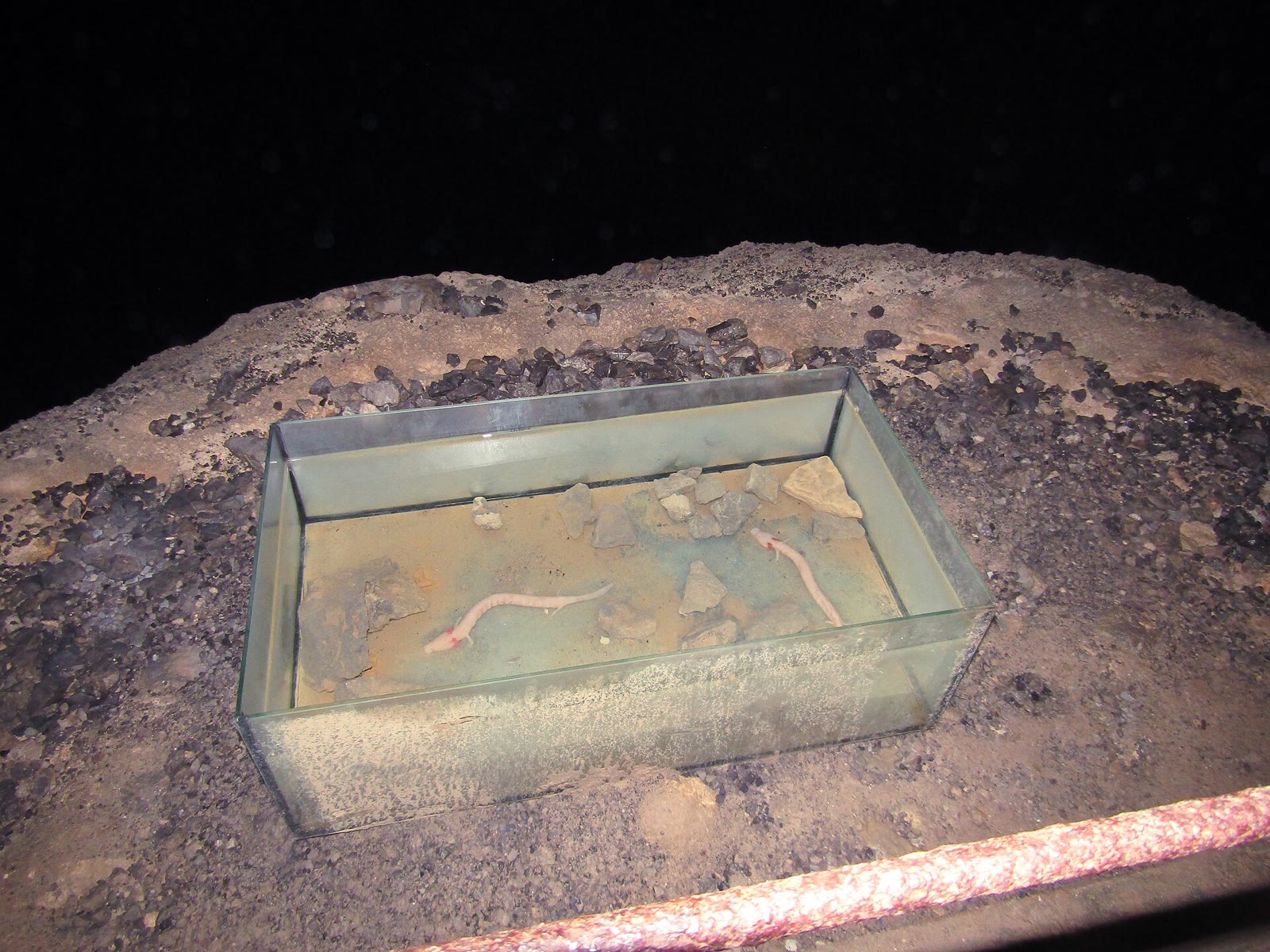
Adults are usually 20–30 cm (occasionally toward 40 cm), slender and eel-like, with feathery red external gills, tiny limbs, and skin that stays milky white to pinkish in darkness (a rare dark subspecies also exists). Eyes are reduced and skin-covered; olms still detect and avoid light, then hunt with smell, lateral-line vibration sense, electroreception, and even magnetic cues.
Longevity that rewrites the amphibian chart
The numbers that put olm on longevity shortlists come from the long-running colony at CNRS Moulis in France. Voituron and colleagues (2011, Biology Letters) analysed decades of weekly breeding and death records and reported:
- Adult average lifespan ≈ 68.5 years
- Predicted maximum lifespan > 100 years
- Sexual maturity ≈ 15.6 years
- Roughly 35 eggs about every 12.5 years
- Very high adult annual survival (~0.984) with no clear senescence signal in the observed ages
For a 15–20 g salamander, that life history is an outlier against the usual amphibian size–longevity curve. The same paper notes that neither an especially low basal metabolic rate nor flashy antioxidant activity fully explains the pattern — which is exactly why olms interest ageing biologists. Popular accounts also emphasise multi-year fasting capacity in food-poor caves; the demographic paper itself is about survival and reproduction, not a single Guinness-style hunger record.
Life in the dark, slowly
Olms are neotenic: they keep larval traits (external gills, aquatic lifestyle) into adulthood rather than metamorphosing into a terrestrial salamander. Diet is small cave prey — crustaceans, amphipods, insect larvae, snails — swallowed whole. When food arrives they can binge and store reserves; when it does not, they wait. Courtship is a slow underwater dance of tail-fanning and contact before egg-laying and guarding. Generation time in the Moulis analysis sits around 36 years. That tempo is wonderful for a stable aquifer and terrible for bouncing back after a pollution pulse.
Vulnerable, because caves are not empty
IUCN lists Proteus anguinus as Vulnerable. AmphibiaWeb and conservation summaries flag groundwater pollution, surface land-use that alters recharge, hydrology changes, tourism pressure in some systems, and illegal collection. Slovenia protected the species early; Croatia and Italy also afford legal protection. Because much of the range is invisible from the surface, “out of sight” is the conservation risk: fertiliser, sewage, or industrial seepage can move through karst faster than policy notices.
An olm in a healthy cave stream is a living water-quality meter. Lose the aquifer chemistry and you do not get a quick restock from a neighbouring pond.
On the Wilder card
The Olm field guide entry tags Water habitat on a Cost 2 Amphibia Common with Resilient + ColdBlooded — the game shorthand for an animal that outlasts problems instead of overpowering them. Pair it in your head with Wilder’s other neotenic star, the axolotl: same broad trick (keep the gills), opposite continent and crisis.
If you have never tried Wilder, guest play is free in the browser:
Quick facts
- Scientific name: Proteus anguinus (olm / proteus / “human fish”)
- Family: Proteidae (olms and mudpuppies)
- Hook: Blind(ish) cave salamander; predicted 100+ year maximum lifespan
- Size: ~20–30 cm typical, up to ~40 cm
- Look: pale pinkish body, red external gills, reduced eyes, slender limbs
- Range: Dinaric karst groundwater (Slovenia–Croatia–Bosnia and Herzegovina–NE Italy)
- Diet: small crustaceans, insect larvae, snails — detected without image-forming vision
- Life history: maturity ~15.6 y; ~35 eggs / ~12.5 y; adult mean lifespan ~68.5 y (Voituron et al. 2011)
- IUCN: Vulnerable
- Wilder family: Amphibia · Water · Cost 2 · ATK 2 / HP 4 · Resilient + ColdBlooded · Common
Photo credit
Hero photograph: Fiver, der Hellseher — Grottenolm in Planina Cave — Wikimedia Commons, CC BY-SA 4.0.

Questions people ask
What is an olm (human fish)?
An olm is Proteus anguinus, a fully aquatic cave salamander from Dinaric karst groundwater (Slovenia, Croatia, Bosnia and Herzegovina, and nearby Italy). Pale skin, external gills, and reduced eyes earned it the nickname "human fish." See Wilder's Olm card.
How long can an olm live?
Captive demographic work at CNRS Moulis (Voituron et al., 2011) estimates an adult average lifespan of about 68.5 years and a predicted maximum over 100 years, with sexual maturity around 15–16 years — among the longest-lived amphibians known.
Are olms really blind?
Adults have eyes that are reduced and covered by skin, so they do not form a normal image in cave darkness. They still sense and avoid light, and hunt with smell, lateral-line vibration sense, and electroreception rather than vision.
How long can an olm go without food?
Olms have an extremely low metabolism and can endure multi-year fasts in food-poor caves. Popular summaries often cite roughly up to a decade without feeding; the published longevity study focuses on survival and reproduction rather than a single maximum fast record.
Is the olm endangered?
IUCN lists Proteus anguinus as Vulnerable. Main threats are groundwater pollution, habitat damage, altered hydrology, and illegal collection. Slow breeding (roughly 35 eggs about every 12.5 years in the Moulis colony) makes recovery slow.