Bald Eagle: White Head, DDT Comeback, and Hollywood's Fake Scream
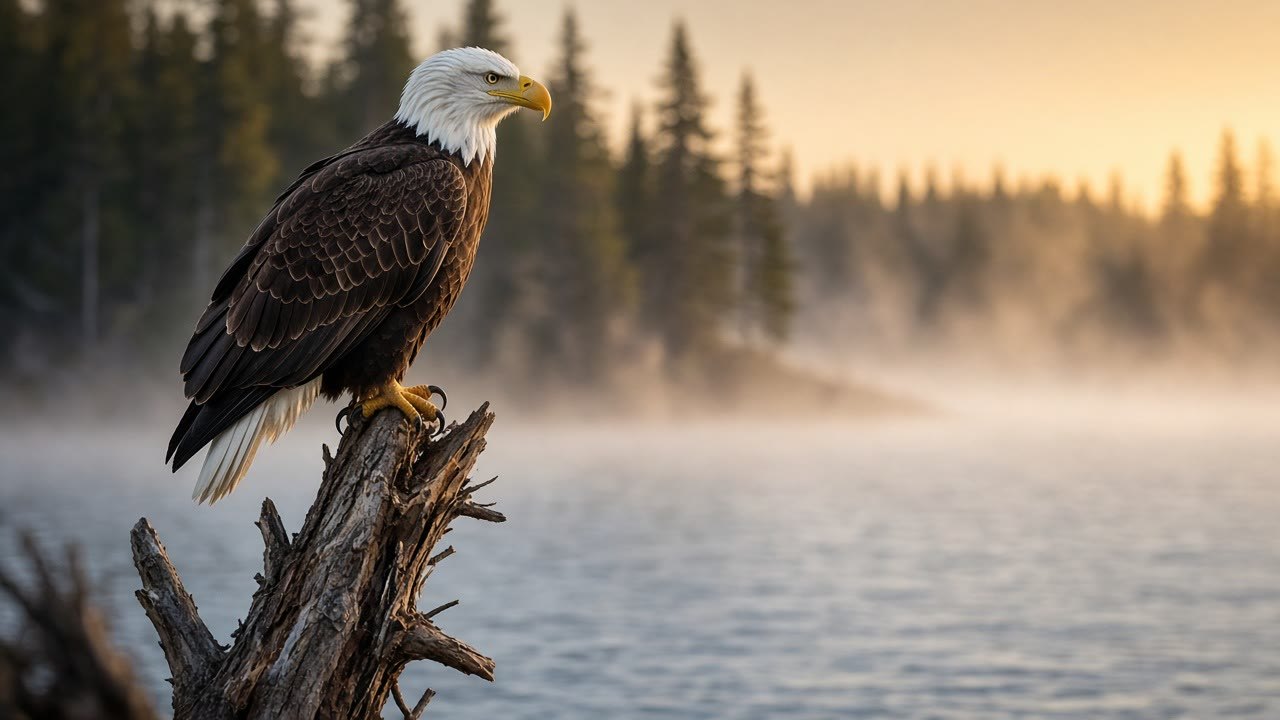
This is a generated illustration, not a photograph.
Species deep dive · bald eagle
Search "why do bald eagles sound like that," "are bald eagles still endangered," or "bald eagle DDT recovery" and you land on the same bird: Haliaeetus leucocephalus — North America's sea eagle. White head, yellow bill, dark body, and a conservation arc that runs from an eggshell crisis to one of the best-documented Endangered Species Act comebacks on the continent.
In Wilder TCG the Bald Eagle is an Aves Water creature (Cost 5). The card is shorthand for a real fish-hunting pirate whose nests can weigh tons, whose adult plumage takes years to earn, and whose movie scream is usually someone else's voice.
A sea eagle, not a golden eagle clone
Adults are unmistakable: white head and tail, dark brown body, yellow eyes and bill. Animal Diversity Web places length at about 79–94 cm and wingspan at about 178–229 cm, with females generally larger than males. That "bald" name is old English for white, not bare skin — the head is fully feathered.
Immatures are a different problem for birders. Through roughly their first four years they stay mottled brown-and-white, often confused with golden eagles. Useful field cues (ADW): immature bald eagles show blotchy white on underwing coverts, axillaries, and tail, plus a relatively longer head and shorter tail than a golden. Full adult plumage is typically reached around the fifth year, though a few dark spots on head or tail can linger longer.
Fish first — and other people's fish when convenient
Diet is opportunistic but fish-centered. Bald eagles snatch prey near the surface with talons rather than plunging like a diving waterbird. They also take waterbirds (and their eggs or nestlings), small mammals, and carrion — especiaAsk why bald eagles "sound like that" in films and the honest answer is: they usually don't. ADW describes their real repertoire as relatively weak, high-pitched chirps, whistles, and harsh chatters — a chatter often rendered as something like kwit-kwit-kwit… kee-kee-kee-kee-ker, plus wails and a long peal used when threats are perceived. The soaring, fierce "eagle scream" audiences expect in trailers is typically a red-tailed hawk call dubbed over eagle footage. The bird of national symbolism got Hollywood's sound design; the hawk got the residual.
Nest cities of sticks — and a cartwheel courtship
Pairs are generally monogamous and are widely described as mating for life until a partner dies. When breeding season reunites them, displays can be dramatic: swoops, and the famous cartwheel — partners clasp feet in mida## DDT, eggshells, and a delisting that stuck
Mid-twentieth-century bald eagle numbers crashed under hunting pressure, habitat loss, and especially organochlorine pesticides such as DDT. Fat-soluble residues biomagnified up food webs; in birds, a signature effect was eggshell thinning and failed hatching. The United States banned DDT for agricultural use in 1972. The Bald Eagle Protection Act (1940; later expanded to include golden eagles) and the Migratory Bird Treaty Act already framed legal protection, but ESA listing and recovery planning were what tracked the rebound in the lower 48.
U.S. Fish and Wildlife Service recovery narratives put roughly 417 breeding pairs in the lower 48 in 1963, rising to about 9,789 pairs by the June 28, 2007 ESA delisting. A 2020 FWS population update put the lower-48 estimate near 316,700 individuals and 71,467 occupied nests. Globally, IUCN / BirdLife list the species as Least Concern.In the Bald Eagle field guide entry you will find taxonomy, habitat, and in-game stats. On the board it plays as a mid-to-high-cost Water Aves presence — the game echo of a fish eagle that steals when it can, rebuilds stick cities for decades, and took decades of policy plus chemistry reform to climb back from the brink.
If you have never tried Wilder, guest play is free in the browser — open packs, build a deck, and put North America's sea eagle on the table:
Quick facts
- Scientific name: Haliaeetus leucocephalus
- Family: Accipitridae (fish eagles / sea eagles)
- Hook: white-headed adult; Hollywood scream usually a red-tailed hawk; DDT eggshell crash → 2007 ESA delisting
- Size: length ~79–94 cm; wingspan ~178–229 cm (ADW)
- Diet: primarily fish; also birds, mammals, carrion; kleptoparasitism on ospreys and others
- Nest: reused stick nests; Florida record ~2 tons / ~30 years (ADW)
- Status: IUCN Least Concern; U.S. ESA delisted 28 Jun 2007; still protected under BGEPA + MBTA
- Recovery (lower 48): ~417 breeding pairs (1963) → ~9,789 pairs at delisting (2007) → ~316,700 individuals / 71,467 occupied nests (FWS 2020 update)
- Wilder family: Aves · Water · Cost 5
On the Wilder card
ir and spin toward the ground before separating.
Nests are stick constructions reused and enlarged year after year, usually in tall trees near water (mangroves in southern Florida; cliffs, towers, and even the ground in some places). ADW records a Florida nest used for about 30 years that weighed roughly two tons when it finally fell — an extreme of nest persistence, not a typical every-year mass. Average nest longevity is shorter and regional (ADW cites roughly five years in some southern Florida and Saskatchewan samples, longer in Alaska). Clutches are usually one to three eggs; incubation is on the order of 35 days, with fledging often between about 8 and 14 weeks, followed by a further period of dependence.
lly in winter when open water is scarce.
They are famous kleptoparasites: pirates that steal from other hunters, notably ospreys. Younger or smaller birds more often hunt for themselves; larger adults may fly, leap, or walk in to snatch a catch. That piracy is ecology, not moral failure — a high-energy predator taking the lowest-cost meal when the chance appears.
The Hollywood scream that isn't theirs
Bald eagles belong to Accipitridae, the family of hawks, kites, and eagles. They are fish eagles in the genus Haliaeetus, native across much of North America near coasts, lakes, and rivers — with strongholds historically and today in places like Alaska, the Pacific Northwest, Florida, and the Great Lakes.