Koala: Not a Bear, Eucalyptus Specialist, and Why They Sleep So Much
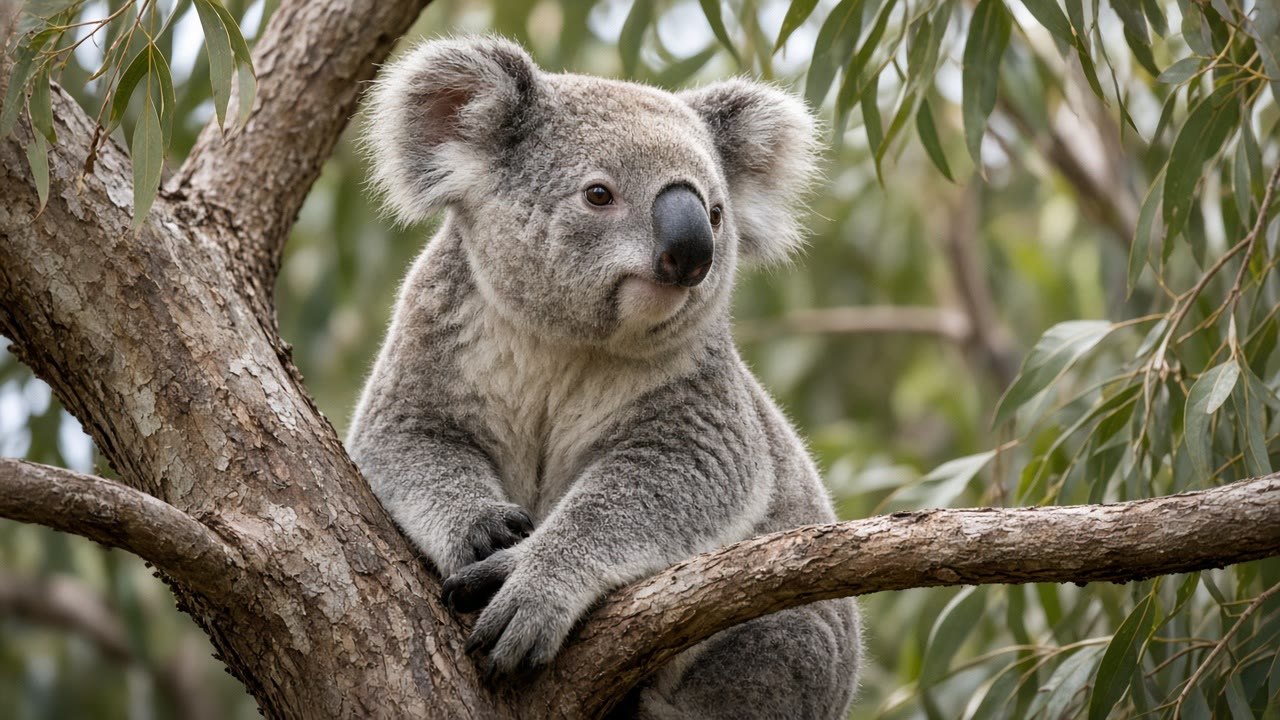
This is a generated illustration, not a photograph.
Species deep dive · koala
Search "are koalas bears," "how much do koalas sleep," or "what do koalas eat" and you land on the same animal: Phascolarctos cinereus — Australia's arboreal marsupial. Fuzzy face, eucalyptus breath, and a conservation status that depends on which list and which state you read.
In Wilder TCG the Koala is a Mammalia Forest creature (Cost 2). The card is shorthand for a real leaf specialist that rests most of the day, climbs with two opposable digits on each forepaw, and is emphatically not a bear.
Marsupial, not Ursidae
Koalas are marsupials in the order Diprotodontia and the family Phascolarctidae — the only living member of that family. The "koala bear" nickname is folk marketing, not taxonomy.
They share a pouch and a different reproductive strategy from placental bears, and their closest living relatives are other Australian marsupials, not Ursidae.
National Geographic and zoo education materials also note fingerprints that can look strikingly human — a classic example of convergent evolution, not shared ancestry with primates. Forepaws carry two opposable digits against the other three for gripping branches; hind feet help with climbing and grooming. The female's pouch opens rearward (toward the rump) and extends forward — practical for an animal that spends its life hugging trunks.
Adult males sport a chest scent gland and advertise with loud bellows in the breeding season.
Southern animals tend to run larger and denser-furred than northern ones; ADW cites southern males near 11.8 kg and northern males nearer 6.5 kg, with females smaller in both regions.
Eucalyptus specialist — picky among hundreds
Koalas are herbivores built around eucalyptus foliage. Of the many eucalypt species across their range, they rely on a much smaller set locally — ADW notes preference for only about five of roughly twenty eaten among hundreds of eucalypts, with regional favorites such as E. viminalis and E. ovata in the south and species including E. camaldulensis and E. tereticornis farther north. Leaves are fibrous, low in usable energy, and loaded with secondary compounds that would sicken many other mammals. Gut microbes and a caecum that can be several times body length help break toxins and fiber down; National Geographic puts daily intake at more than a pound of leaves, while older ADW synthesis cites about 500 g per day — same order of magnitude, different citation eras.
The common name is often linked to a folk etymology along the lines of "no drink." Koalas do get most of their water from leaves, but the story is not absolute: during droughts they may come to the ground seeking water, burning energy and raising risk from dogs, cars, and predators.
Why they sleep 18–22 hours
That toxic, low-calorie diet is why rest dominates the day. National Geographic reports koalas may sleep 18–22 hours; ADW's older account centers sleep near 18 hours. Either way, the pattern is energy economics: little surplus fuel for play or long travel when not breeding. When awake they feed, move between trees, and — for breeding males — patrol and bellow. Outside the breeding season they are largely solitary, typically one animal per tree even where home ranges overlap.
Young are born tiny after a short gestation (ADW: roughly 25–35 days), crawl to the pouch, and later transition onto leaves — including a period of feeding on soft fecal "pap" from the mother that helps seed the right gut flora before full leaf independence.
Chlamydia, cars, fire — and a status scramble
Threats stack. Habitat loss from clearing and fragmentation shrinks the continuous eucalypt cover koalas need. Cars and dogs kill animals forced to cross open ground. Bushfires — including the catastrophic 2019–2020 season — destroy forage and shelter. Climate stress can worsen leaf nutrition and drought, pushing animals out of trees.
Chlamydiosis (often discussed as Chlamydia infection in koalas) can affect eyes and the urogenital tract and is linked to blindness, infertility, and sometimes death in affected populations — a serious disease pressure, not a single invented prevalence percentage.
Conservation status depends on the authority:
- IUCN: widely cited as Vulnerable (2020 amended global assessment; NatGeo and Australian jurisdictional summaries agree). Older ADW and the legacy 2008 Red List page still show Least Concern — treat those as superseded caches, not current consensus.
- Australia (EPBC Act): the combined populations of Queensland, New South Wales, and the ACT were upgraded to Endangered effective 12 February 2022 (from Vulnerable in 2016). Victoria and South Australia sit outside that combined national listing frame; state rules still apply locally.
So a fair short answer to "are koalas endangered?" is: IUCN Vulnerable globally; Australia lists the combined QLD/NSW/ACT populations as Endangered under national law (2022). Both can be true at once.
On the Wilder card
In the Koala field guide entry you will find taxonomy, habitat, and in-game stats. On the board it plays as an accessible Forest Mammalia presence — the game echo of a specialist that trades speed for a toxic canopy niche, fingerprints and all.
If you have never tried Wilder, guest play is free in the browser — open packs, build a deck, and put Australia's most misnamed marsupial on the table:
Quick facts
- Scientific name: Phascolarctos cinereus
- Family: Phascolarctidae (Diprotodontia) — marsupial, not a bear
- Hook: eucalyptus specialist; 18–22 h rest; fingerprints; Vulnerable / regionally Endangered
- Diet: mostly a short list of local eucalypts; ~500 g–1+ lb leaves/day (ADW / NatGeo)
- Sleep/rest: ~18–22 hours/day (low-energy toxic diet)
- Notable anatomy: two opposable forepaw digits; rear-opening pouch; male chest scent gland + bellows
- Status: IUCN Vulnerable (widely cited); EPBC Endangered for combined QLD/NSW/ACT populations (12 Feb 2022)
- Threats: habitat loss, vehicles, dogs, bushfire, climate/leaf nutrition, chlamydiosis
- Wilder family: Mammalia · Forest · Cost 2
Sources
- National Geographic — Koala
- Australian Government (DCCEEW) — Koala listing under national environmental law
- Species Profile and Threats Database — Phascolarctos cinereus (combined QLD/NSW/ACT)
- Animal Diversity Web — Phascolarctos cinereus
- IUCN Red List — Phascolarctos cinereus
- San Diego Zoo — Koala
- Wilder TCG — Koala field guide