Gray Wolf: California Comeback, Pack Howls, and Yellowstone's Cascade
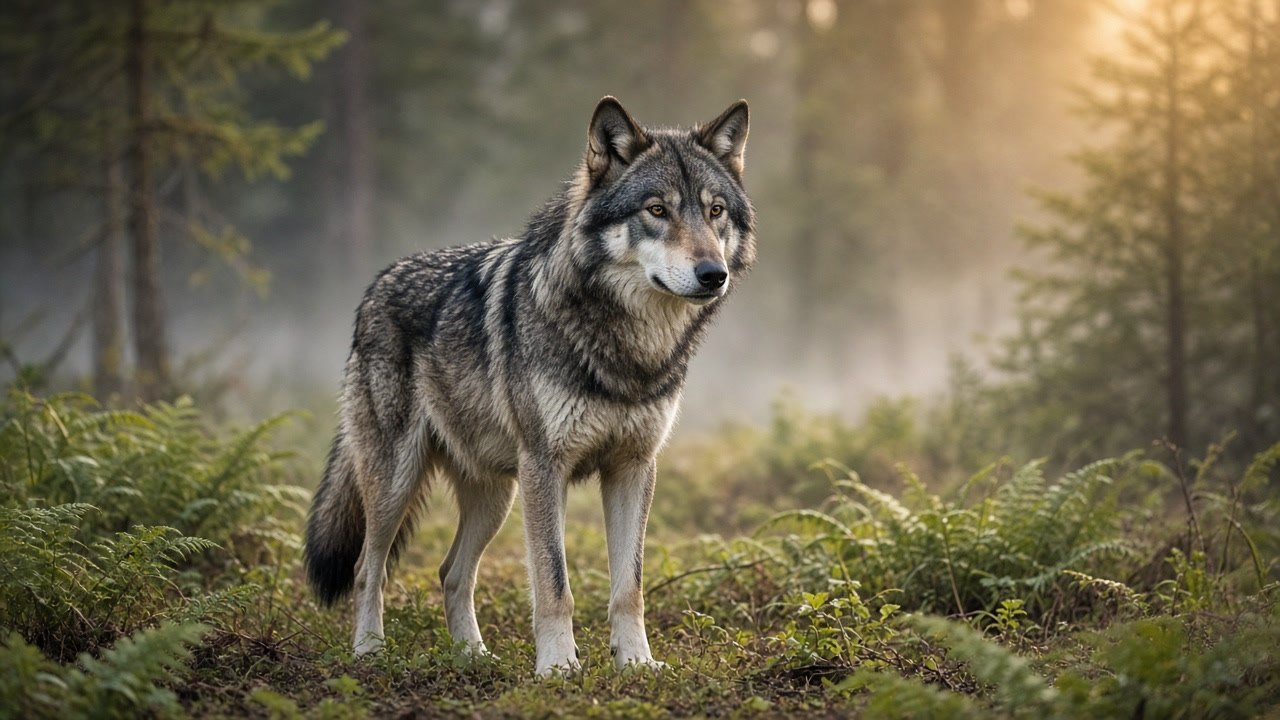
This is a generated illustration, not a photograph.
Species deep dive · gray wolf
Search “are there wolves in California,” “gray wolf endangered status,” or “Yellowstone wolf cascade,” and the same animal keeps showing up: Canis lupus — the gray wolf, largest living wild canid, pack hunter, howler, and one of North America’s most contested recoveries.
In late August 2026, California Department of Fish and Wildlife biologists verified photographs and tracks of a gray wolf where Mendocino, Glenn, and Lake counties meet in the Mendocino National Forest the first modern confirmed detection west of the Sacramento Valley since wolves returned to the state. That single dispersing animal is not a pack. It is a headline that answers a live search question with a careful yes: wolves are back in California, expanding, and still tightly protected.
In Wilder TCG the Gray Wolf is a Mammalia Forest creature (Cost 5) with Pack Howl — shorthand for a real social predator whose territories, livestock conflicts, and ecosystem roles keep rewriting western wildlife policy.
A Holarctic canid, not a coyote with better PR
Gray wolves belong to Canidae, genus Canis. Animal Diversity Web places adult males roughly 30–80 kg (often around 55 kg on average) and females 23–55 kg, with shoulder height commonly 60–90 cm. Coat color runs from Arctic white through grizzled gray, cinnamon, and nearly solid black. Compared with coyotes they are substantially larger, with broader snouts and bigger feet — a field ID that still confuses trail-camera owners every season.
Historically they occupied most of the Northern Hemisphere south to about 20° N/S latitudes. Habitat destruction, prey depletion, and deliberate persecution collapsed that map. Today strongholds remain across Alaska, Canada, parts of the northern Rockies and Great Lakes, plus Eurasian remnants. Globally, IUCN lists Canis lupus as Least Concern. Regionally — especially in the contiguous United States — the legal picture is a patchwork of Endangered Species Act listing, state protections, hunting seasons, and court orders that change faster than many explainers admit.
California’s quiet return — then Mendocino
California did not truck wolves in. CDFW is explicit: wolves recolonized on their own after Oregon wolf OR-7 crossed into the state in 2011. The species had been largely extirpated from California by the 1920s. The first modern pack was the Shasta Pack (2015; no longer active). Through 2025–2026 quarterly monitoring, CDFW has tracked a growing set of confirmed packs in the state’s northeast and Sierra/Cascade fringe — Ashpan, Diamond, Grizzly, Harvey, Ice Cave, Interstate, Lassen, Long Valley, Tunnison, Whaleback, Whitehorse, and others as status flips between active and inactive.
Legal status inside California is unambiguous and strict: gray wolves are listed as endangered under both the California Endangered Species Act and the federal Endangered Species Act. Take hunt, pursue, harass, catch, capture, or kill — is prohibited statewide. There is no wolf hunting season.
The Mendocino National Forest verification (public reporting and Guardian coverage in early September 2026) matters because it sits west of the Sacramento Valley, outside the northeast corridor where most California packs have concentrated. County and CDFW statements described photos plus on-the-ground track confirmation by a wolf biologist. Contemporaneous reporting put California’s documented wolf count around fifty individuals — a recovery still measured in dozens, not thousands, and still vulnerable to vehicles, illegal kill, and livestock conflict politics.
Pack howls, family territories, and feast-or-famine meat
A gray wolf pack is usually a family: a breeding pair plus offspring of one or more years, sometimes joined by unrelated immigrants. ADW cites typical packs of about 5–9 animals (documented extremes from a couple to the mid-thirties depending on prey). Rank is negotiated with posture and facial signals as much as with teeth.
Howling is not Hollywood loneliness. It reunites scattered members, coordinates assembly for hunts, and advertises territory to neighboring packs. Scent marks — often dominated by the breeding male’s contribution in classical accounts — draw the invisible fences. Daily travel can cover long distances; ADW notes paces around 8 km/h with bursts to 55–70 km/h, and territory sizes spanning roughly 130–13,000 km depending on prey density.
Diet is carnivore-first: elk, moose, deer, caribou, bison where available, plus beavers, hares, and opportunistic scavenging. Packs isolate weaker or slower ungulates; a single wolf may put away on the order of 9 kg of meat in a sitting before the feast-or-famine cycle resumes. Livestock depredation is real in some landscapes and often overstated in others — both can be true at once, which is why conflict protocols exist.
Yellowstone’s cascade real, debated, not a cartoon
Wolves were reintroduced to Yellowstone National Park in 1995–96 after decades of absence. The park became a living experiment in predator restoration. Researchers documented shifts in elk behavior and density, and in some drainages taller willows, aspen, and cottonwoods followed reduced browsing pressure. Beavers, songbirds, and channel morphology appear in cascade narratives as downstream beneficiaries.
The National Park Service’s own overview of the debate is the right tone for a Journal piece: wolves matter, and so do drought, hydrology, beaver history, bison, cougars, bears, and human harvest outside the park. Trophic cascades in Yellowstone are multi-causal, spatially patchy, and still argued in the literature — not a single viral video’s “wolves fixed the rivers” slogan. The honest answer to “did Yellowstone wolves cause a trophic cascade?” is: evidence supports important wolf-driven effects; they are not the only drivers.
People, pets, and the fear that sells clicks
Wild wolves generally avoid people. CDFW’s human-safety guidance matches the broader North American pattern: direct aggression is rare; risk rises with habituation, food-conditioning, or situations involving dogs. Do not feed wolves. Do not approach. Keep pets close in wolf country; leash when sign is present. If a close encounter occurs, do not run — maintain eye contact, act assertively, make noise, and retreat slowly.
Livestock producers in wolf country face a harder ledger. Nonlethal tools — fladry, range riding, night penning, carcass management, foxlights, radio-activated guards — are the first line in California’s conservation plan. Across the state line in Washington, September 2026 brought a harder call: WDFW’s director authorized incremental lethal removal of one or two wolves from the Couse pack territory in Asotin County after repeated confirmed livestock mortalities and injuries despite documented nonlethal deterrents. Recovery and rural livelihoods collide on the same calendar; Journal coverage should name both without turning either into myth.
Federal listing itself remains contested. Courts, Interior Department proposals, and political orders have repeatedly tried to redraw which Lower 48 wolves stay ESA-listed. Readers asking “are gray wolves endangered?” need the split answer: IUCN Least Concern globally; California endangered under state and federal law; other U.S. regions vary by jurisdiction and court order.
On the Wilder card
In the Gray Wolf field guide entry you will find taxonomy, Forest habitat tagging, and in-game stats including Pack Howl. On the board it plays as a mid-to-high-cost Mammalia presence — the game echo of a social hunter that holds territory with voice, reshapes ungulate landscapes when numbers allow, and is rewriting California’s predator map one dispersing track at a time.
If you have never tried Wilder, guest play is free in the browser — open packs, build a deck, and put the pack’s wild legend on the table:
Quick facts
- Scientific name: Canis lupus
- Family: Canidae (dogs, wolves, coyotes, jackals)
- Hook: 2026 Mendocino west-of-valley sighting; pack howls; Yellowstone cascade with nuance; ESA/CESA endangered in California despite IUCN Least Concern globally
- Size: males ~30–80 kg; females ~23–55 kg; shoulder ~60–90 cm (ADW)
- Pack: typically ~59 related animals; breeding pair plus offspring
- Diet: large ungulates (elk, deer, moose, etc.), smaller mammals, scavenged carrion; occasional livestock conflict
- California return: natural dispersal from Oregon since 2011 (OR-7); not a state reintroduction; ~50 documented individuals in recent reporting; multiple monitored packs in 2025–2026
- Status: IUCN Least Concern (global); Endangered under California ESA + federal ESA in CA; Lower 48 listing is a legal patchwork
- Human risk: generally low; avoid habituation and food-conditioning; control dogs in wolf habitat
- Wilder family: Mammalia · Forest · Cost 5 · Pack Howl
Sources
- California Department of Fish and Wildlife — Gray Wolf
- The Guardian — California confirms rare sighting of gray wolf in Mendocino national forest (8 Sep 2026)
- Washington Department of Fish & Wildlife — Director approves lethal removal in Couse wolf pack territory (11 Sep 2026)
- Animal Diversity Web — Canis lupus
- IUCN Red List — Canis lupus
- NPS — The Big Scientific Debate: Trophic Cascades
- NPS Yellowstone — Wolf Restoration
- U.S. Fish & Wildlife Service — Gray Wolf Recovery
- Wilder TCG — Gray Wolf field guide