Pistol Shrimp: Cavitation Snap, Shockwave, and Shrimpoluminescence
Species deep dive · pistol shrimp
Pistol Shrimp: Cavitation Snap, Shockwave, and Shrimpoluminescence
Search "pistol shrimp" and you usually get the same viral claim: a claw so fast it boils water hotter than the Sun. The real story is better — and more careful. In Alpheus heterochaelis, the loud snap is not the claw slamming shut. High-speed video and hydrophones show a water jet from the closing snapper claw forms a cavitation bubble; the sound (and the punch) arrive when that bubble collapses.
In Wilder TCG the Pistol Shrimp is a Common Insecta creature with Ambush and Camouflage, plus the ability Cavitation Snap. The card is shorthand for a tiny western Atlantic hunter that settles fights with physics, not bulk.
Taxonomy of a sonic crustacean
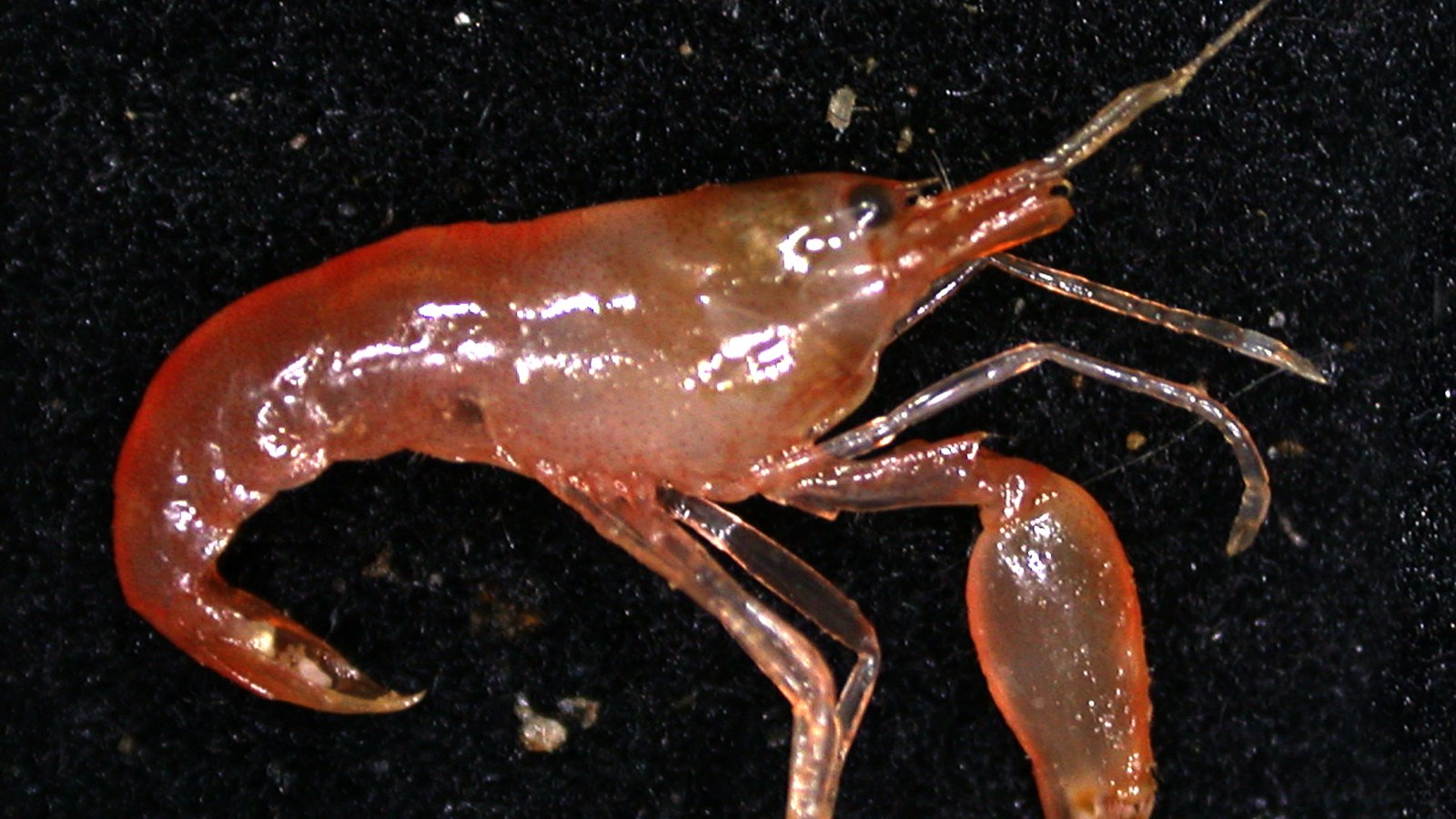
Alpheus heterochaelis Say, 1818 belongs to Alpheidae — the snapping or pistol shrimps. English names include bigclaw snapping shrimp and pistol shrimp. Adults reach about 3–5.5 cm; the enlarged snapper claw can be roughly half the body length and may sit on either the left or the right side. Juveniles start with two ordinary claws; later one enlarges into the snapper while the other stays a pincer.
Wilder files the card under Insecta as a playable tribe, even though the living animal is a malacostracan decapod — a deliberate game taxonomy, not a biology claim.
How the snap actually works
The snapper claw has a plunger-and-socket geometry. When the claw closes at high speed, water is forced out through a narrow groove as a jet (classic measurements put jet speed on the order of ~25 m/s). That jet drops local pressure enough for a vapor cavity to form. Collapse of the cavity — not claw contact — produces the short, extremely loud pulse that can stun or kill small prey millimeters away and contributes heavily to the crackle of shallow coastal noise.
A follow-up Nature note described a faint flash of light at collapse — "shrimpoluminescence," by analogy with sonoluminescence. Estimated interior temperatures at collapse sit around at least ~5,000 K. That heat and flash are real physics byproducts; they are not what the shrimp uses as a weapon. The biologically useful product is the shockwave.
Handle the meme carefully: "hotter than the surface of the Sun" is a popular paraphrase of those estimates, not a claim that the shrimp burns prey with a plasma torch.
Western Atlantic burrow life
A. heterochaelis ranges from about Cape Hatteras south through Florida, the Gulf of Mexico, the Caribbean, Bermuda, and on toward Brazil. It favors shallow structured bottoms — reefs, seagrass, oyster clumps, salt marshes, muddy nooks — often within a few tens of meters of the surface.
Pairs are often monogamous. Females are briefly receptive after molting; males may guard during that vulnerable window. Eggs hatch after roughly a month; larvae develop quickly through a short non-feeding larval sequence. Diet is opportunistic: worms, small crustaceans, shellfish, and occasional small fish, with algae in the mix.
This species is commonly associated with the black-clawed mud crab (Panopeus herbstii), sharing burrow space without becoming an easy meal. Broader "pistol shrimp + goby lookout" mutualisms are famous elsewhere in Alpheidae; treat those as family-level natural history unless a specific A. heterochaelis study is in hand.
From reef crackle to Wilder card
In the Pistol Shrimp field guide you will find taxonomy, habitat, and in-game stats. On the board, Cavitation Snap pacifies an enemy creature for a turn — a clean echo of a shockwave that ends the chase before it starts. Ambush and Camouflage nod at a burrow ambush hunter that waits rather than sprints.
Play it in Wilder — then listen for the real soundtrack the next time you are over a busy shallow reef.
Quick facts
- Scientific name: Alpheus heterochaelis Say, 1818
- Hook: cavitation-bubble collapse, not claw clap, makes the snap
- Jet / bubble: ~25 m/s water jet; collapse emits sound + faint light
- Size: body ~3–5.5 cm; snapper claw up to ~half body length
- Range: western Atlantic shallows, roughly North Carolina to Brazil
- Social: often monogamous pairs; mud-crab burrow association reported
- Conservation: widespread and common; no special IUCN spotlight for this species
- Wilder family: Insecta · Common · Ambush, Camouflage · Cavitation Snap
Photo credit
Hero photograph: CSIRO, "CSIRO ScienceImage 10852 A probable new species of Alpheus pistol shrimp" (Wikimedia Commons), CC BY 3.0. Cropped for the Field Journal hero.
