Orca vs Great White Shark: Why Great Whites Flee When Orcas Show Up
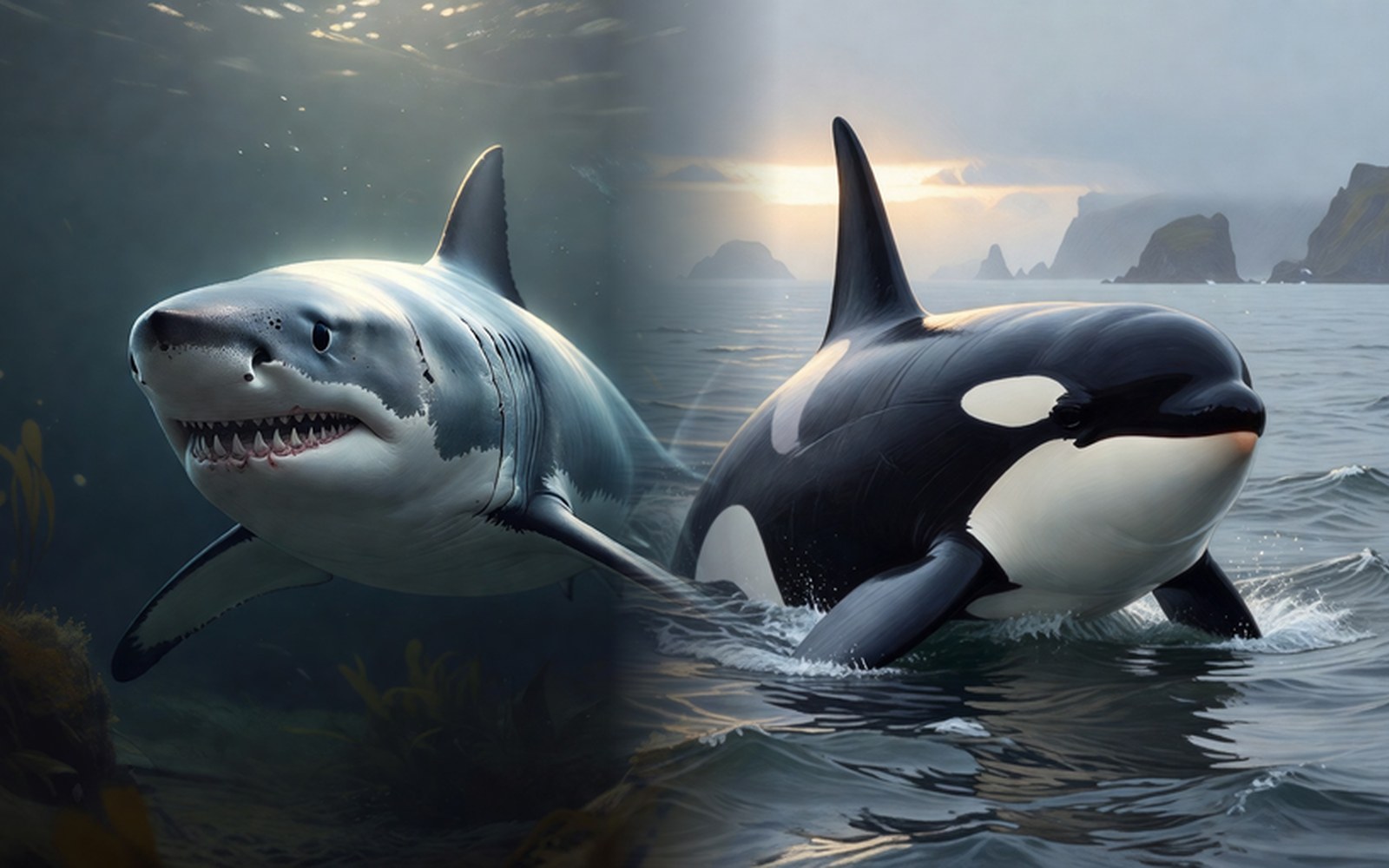
This is a generated illustration, not a photograph.
Showdown · orca, great white shark
Great white sharks are among the most feared predators in the sea, yet when orcas show up, they leave. This is not a legend: researchers have measured it with acoustic shark tags, decades of surveys and drone footage, off California and South Africa (Jorgensen et al. 2019; Towner et al. 2022). Here is what the data shows, how orcas actually kill great whites, and how the two match up in Wilder.

Size and weapons
An adult male orca (killer whale) can reach about 32 feet and weigh up to 11 tons (NOAA Fisheries). A great white shark tops out around 20 feet and up to about 4,500 pounds, roughly two tons (NOAA Fisheries). At their maximums, the orca can be about five times heavier.
The shark's bite is famous: a 3D computer model estimated that a very large great white could bite with about 18,000 newtons, roughly 1.8 tonnes of force (Wroe et al. 2008). No one has measured an orca's bite. But orcas bring something the shark usually doesn't: a team. They are warm-blooded mammals that hunt cooperatively in pods, while great whites are only partly warm-blooded and mostly ambush seals from below.
Showdown 1: the Farallon tagged-shark exodus
The South East Farallon Island, off San Francisco, is a classic great white hunting ground for elephant seals. In October 1997, orcas killed a white shark there and ate little more than its liver. Afterwards, shark attacks on seals at the island almost stopped for the rest of the season: researchers recorded only two more in the following eight weeks (Jorgensen et al. 2019).
Tags later turned that story into hard data. On 2 November 2009, 17 acoustically tagged white sharks were at the island when a pod of orcas passed through for about two and a half hours. Within about eight hours, every tagged shark had left, and most were not detected there again until the next season. Similar exits followed orca visits in 2011 and 2013. In years when orcas came close, shark kills of seals at the island fell 3.5 to 7 times below normal. Several tagged sharks turned up at Año Nuevo Island, about 90 km to the south, within days (Jorgensen et al. 2019).
Showdown 2: Port and Starboard, South Africa's liver hunters
In 2017, five white shark carcasses washed up near Gansbaai, South Africa, one of the best-known great white sites in the world. Four were missing their livers. The likely hunters were a pair of male orcas known as Port and Starboard, named for their collapsed dorsal fins, which bend to opposite sides. Tagged sharks left the area right away, and white shark sightings stayed low for years, while bronze whaler sharks moved in (Towner et al. 2022).
In May 2022, a drone and a helicopter filmed orcas killing a white shark near Mossel Bay, the first direct footage of such a hunt, and other sharks fled the area afterwards (Towner et al. 2023). Then, in June 2023, Starboard did it alone: he killed a young white shark of about 2.5 m and carried off its liver in under two minutes (Towner et al. 2024).
How the hunts work
Why the liver? A shark's liver is huge, up to about a third of its body weight, and packed with energy-rich oil. Necropsies of the South African sharks found neat tears between the pectoral fins, with the liver removed and organs like the heart and stomach left behind (UCT News).
The footage shows how the orcas get there: an orca pushes the shark up from below, rolls it over and bites near the pectoral fins. Researchers suggest that holding a shark upside down may also trigger tonic immobility, a trance-like state some sharks fall into when flipped, though this is not proven. A shark may circle to keep an orca in view, but against two or more orcas it cannot watch them all (SANParks Scientific Services).
Leaving is not cowardice. Biologists call it a risk effect: giving up a good feeding spot for a while costs far less than dying. And not all orcas hunt sharks. Orca diets differ by population, and some, like the Southern Resident killer whales, eat almost only fish (NOAA Fisheries).
The Wilder card face-off
Both animals are Rare Water cards in Wilder, and both have Ambush and Relentless:
- Orca: Cost 7, ATK 6, HP 8.
- Great White Shark: Cost 6, ATK 6, HP 5.
They hit equally hard, but the orca can take three more hits for one extra cost, so in a straight trade the orca survives and the shark doesn't. Just like in the real ocean. For more on each animal, read our pieces on orca pods, culture and menopause and the great white's ambush hunting.
Play Wilder free in your browser. It's a free browser collectible card game, and no signup is needed.
Image credit
Hero image: Wilder TCG card art for the Great White Shark and Orca cards, combined for the Field Journal hero.
Questions people ask
Where do orcas and great white sharks meet in the wild?
Their ranges overlap widely: orcas live in every ocean, and great whites roam temperate and subtropical seas. Direct encounters have been recorded off California, South Africa and southern Australia (Jorgensen et al. 2019; NOAA Fisheries).
Do great white sharks have any natural predators?
Yes. Adult great whites have very few, but orcas are documented killing them off California and repeatedly in South Africa, where the hunts were filmed by drone in 2022 (Towner et al. 2023). Young sharks can also fall to larger sharks.
Is an orca a whale or a dolphin?
Both, in a sense: the orca, or killer whale, is a toothed whale and the largest member of the dolphin family, Delphinidae (NOAA Fisheries). See our Orca card.
Are orcas endangered?
Not as a species overall: the IUCN Red List rates the orca Data Deficient, because populations differ so much (IUCN Red List). Some populations are in trouble, though. The Southern Resident killer whales of the Pacific Northwest are listed as endangered in the US (NOAA Fisheries).
How long do great white sharks live?
Much longer than once thought: radiocarbon dating of vertebrae found great whites living to at least 70 years, with the oldest male aged about 73 (Hamady et al. 2014, PLOS ONE). See our Great White Shark card.
Sources
- Killer whales redistribute white shark foraging pressure on seals (Jorgensen et al. 2019, Scientific Reports 9:6153)
- Fear at the top: killer whale predation drives white shark absence at South Africa's largest aggregation site (Towner et al. 2022, African Journal of Marine Science)
- Direct observation of killer whales preying on white sharks and evidence of a flight response (Towner et al. 2023, Ecology)
- Further insights into killer whales preying on white sharks in South Africa (Towner et al. 2024, African Journal of Marine Science 46:1–5)
- Killer whales drive white sharks away: a shifting predator seascape (SANParks Scientific Services)
- Shark-eating killer whales in Cape Town's waters (UCT News, Kock & Engelbrecht 2019)
- Killer whale species page (NOAA Fisheries)
- White shark species page (NOAA Fisheries)
- Three-dimensional computer analysis of white shark jaw mechanics (Wroe et al. 2008, Journal of Zoology)
- Orcinus orca (IUCN Red List)
- Vertebral bomb radiocarbon suggests extreme longevity in white sharks (Hamady et al. 2014, PLOS ONE)