Murder Hornet Facts: Eradicated in the US, Cooked Alive by Bees
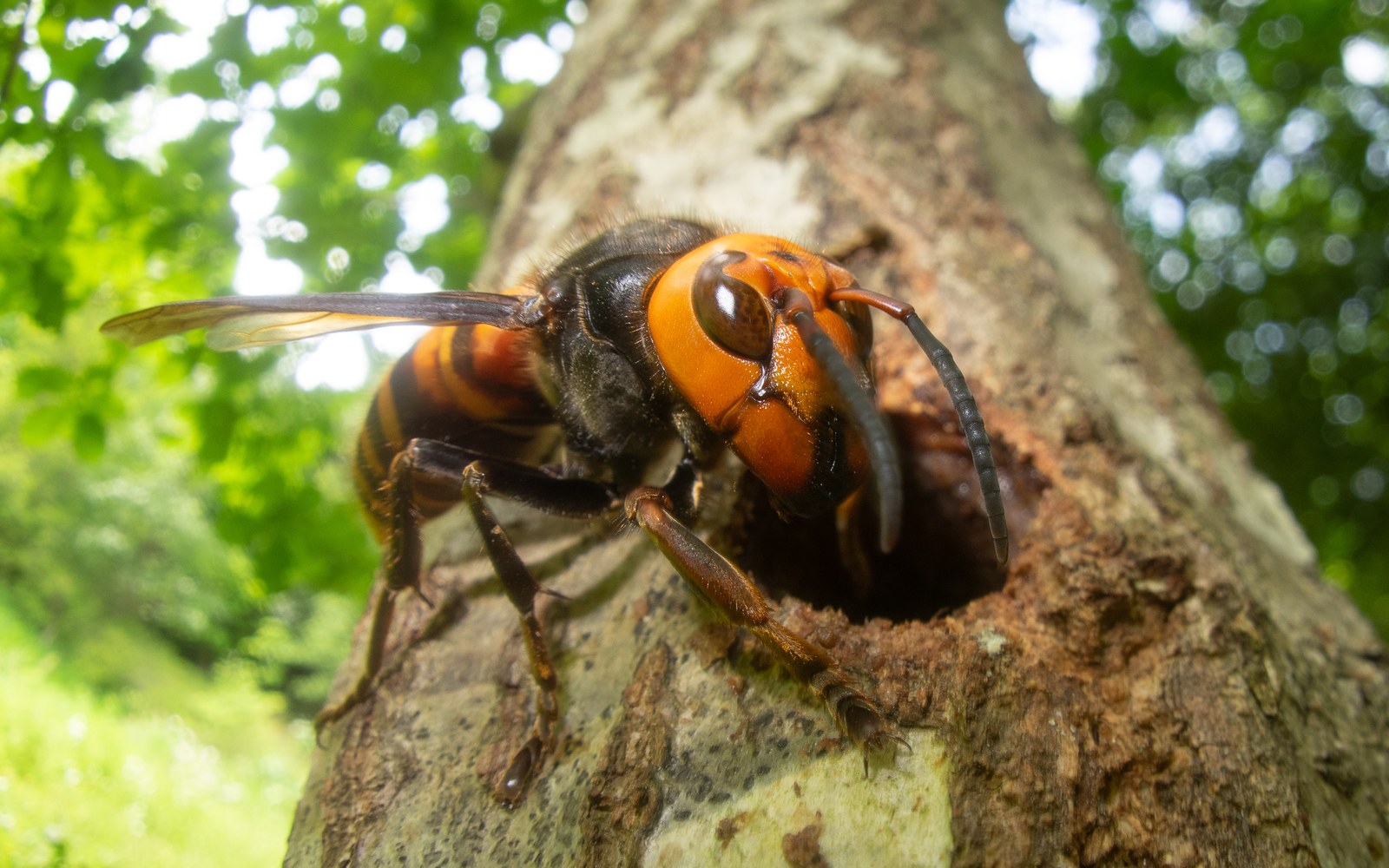
Species deep dive · northern giant hornet
Are "murder hornets" still in the US? No. On December 18, 2024, the Washington State Department of Agriculture (WSDA) and the USDA declared the Northern Giant Hornet (Vespa mandarinia), the insect headlines called the "murder hornet", eradicated from Washington and the United States after three straight years without a confirmed detection (WSDA; USDA APHIS). In its native East Asia it is a common, natural part of forest life.
How it arrived, and how it was beaten
The hornet was first found in North America in British Columbia in August 2019 and confirmed in Washington in December 2019. DNA suggests these were two separate introductions from different countries (WSDA news release). In October 2020 WSDA tracked a radio-tagged hornet to the first US nest, inside a hollow dead alder. Crews in sting-proof suits sedated the colony with carbon dioxide and vacuumed it out (Washington Invasive Species Council). Three more nests followed in August and September 2021, all in alder cavities in Whatcom County. After that, trapping from 2022 through 2024 caught nothing (WSDA).
The world's largest hornet
Vespa mandarinia is the largest hornet species on Earth. Workers are about 1 to 1½ inches (2.5–3.8 cm) long, queens reach about 2 inches (5 cm), and the wingspan is about 3 inches. Females carry a stinger about ¼ inch (6 mm) long, while males have no sting (Utah State University Extension). Because the stinger is smooth, a single hornet can sting again and again (WSU Extension). Each colony starts in spring with one mated queen. New queens and males appear in autumn, the founding queen dies in late autumn, and only the newly mated queens survive the winter in the soil (Utah State University Extension).
The slaughter phase
These hornets hunt many insects, but in late summer honey bee colonies become their target because bee larvae and pupae make rich food for the next generation of hornet queens and males. Attacks run in three phases. In the hunting phase, single hornets pick off bees at the entrance. A scout then marks the hive with a pheromone from a gland at the tip of her abdomen and recruits nestmates for the slaughter phase, where groups of 2 to 50 hornets can kill a strong colony of 30,000–50,000 worker bees within a few hours. In the occupation phase, the hornets guard the captured hive and carry off its brood for 10–14 days (WSU Extension). Adult hornets chew the brood into a paste for their larvae, then drink an energy-rich liquid that the larvae give back (WSU Extension).
The bees that cook hornets alive
European honey bees have no answer to this; they rush out one by one and die. Japanese honey bees (Apis cerana japonica), which evolved alongside the hornet, recognise the hornet's marking pheromone. When a scout lands, several hundred workers engulf it in a tight "bee ball" and vibrate their flight muscles until the core reaches about 47 °C (117 °F) with high carbon dioxide. The bees hold the ball for about 20 minutes and can survive temperatures a few degrees above what kills the hornet. The defence costs them, though: it can kill about a quarter of the bees involved (Ono et al. 1995, Nature; WSU Extension). Later experiments found that the trapped hornet faces more than heat: the high CO₂ and humidity inside the ball lower its heat tolerance further (Sugahara et al. 2012, Zoological Science). By killing the scout, the bees stop the mass attack before it starts.
Why it's not called "murder hornet" anymore
In July 2022 the Entomological Society of America adopted "northern giant hornet" as the official common name. Its guidelines avoid fear-stoking names, and "Asian giant hornet" told readers nothing useful because all 22 hornet species in the genus Vespa are native or common in Asia. The closely related Vespa soror became the southern giant hornet (Entomological Society of America).
How the northern giant hornet plays in Wilder
In Wilder the Northern Giant Hornet is a Cost 4 Insecta Air Uncommon (ATK 3 / HP 4) with Swarm and the ability Hive Raid (cost 2: deal 1 damage to an enemy). Its flavor text, "Raids entire hives.", nods to the slaughter phase, and Swarm reflects a hornet that turns one scout into a raiding party.
Play Wilder free in your browser. It's a free browser collectible card game, and no signup is needed.
Photo credit
Hero photograph: Yasunori Koide, "Queen of Japanese giant hornet, Vespa mandarinia japonica" (Wikimedia Commons), CC BY-SA 4.0. Cropped for the Field Journal hero.

Questions people ask
Can a murder hornet sting kill you?
Rarely, but yes. WSU Extension says stings can trigger anaphylaxis in allergic people and can occasionally kill people who are not allergic if they receive enough venom, though this is rare even where the hornet is native. Hornets are not aggressive away from the nest but defend it fiercely; if you stumble on a nest, leave and report it (WSU Extension).
Can a northern giant hornet sting through a bee suit?
Yes. The stinger is about a quarter inch (6 mm) long and can get through a standard beekeeper's suit or coveralls, so professionals removing nests wear double layers of smooth, slippery fabric plus face protection, since the hornets can also spray venom (WSU Extension).
What is the difference between the northern giant hornet and the yellow-legged hornet?
They are different species. The northern giant hornet (Vespa mandarinia) is the world's largest hornet and was eradicated from the US in 2024. The yellow-legged hornet (Vespa velutina) has spread through Europe, causing up to 30% losses of hives and honey, was detected in Georgia and South Carolina in 2023, and one was photographed at the Port of Vancouver, Washington, in April 2026 (WSDA).
Are there any native hornets in North America?
No. No true hornets (genus Vespa) are native to North America. The European hornet (Vespa crabro) was introduced and is now well established in much of the eastern US, but it is not a major threat to honey bees (WSU Extension; WSDA).
How fast can a northern giant hornet fly?
Reportedly up to about 25 mph (40 km/h), which is why WSU Extension advises weaving around trees and getting into a car or building rather than trying to outrun an attack (WSU Extension). See the Northern Giant Hornet card.
Sources
- Hornets: northern giant hornet eradicated (Washington State Department of Agriculture)
- WSDA news release: eradication of northern giant hornet (Dec 18, 2024)
- Victory over the world's largest hornet species (USDA APHIS)
- Northern giant hornet accomplishment (Washington Invasive Species Council)
- The Asian Giant Hornet: What the Public and Beekeepers Need to Know (WSU Extension)
- Asian Giant Hornet (a.k.a. Northern Giant Hornet) fact sheet (Utah State University Extension)
- Unusual thermal defence by a honeybee against mass attack by hornets (Ono et al. 1995, Nature)
- Differences in heat sensitivity between Japanese honeybees and hornets under high CO2 and humidity inside bee balls (Zoological Science 2012)
- 'Northern Giant Hornet' adopted as common name (Entomological Society of America, 2022)
- 20200512-P1090983 Vespa mandarinia japonica (Wikimedia Commons)