Why Is It Called a White Rhino? The Grey Grazer Behind the Name
Species deep dive · white rhinoceros
Why is the white rhino called "white"? Nobody knows for sure, and it has nothing to do with colour. The White Rhinoceros (Ceratotherium simum) is grey, just like the black rhino, and usually ends up the colour of whatever mud it last rolled in (Save the Rhino). The story you will hear on safari is that Dutch or Afrikaans settlers called it wijd ("wide") for its broad mouth and English speakers misheard it as "white". When rhino historian Kees Rookmaaker went looking for evidence in 2003, though, he found no 18th- or 19th-century Dutch, Afrikaans or English source that calls the animal "wide" (Rookmaaker 2003, Pachyderm; Rhino Resource Center).
What it was called before "white"
William Burchell described the species for science in 1817 without giving it a common name. Through the 1820s and 1830s it was known as "Burchell's rhinoceros" or the "flat-nosed rhinoceros", and "white" and "black" only settled into regular use from the 1830s on (Rhino Resource Center). The scientific name is more honest: Ceratotherium means "horn beast" and simum comes from the Greek for "flat-nosed" (International Rhino Foundation). Its other common name, the square-lipped rhinoceros, gets closest to the truth.
A lawnmower with horns
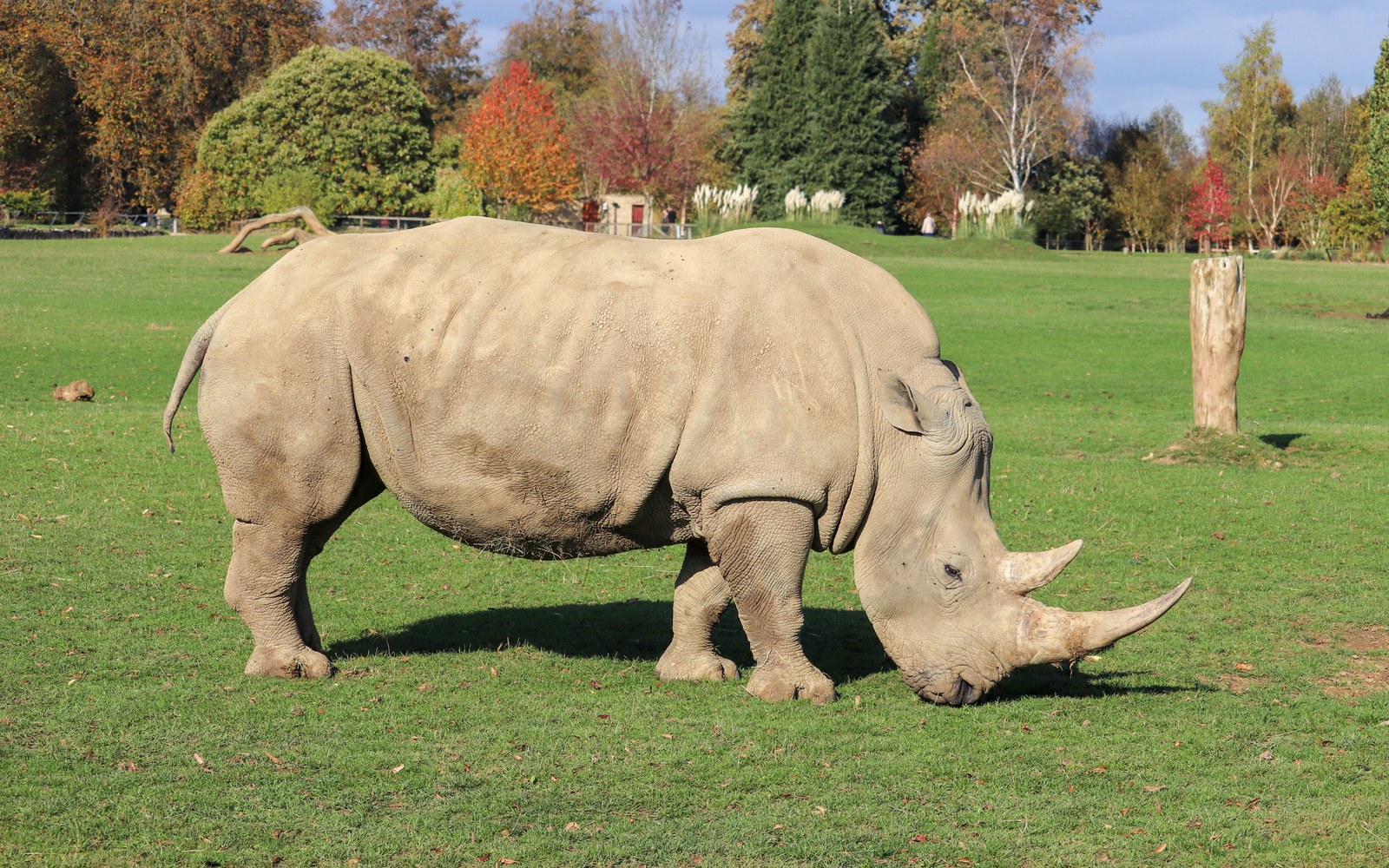
That square lip is the real field mark. White rhinos are grazers: the wide, flat upper lip crops short grass close to the ground, while the black rhino is a browser that plucks leaves and twigs (International Rhino Foundation; Save the Rhino). A white rhino spends much of the day with its huge head hanging low, and the neck muscles that hold it up give the animal its pronounced hump. It is the larger of Africa's two rhinos: adult males weigh 1,800–2,500 kg and stand 1.5–1.8 m at the shoulder (Save the Rhino). The front horn has been measured at up to about 2 m (79 in). Like all rhino horn it is compressed keratin, the stuff of fingernails, and it grows back if broken. Despite the bulk, a white rhino can run at up to 40 km/h in short bursts (International Rhino Foundation; Save the Rhino).
Grazing this hard shapes the landscape. When African Parks moved southern white rhinos into Garamba National Park in the Democratic Republic of the Congo, the team saw shorter grazing lawns spreading around them, and buffalo, giraffe, kob, warthog and oribi moving in to use them (African Parks).
Crashes, middens and calves out front
White rhinos are semi-social. Adult bulls are mostly solitary and hold small territories that average 1–3 km², while cows usually move with their latest calf and often team up with other females. Stable groups of up to six are called crashes. Everyone leaves dung at shared heaps, or middens, along territory borders, but only the territorial bull scatters his with ritual kicks and marks the boundary with sprays of urine. A calf stays with its mother for about three years and usually walks in front of her (Save the Rhino).
From fewer than 100 to 21,000, and back down
The southern white rhino is one of conservation's great comebacks. Fewer than 100 were left in the early 1900s; by the end of 2012 there were more than 21,000. Then their large numbers made them poachers' main target, and numbers fell 24% to about 15,942 by 2021 (International Rhino Foundation). The latest IUCN count puts Africa's white rhinos at 15,752 at the end of 2024, down 11.2% in a single year and the lowest since 2007. The experts blame a mix of poaching in Namibia and South Africa, management problems, missing surveys and possibly earlier overestimates. Poaching itself took 2.15% of Africa's rhinos in 2024, the lowest rate since 2011 (IUCN; CITES CoP20 rhino report). Another 1,299 white rhinos live in zoos and other facilities outside Africa.
The northern white rhino is a different story. Only two remain, both females, at Ol Pejeta Conservancy in Kenya (Save the Rhino). The BioRescue team has transferred lab-made northern white embryos into southern white surrogate mothers six times as of April 2026, and none has yet led to a lasting pregnancy, so two more proven surrogate females have joined the programme (BioRescue).
2026: rhinos on the move
In September 2023 African Parks took over the world's largest captive breeding operation for southern white rhinos, with a ten-year plan to rewild all 2,000 animals. Three years in, 745 rhinos have gone to 19 protected areas in South Africa, Rwanda, the DRC and Uganda, covering more than 551,000 hectares. 89 calves have been born in the new populations and 61 rhinos have died (African Parks). The biggest single move sent 70 rhinos about 3,400 km by road and air to Akagera National Park in Rwanda in June 2025, and Akagera now has just over 100 white rhinos. Garamba, where northern white rhinos once lived, now holds more than 60 southern whites.
How the white rhino plays in Wilder
In Wilder the White Rhinoceros is a Cost 6 Mammalia Grassland Rare with ATK 4 / HP 10 and the keywords Resilient and Guardian. Its flavor text reads "Horn-first diplomacy at its finest." Guardian means enemies must attack it before your other creatures or your Den, which suits a two-tonne grazer that stands its ground. For more African giants, read our pieces on the hippopotamus and the African bush elephant.
Play Wilder free in your browser. It's a free browser collectible card game, and no signup is needed.
Photo credit
Hero photograph: Vauxford, "Adult White Rhinoceros (Ceratotherium simum simum) (CWPG)" (Wikimedia Commons), CC BY-SA 4.0. Cropped for the Field Journal hero.

Questions people ask
How long do white rhinos live?
Roughly 35–40 years, and up to about 50. The International Rhino Foundation gives a lifespan of 35–40 years, and Save the Rhino says white rhinos can live up to 50 (International Rhino Foundation; Save the Rhino). Females reach maturity at about 6–7 years and males at 10–12.
Are white rhinos endangered?
Not officially, but they are Near Threatened. The IUCN Red List classes the white rhino as Near Threatened, while the black rhino is Critically Endangered (IUCN). The northern white rhino subspecies is functionally extinct, with only two females left (International Rhino Foundation).
Which countries do white rhinos live in?
Mostly South Africa. Just five countries hold 99% of Africa's white rhinos, the vast majority in South Africa (International Rhino Foundation). Save the Rhino lists Angola, Botswana, DRC, Eswatini, Kenya, Mozambique, Namibia, Rwanda, South Africa, Uganda, Zambia and Zimbabwe as range countries (Save the Rhino). See the White Rhinoceros card.
Can white rhinos see well?
No, their eyesight is poor. Rhinos make up for it with a keen sense of smell and sharp hearing (International Rhino Foundation; Save the Rhino).
How long is a white rhino pregnant?
About 16 months. Zoo records range from 480 to 548 days. Calves weigh 40–60 kg at birth, stand within an hour, start grazing at about two months and are weaned at around a year, and a mother usually calves every 3–4 years (Save the Rhino).
Sources
- Why the name of the white rhinoceros is not appropriate (Rookmaaker 2003, Pachyderm 34)
- Nobody knows why the white rhino is called 'white' (Rhino Resource Center)
- White rhino (Save the Rhino International)
- White rhino (International Rhino Foundation)
- Poaching of African rhinos down, but drought and other threats drive losses globally (IUCN press release, 2025)
- African and Asian Rhinoceroses: Status, Conservation and Trade (CITES CoP20 Doc. 84, IUCN SSC AfRSG/AsRSG and TRAFFIC)
- Rhino Rewild: Three Years In (African Parks, 2026)
- New embryo boosts survival chances for the Northern White Rhino (BioRescue, April 2026)
- Adult White Rhinoceros (Ceratotherium simum simum) (CWPG) (Wikimedia Commons)